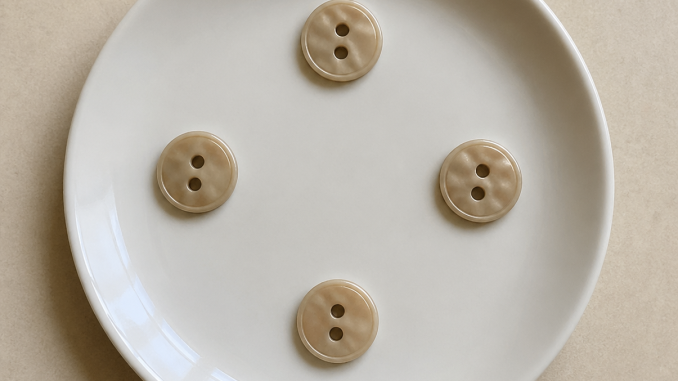
Most people answer quickly. They notice the four larger shapes and assume the answer must be four. Others take a second look and realize each of those shapes contains smaller circles inside, so they adjust their answer. What makes this puzzle interesting is not the difficulty of counting, but how easily the brain stops searching once it thinks it has found a pattern.
This type of visual challenge plays on attention and perception. Our minds are trained to simplify what we see. When objects are grouped together, we often treat them as a single unit instead of examining every detail within them. In this case, the four button-like shapes are seen as four objects, even though each one is made up of multiple circular elements.
If you look more carefully, each of the four inner shapes contains two small circles. That already increases the count beyond the obvious. But the puzzle does not stop there. Each of those shapes also has its own outer circular boundary. And beyond all of them, there is one large circle that encloses the entire arrangement.
This is where the challenge becomes more interesting. It is not just about counting what stands out, but also about noticing every layer: the small details, the outlines, and the overall structure.
To solve it correctly, you need to break the image down step by step.
There are four groups inside the plate. Each group contains two small circles, giving a total of eight small circles. Around each pair, there is one larger circle, adding four more. Finally, there is the big outer circle that surrounds everything.
When all of these are counted together, the total becomes clear.
The correct answer is 13 circles.