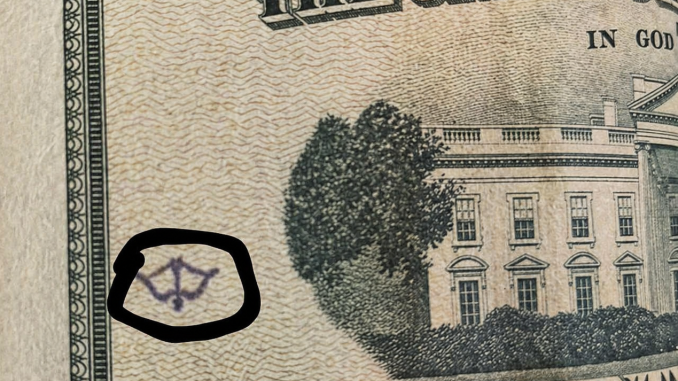
If you’ve ever taken a closer look at a U.S. dollar bill, you might have noticed something unusual—a small symbol, initials, or even what looks like a bow and arrow. These markings are known as chop marks, and they tell a surprisingly interesting story about global trade, trust, and how money moves around the world.
While most people think of U.S. currency as something used mainly within the United States, many bills actually travel far beyond its borders. Along the way, they can pick up these tiny stamps, which serve as proof that the bill has been checked and accepted in different parts of the world.
What Are Chop Marks?
Chop marks are small stamps placed on U.S. bills, commonly seen in regions like Southeast Asia, Africa, and Latin America. They are added by money changers, merchants, or currency handlers as a way to confirm that a bill is genuine.
In simple terms, a chop mark means: “This bill has been checked and is considered real.”
In places where counterfeit money is more common, this kind of visible verification helps people trust the cash they receive during everyday transactions.
One of the more recognizable versions is the small bow and arrow symbol sometimes seen on a $20 bill.
Where Did This Practice Come From?
The idea of chop marks goes back centuries, especially to China. In the past, merchants used to stamp silver coins to prove their authenticity and weight. These stamps became a trusted system—each mark showed that someone had verified the coin.
Over time, this tradition expanded to paper money, including U.S. dollars. Since the U.S. dollar is widely used around the world, it naturally became part of this system of verification.
In regions where banking systems may not be as strong—or where fake bills are a concern—these marks became a practical solution.
Why Are Chop Marks Used?
Money changers and traders rely on chop marks for a few key reasons:
1. Confirming Authenticity
Once a bill is checked and confirmed to be real, it gets stamped. This shows others that it has already been verified.
2. Tracking Movement
As a bill passes through different hands and markets, the marks can hint at its journey through various locations.
3. Building Trust
In places without strong financial infrastructure, these marks help create confidence. A stamped bill is often easier to accept than one that hasn’t been marked.
What Do They Look Like?
Chop marks are usually small and simple so they don’t interfere with the bill’s design or security features. They’re often stamped using ink in colors like blue, black, or red.
Common designs include:
- Arrows, stars, or birds
- Letters or initials
- Geometric shapes
- Symbols like the bow and arrow
The design often depends on the person or region applying the mark.
Are Chop Marks Legal?
Technically, U.S. law does not allow currency to be damaged in a way that affects its value. However, small marks like these are generally tolerated as long as they don’t interfere with the bill’s usability.
That said, if a bill is heavily marked or damaged, banks or machines might refuse to accept it.
A Hidden Story in Your Wallet
A bill with a chop mark is more than just money—it’s a record of where it has been. It may have passed through markets in different countries, handled by countless people along the way.
Each mark represents a moment of trust, a quick verification in a place where certainty matters.
What It Says About the U.S. Dollar
The widespread use of chop marks highlights something important: the global role of the U.S. dollar. In many parts of the world, it’s not just foreign currency—it’s a trusted form of payment used for trade, savings, and daily life.
Because of that, people go the extra step to verify it—and chop marks are part of that process.
Conclusion
At first glance, a small bow and arrow or any other symbol on a dollar bill might seem random. But in reality, it represents a long tradition tied to global commerce and trust.
Chop marks remind us that money doesn’t stay in one place. It moves, it circulates, and it connects economies across the world.
So the next time you spot a marked bill, remember—it may have traveled much farther than you think, carrying with it a quiet story of exchange, verification, and global connection.