Sometimes, the most interesting discoveries aren’t large monuments or famous landmarks. Instead, they’re small, easily overlooked objects that most people would walk past without a second thought.
Picture yourself walking along an old trail in the woods. The path looks ordinary—just a worn stretch of dirt and gravel. Trees lean overhead, leaves gather in shallow grooves, and birds move quietly through the branches.
Then, just off the side of the trail, something catches your attention.
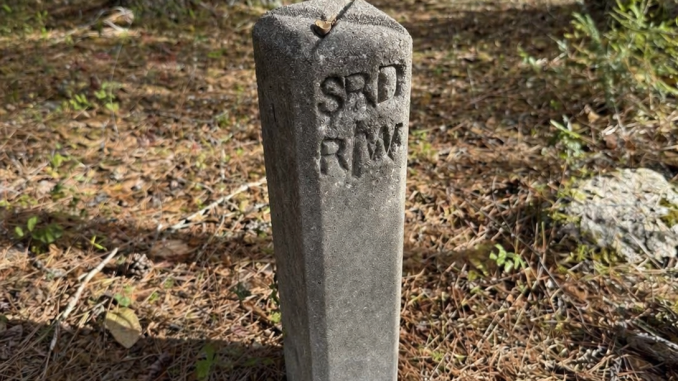
A small concrete post stands among the weeds. About knee-high, weathered by years of rain and sun, it doesn’t seem important at first. Just a simple block—maybe with faint markings or letters.
But that small object might be holding an entire story.
These posts are often remnants of State Road Department right-of-way markers. While they may seem ordinary, they carry surprising historical value. They are silent witnesses to roads that once connected communities, carried travelers, and shaped the land—long before nature reclaimed it.
The Quiet Excitement of Hidden History
For those who enjoy exploring old railways, forest trails, or abandoned roads, moments like this are unforgettable.
You begin your walk expecting nothing unusual—just a peaceful escape into nature. But then you notice something small and mysterious, and suddenly everything changes.
That concrete post is no longer just an object.
It becomes a clue.
A sign that something once existed here.
Explorers often describe this as a shift in perspective. The forest stops feeling random and begins to reveal patterns left behind by people.
Old infrastructure rarely disappears completely. Even after decades, subtle traces remain:
- A ridge that looks too straight
- A smooth dip in the ground
- Bits of gravel hidden in the soil
- And sometimes, a single concrete marker
Each one quietly marking something that once mattered.
What Is a Right-of-Way Marker?
That small concrete post is often a State Road Department (SRD) right-of-way marker.
The letters “R/W” usually stand for “Right of Way.”
This refers to the strip of land legally reserved for a road or transportation route.
When roads are planned, engineers and surveyors define exact boundaries. These markers were placed to show where the road’s limits were.
Concrete became the ideal material—cheap, durable, and resistant to weather.
Even when the road itself disappears, the markers often remain exactly where they were placed decades ago.
Why These Markers Matter
At first glance, they may seem unimportant.
But for historians, surveyors, and curious explorers, they reveal a lot.
Their presence confirms that the land was once carefully measured and officially used for transportation.
This wasn’t just a random path—it was a real road.
At some point:
- Engineers planned it
- Surveyors measured it
- Workers built it
That small marker represents an entire chapter of infrastructure history.
How Roads Slowly Disappear
One of the most fascinating things about these markers is that they often outlast the roads themselves.
Roads can vanish faster than we think.
Once traffic stops and maintenance ends:
- Grass grows through cracks
- Leaves cover the surface
- Plants take over
- Trees begin growing on the road itself
Within years, a once-busy road can turn into a quiet trail.
But the concrete markers remain.
They often become the last visible proof that a road ever existed.
Learning to Read the Landscape
Once you recognize these markers, you start seeing more clues around you.
The forest begins to tell a story:
- Raised ground may be an old roadbed
- Ditches could be old drainage systems
- Gravel patches show former road surfaces
- Curves in terrain reveal the path of the road
What once looked random suddenly becomes a carefully designed route.
Where You’ll Usually Find Them
These markers were placed along official roads, especially in key areas like:
- Curves
- Intersections
- Bridges
- Narrow sections
- Property boundaries
They helped ensure roads stayed within legal limits and didn’t cross into private land.
Small Objects, Big Stories
Big landmarks attract attention—but small objects tell deeper, quieter stories.
These markers were once ignored by passing drivers.
They were just part of the background.
But today, they’ve become meaningful.
They are pieces of a past that might otherwise be forgotten.
The Beauty of Everyday History
Not all history is dramatic.
Sometimes it’s about everyday life:
- Roads connecting small towns
- Farmers transporting goods
- Families traveling together
These simple things shaped communities.
Right-of-way markers are reminders of that ordinary—but important—history.
A Personal Connection
Finding one of these markers often sparks curiosity.
Standing beside it, you start imagining the past:
- Cars passing by
- Children riding bikes
- Travelers stopping nearby
The road is gone—but the story remains.
Built to Last
Concrete markers were made to endure.
Unlike wood or metal, they survive:
- Rain
- Snow
- Heat
- Decades of neglect
In many cases, they outlast everything else.
A Link Between Past and Present
These markers help us reconnect with history.
They show how transportation changed over time.
They remind us that landscapes are always evolving.
What looks like untouched nature today may have once been a busy road.
Why Discoveries Like This Matter
At first, it’s just a small piece of concrete.
But once you understand it, it becomes something more.
A clue.
A story.
A connection to the past.
For explorers, it transforms a simple walk into something meaningful.
Still Standing
That small concrete post is more than it seems.
It marks history, boundaries, and human activity that once shaped the land.
Even as the forest grows around it, it remains:
Quiet.
Unnoticed.
But full of meaning.
A Hidden Reminder
History doesn’t always disappear.
Sometimes, it simply waits to be found again.
A single marker beside a trail may represent a road once traveled by thousands.
Now it stands alone in the trees—
One small object.
One forgotten road.
One quiet reminder that the past is never truly gone.