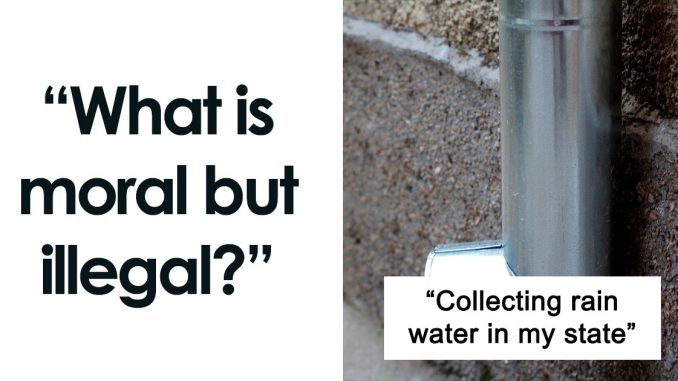
People often encounter tough moral choices in life. For example, should you tell the truth to a partner if it might hurt their feelings? In college, a friend might ask for help cheating to avoid failing a class and losing their scholarship. Or, you might see a coworker stealing, and reporting them could lead to their eviction. Life presents many complicated decisions, and ethics can be hard to define. However, laws are usually clearer, regardless of personal opinions.
Recently, a Reddit user known as Dr_vinci asked, “What is moral but illegal?” Many users responded with examples of strange laws that conflict with their sense of right and wrong. Below are some of the responses, along with an interview with Dr_vinci, for readers to consider whether these laws make sense.
In some places, euthanasia is illegal. A person shared how painful it was to watch a family member suffer without hope, raising the question of whether forcing them to endure such a state is truly moral.
Morality differs greatly among individuals. Most would be shocked if someone suggested harming their pet. Yet, opinions on animals like cows can vary. A farmer might see no issue with using cattle for food, while a vegan or a Hindu person might disagree. Morals can shift based on culture, time, and circumstances. Some psychologists argue that morality itself is an evolving trait. Dr. Jean Decety from the University of Chicago discussed how morality has developed over time through both genetics and culture. He noted that human brains are structured to care for others, respond to harm, and create rules for coexistence.
Abortion is another issue where legality varies across many regions.
Dr. Decety outlined three key pieces of evidence supporting the idea that humans are hardwired for morality. The first is that some non-human animals display moral behaviors. For instance, rodents and primates show a tendency to help each other in distress. Chimpanzees comfort each other after fights, and rats assist their fellow rodents before seeking food for themselves. While these animals may not have the same moral complexities as humans, their empathy suggests that morality has evolutionary roots.
In numerous countries, being part of the LGBT community is against the law, which raises questions about the morality of such legal restrictions.
Another example mentioned is retrieving discarded food from grocery store dumpsters, which is also illegal in some areas.
The second point Dr. Decety makes is that even infants show early signs of moral understanding. Research indicates that babies start forming social bonds before they turn one. Toddlers as young as 18 months can sense when their mothers are upset and try to comfort them. Remarkably, babies grasp the idea of fairness by their first birthday.
These varied examples invite reflection on the relationship between laws and personal morality. What do you think about these laws?
Sources:
Source: Bored Panda, by Bored Panda