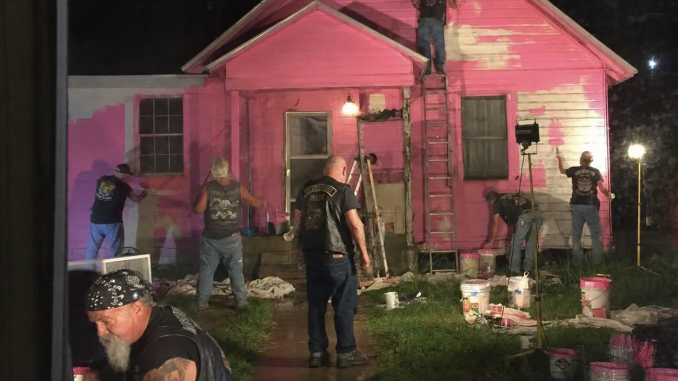
They were painting my late mother’s house bright pink at 4 a.m., and I had never seen any of them before.
There were nine bikers. Not one familiar face.
My mom passed away on a Tuesday after a long battle with pancreatic cancer. She was 67. I flew home from Seattle for the funeral and planned to stay only long enough to handle the paperwork, clean out the house, and put it on the market.
We hadn’t been close for years.
I hadn’t been back home in more than three years, and I expected to find an empty house that had slowly fallen apart.
I was right about one thing.
The paint was peeling. The gutters were hanging loose. The porch railing was rotting away. My mother had been sick for over a year, and I assumed she had no one to help her.
I couldn’t have been more wrong.
That first night, exhausted from unpacking boxes, I fell asleep on the living room couch.
Around 4 a.m., a scraping noise outside jolted me awake.
I looked through the window—and froze.
Motorcycles lined both sides of the street. Portable work lights illuminated the yard. Several men stood on ladders, carefully painting my mother’s house a bold, unmistakable shade of pink.
Not soft pink.
Not pastel.
Bright pink.
I rushed outside barefoot, still wearing my pajamas.
“What are you doing?” I demanded.
The tallest biker climbed down, wiped his hands on his jeans, and looked at me with gentle, tired eyes.
“You must be Claire,” he said.
I stared.
“How do you know my name?”
He smiled.
“Your mama talked about you every single day.”
His name was Walt.
He reached into his vest and carefully unfolded a piece of paper.
“She gave us this about eight months ago,” he said quietly. “Before she got too sick. She made us promise we’d finish every item.”
I recognized her handwriting instantly.
It was shaky, but unmistakably hers.
A handwritten list.
Twenty-three things.
The very first line read:
1. Paint the house pink. I always wanted it pink, but Ray said it looked trashy. Ray’s gone now, and so am I. Paint it pink.
I looked back at the men covering the old siding with fresh pink paint.
“Who are you?” I whispered.
Walt smiled.
“We’re the Monday Crew.”
He explained everything.
Eleven years earlier, his motorcycle had broken down near my mother’s house.
She had been sitting on the porch shelling peas.
Instead of being afraid of a biker covered in leather and patches, she simply asked,
“You look overheated. Want a glass of lemonade?”
He came back the next Monday.
This time with a friend.
She cooked lunch.
They repaired her porch steps.
The following Monday, more bikers showed up.
She served pot roast.
They fixed her garage roof and cleaned the yard.
Without anyone planning it, Monday became tradition.
Every Monday.
For eleven years.
She cooked.
They fixed whatever needed fixing.
No one ever missed.
“Even after she got sick?” I asked.
“When she couldn’t cook anymore,” Walt replied, “we brought the food instead. We still sat around the table every Monday.”
“She talked about you all the time.”
That hurt more than I expected.
By noon, the little house had transformed.
It stood proudly among rows of beige homes, bright pink and impossible to ignore.
It looked ridiculous.
It looked beautiful.
It looked exactly like my mother.
As the crew packed up, I stopped them.
“It’s Monday,” I said.
“Come inside. Let me make lunch.”
Nine bikers crowded around my mother’s kitchen table while I cooked rice and beans using the groceries she had carefully stocked before she died.
Every spice jar was labeled in her handwriting.
Everything was organized.
She had prepared the kitchen knowing someone would eventually need it.
During lunch, they told story after story.
How she convinced Danny to finally wear a motorcycle helmet.
How she mailed birthday cards—with five-dollar bills tucked inside—to their children every year.
How she never forgot a birthday.
Those tough, tattooed men laughed until tears filled their eyes.
“She changed after your dad passed away,” Walt said softly.
“She finally became the person she always wanted to be.”
I excused myself.
Locked myself in the bathroom.
And cried.
I had spent years holding onto old anger while my mother had quietly rebuilt an entirely new life.
Over the next nine days, the Monday Crew returned every morning.
Together we worked through every item on her list.
We planted rose bushes.
Repaired plumbing.
Built a bench beneath the old oak tree.
Returned library books that were years overdue.
Paid the late fees.
Slowly, her house—and my heart—began healing.
Then I found the attic.
Twelve shoeboxes.
One for every year since I moved away.
Inside were printouts of my social media posts.
Newspaper clippings about my promotions.
Birthday cards she never mailed.
Half-finished letters.
Little handwritten notes beside photos.
So proud of her.
She looks happy.
My beautiful girl.
She had watched my life from afar every single year.
She never stopped loving me.
Even when we barely spoke.
Twenty-two items on the list were complete.
Only one remained.
Number 23.
This one is for Claire.
If she comes home.
Inside my old bedroom closet, exactly where she described, sat a wooden box with a brass latch.
Inside were my grandmother’s ring and my mother’s wedding ring.
Along with one final letter.
She apologized for not leaving my father sooner.
For allowing our home to become a place I felt I had to escape.
She told me not to carry guilt for leaving.
“You had to save yourself,” she wrote.
“I stayed until I finally learned how to save myself.”
She wanted me to know she had not been alone.
The Monday Crew had become her family.
She loved me every day, even when I forgot birthdays, missed phone calls, or stayed away.
She never stopped.
Walt found me sitting beneath the oak tree holding that letter.
Neither of us spoke for a long time.
Finally, I whispered,
“She wanted me to know she wasn’t alone.”
“She wasn’t,” he answered.
“Because of you.”
He shook his head.
“No.”
“She’s the one who offered the lemonade.”
“She opened the door.”
“We just kept coming back.”
I slipped both rings onto my fingers.
They fit perfectly.
Then I looked at Walt.
“What’s everyone eating next Monday?”
He smiled.
“Your mama usually made pot roast.”
“I’ve never made pot roast.”
He laughed.
“I’ll teach you.”
“She taught me.”
That was six months ago.
I sold my apartment in Seattle.
I moved into the bright pink house.
Every Monday, the crew still comes over.
I cook lunch.
We gather around my mother’s table.
Afterward, everyone finds something small to repair—even though there’s nothing left that actually needs fixing.
Walt bakes the pie now using my mother’s recipe.
He still insists mine will be better one day.
Neighborhood kids sneak tomatoes from the garden.
I pretend not to notice.
People slow down when they drive past the bright pink house.
Some smile.
Some shake their heads.
I smile every single time I pull into the driveway.
My mother wanted a pink house.
She wanted rose bushes.
A bench beneath the oak tree.
A kitchen filled with laughter.
Most of all…
She wanted her daughter to come home.
She got every one of the twenty-three things on her list.
Sometimes, on Monday afternoons, when sunlight pours through the kitchen windows and laughter fills the room, I still feel her.
In the neatly labeled spice jars.
In the empty chair no one dares to sit in.
In the way Walt still says, “your mama,” instead of “your mother.”
She’s still here.
In every corner of this pink house.
And now…
So am I.
Finally.