I had already stopped believing in God when the bikers arrived.
I was on my knees in front of my son’s casket. Daniel was twenty-four years old. He came home in that box on a quiet Tuesday afternoon.
Across the road, there were voices—loud, cruel, relentless. Fifteen… maybe twenty people, holding signs that said my son was burning exactly where he belonged.
My husband, Earl, tried to cover my ears with his hands, but they were shaking too badly to block anything out. I remember thinking, this is the last thing Daniel will ever hear. Not his mother’s voice. Not “Taps.” Just hate.
I closed my eyes and asked God why. What had my boy done to deserve this, even in death?
The chaplain tried to speak, but every time he opened his mouth, the shouting grew louder, drowning him out completely.
Then I heard the engines.
At first, my heart sank even deeper. I thought more of them were coming. I thought it was about to get worse. I even prayed—right there—that the ground would open up and take me before it did.
Earl leaned closer and whispered, “Margaret… open your eyes.”
So I did.
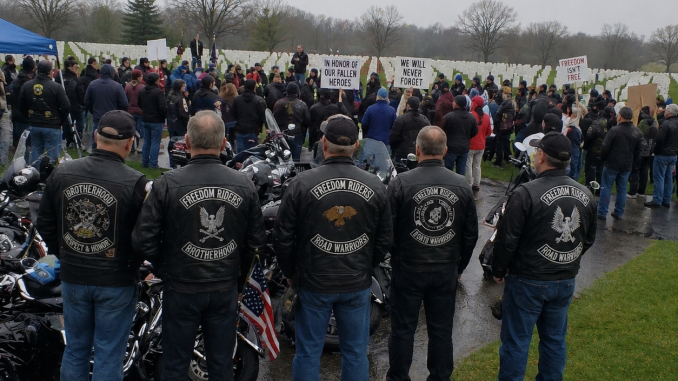
There were fifty bikers.
I counted them later, after seeing the news footage. Fifty men on Harleys, riding in two perfect lines through the cemetery gates.
Most of them had gray in their beards. Many carried American flags mounted to the backs of their bikes. They didn’t honk. They didn’t shout. They simply rode forward, straight toward us, and positioned themselves between our family and the protesters.
A living wall of leather and chrome.
One protester climbed onto a van, trying to shout over them. That’s when one of the bikers—an older man, about my age—walked calmly up to the fence.
He rested his hands on the rail and spoke.
Just a few quiet words.
I couldn’t hear everything from where I stood, but I saw the young man’s face change. I saw his mouth stop moving.
The biker never raised his voice. Not once. He spoke like a man stating something simple, something certain.
He told him he could scream whatever he wanted—but he would scream it at him, not at a grieving mother.
Something shifted in that moment.
The shouting didn’t stop immediately, but it weakened. The voices began to shake. The signs started lowering, one by one, as if the anger behind them had run out of strength.
For the first time that day, the chaplain was able to speak.
“If the family is ready,” he said softly.
I couldn’t talk, but I nodded.
And this time, when he began again, nobody drowned him out.
I don’t remember everything he said. Grief has a way of erasing parts of even the most important moments.
But I remember the bikers.
I remember that every time I looked up, they were still there—standing shoulder to shoulder along the fence, silent, steady, present.
One of them, a large man with a long gray ponytail, was crying. The tears ran straight into his beard, but he never wiped them away. He didn’t move at all.
When the honor guard folded the flag, every single biker removed his cap.
Fifty hands over fifty hearts.
When the bugler played “Taps,” the protesters were still there—but they were no longer shouting. They just stood and watched, as if they didn’t quite understand what they were seeing.
When the final note faded, a soldier stepped forward and handed me the flag.
“On behalf of the President of the United States, the United States Army, and a grateful nation…”
The flag felt heavier than I ever imagined.
No one ever tells you that.
Earl had to help me hold it.
I looked past the soldier and saw the older biker again. He gave me a small nod. Just one. Like he was telling me, you’re doing okay… keep going.
And somehow, I did.
After the service ended, I thought they would leave.
They didn’t.
They stayed, sitting quietly on their bikes, engines off, watching as the protesters slowly packed up and drove away without saying a word.
Only then did the bikers move.
I don’t know what pulled me there, but I found myself walking across the grass toward the fence, toward the older biker.
Up close, he looked even older—maybe seventy. His hands were weathered, marked with scars and sunspots. His eyes were pale blue, tired but kind.
His patch read: DOC.
“Ma’am,” he said, removing his cap.
I struggled to speak. “How… how did you know to come?”
He gave a small, sad smile.
“We have a list,” he said. “When someone like your boy comes home, someone calls us. And when we hear the other kind of people might show up… we make sure we get there first.”
“And you just come?” I asked.
“We just come.”
I held the folded flag tighter in my hands.
“What about your son?” I asked quietly.
“Michael,” he said. “2005. Iraq.”
There was a long silence between us.
Then he said something I will never forget.
“Do you want to know why we really come?”
I nodded.
“Because once… someone came for us.”
That was all.
And somehow, it meant everything