I never imagined that a brief moment from my teenage years would follow me for the rest of my life.
But one ordinary morning, it came back to me in a way I never could have expected.
I was 17 when I had my twin daughters.
At that age, I was broke, exhausted, and just trying to survive. I held onto school like it was the only thing that could save me. I was an honor student, but none of that mattered to my parents anymore.
They told me I had ruined everything.
Within days, I was on my own—with two newborns and nowhere to go.
By November 1998, my life had become a cycle of survival. I worked nights at the university library, took whatever small jobs I could find during the day, and tried to keep up with classes in between.
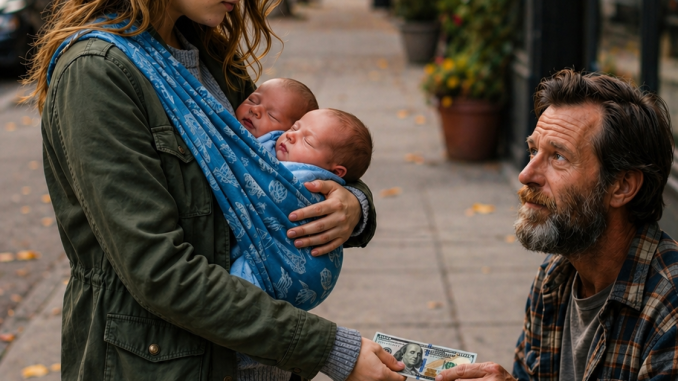
My daughters, Lily and Mae, were always close to me—wrapped against my chest in a worn sling I had bought secondhand.
Most days, I lived on instant noodles and cheap coffee.
There was no plan.
Only survival.
That night, the rain was pouring in Seattle as I left work.
I had exactly $10 in my pocket. It was everything I had—enough for bus fare and a few days of food if I stretched it carefully.
I pulled my umbrella close, adjusted the sling so my girls wouldn’t get wet, and started toward the bus stop.
That’s when I saw him.
An older man sat under a rusted awning across the street. His clothes were soaked through, and his hands were shaking so badly it hurt just to look at him.
He wasn’t asking for money.
He wasn’t even looking at anyone.
He was just… there.
Cold. Alone. Invisible.
And something in me wouldn’t let me walk away.
Before I could talk myself out of it, I crossed the street.
I reached into my pocket, pulled out the $10, and placed it gently in his hand.
“Please… get something warm,” I said.
He looked up then.
Really looked at me.
There was something in his eyes I couldn’t explain.
For some reason, I asked, “What’s your name?”
There was a pause before he answered.
“Arthur,” he said quietly.
“I’m Nora,” I replied. I even told him my last name. Then I leaned slightly so he could see my daughters.
“This is Lily… and Mae.”
He repeated my name softly.
“Nora.”
As if he didn’t want to forget it.
That night, I walked home.
Three miles.
In the rain.
By the time I got there, my shoes were soaked through, my hands were numb, and my wallet was empty.
I remember standing in my small apartment, staring at it.
Thinking I had made a mistake.
Thinking I couldn’t afford kindness.
The years that followed were not easy.
I worked afternoons at a diner, nights at the library, and slept whenever my daughters allowed me to.
Then one day, everything shifted—because of someone else.
Mrs. Greene lived in my building.
“You leave those babies with me when you have work,” she told me.
I tried to pay her.
She refused.
“You finish school,” she said. “That’s enough.”
So I did.
Slowly. One class at a time.
My daughters grew up in small apartments that gradually got a little better as life stabilized. Eventually, I found steady work doing administrative support for a small company.
It wasn’t easy.
But it was enough.
For a while.
Twenty-seven years passed.
I was 44.
My daughters were grown.
And then… life pulled me under again.
Mae got sick.
At first, it seemed manageable.
Then it wasn’t.
Doctor visits turned into procedures.
Procedures turned into bills.
And the bills never stopped.
I worked longer hours, took extra shifts, cut back on everything—but it still wasn’t enough.
I was drowning.
Again.
That morning, I sat at my desk staring at another overdue notice, trying to figure out what I could delay this time.
That’s when the door opened.
A man in a charcoal suit walked into the office and came straight toward me.
“Are you Nora?” he asked.
“Yes,” I said cautiously.
He placed a small, worn box on my desk.
“My name is Carter. I represent the estate of Arthur.”
My heart stopped.
Arthur.
The man from that rainy night.
I had never seen him again.
But I had never forgotten him either.
“He spent years trying to find you,” Carter continued. “He asked me to deliver this personally.”
My hands shook as I opened the box.
Inside was a worn leather notebook.
I flipped it open.
Every page had a date.
And next to each date—a short note.
The very first entry froze me in place.
“Nov. 12, 1998 — Girl named Nora. Two babies. Gave me $10. Don’t forget this.”
My vision blurred instantly.
I turned the page.
More entries.
More people.
Moments.
But my name kept appearing again and again.
“Never forget Nora.”
“Must find Nora and the girls.”
“I hope Nora is safe.”
I couldn’t speak.
Carter gently explained.
Arthur hadn’t always been homeless.
He once owned a small machining business. When it failed, he lost everything and drifted for years with no one to rely on.
But that night…
Meeting me had changed something in him.
“It was the first time in years someone treated him like he mattered,” Carter said.
Arthur started rebuilding his life slowly.
Small jobs.
Saving what he could.
Eventually, he found stable housing.
A small apartment.
He lived simply.
But every year, on the same date, he wrote one line in that notebook:
“Still looking for Nora.”
“How did he find me?” I asked quietly.
“Two years ago,” Carter said, “you posted a fundraiser online.”
My heart skipped.
Mae’s medical fundraiser.
“He recognized your name… and your daughters.”
Arthur had found me.
But by then… his health was failing.
So he did the only thing he could.
He made a will.
“Take another look inside the box,” Carter said.
I did.
There was a check.
I picked it up slowly.
And then I saw the number.
$62,000.
I stared at it, unable to breathe.
“This can’t be real,” I whispered.
“It is,” Carter said softly. “Every dollar he saved.”
I shook my head in disbelief.
“Why would he do this?”
Carter didn’t hesitate.
“He said it was never his money,” he replied. “He believed it belonged to the moment that changed his life.”
I broke down.
Not because of the amount.
But because of what it meant.
That $10 I thought I couldn’t afford…
had never disappeared.
It had stayed with him.
For nearly 30 years.
In the weeks that followed, everything changed.
For the first time in years, I wasn’t choosing which bill to delay.
I paid off Mae’s medical debt.
Watched the numbers finally go down to zero.
Mae continued her treatments—but now, there was breathing room.
And one day, I realized something I hadn’t felt in decades.
I was free.
A few days later, I went to visit someone.
Mrs. Greene.
She was older now, slower—but still the same.
We sat together, and I told her everything.
Then I placed an envelope in front of her.
“I never paid you back,” I said.
She smiled gently.
“You finished school,” she said. “That was the deal.”
I shook my head.
“You gave me more than that.”
She looked at me for a long moment… then finally took the envelope.
That night, I opened Arthur’s notebook again.
And for the first time, I turned to a blank page.
I picked up a pen.
And I started writing.
“April 3 — Paid Mrs. Greene back for helping me raise my daughters.”
It was simple.
But it meant everything.
Now, I keep my own list.
Not of money.
But of moments.
Helping someone with groceries.
Covering a bus fare.
Supporting someone quietly when they need it most.
I don’t tell anyone.
Because now I understand something I didn’t before.
It’s not about how much you give.
It’s about making someone feel seen.
A week later, I visited Arthur’s grave.
I stood there quietly.
Then I reached into my pocket.
Pulled out a ten-dollar bill.
And placed it gently on the stone.
“I found you too,” I whispered.
For years, I believed kindness was something I couldn’t afford.
I was wrong.
Because sometimes…
it doesn’t disappear.
It waits.
And when it comes back—
it changes everything.