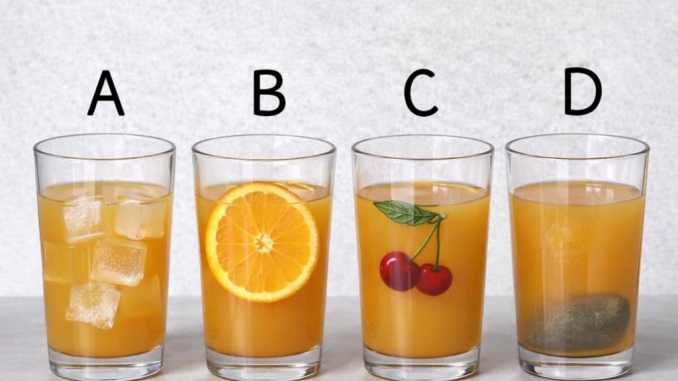
At first glance, this picture looks like one of those simple brain teasers that should take only a second to solve. Four glasses are shown, each apparently filled to a similar level with juice. But each glass also contains a different object: ice cubes in Glass A, an orange slice in Glass B, cherries in Glass C, and a large stone in Glass D.
The question seems easy:
Which glass contains more juice?
Most people answer too quickly because they focus on what they see at the top level of the liquid. Since the glasses appear to be filled to almost the same height, many assume they all hold roughly the same amount of juice. But that is exactly where the trick lies.
This puzzle is not really about the visible height of the liquid. It is about how much actual space inside each glass is being taken up by the object placed in it. The more space the object occupies, the less room there is left for juice.
So even if the liquid level looks similar in all four glasses, the real amount of juice is not the same.
Look Closely at Each Glass
Glass A contains several ice cubes. Those cubes take up a noticeable amount of space inside the glass. That means some of the volume that could have been filled with juice is instead occupied by the ice.
Glass B contains an orange slice. While it is only one object, it still takes up space inside the glass, especially because the slice is fairly wide.
Glass C contains two cherries with stems. Compared to the other objects, the cherries take up the least amount of space. They are small, compact, and displace less liquid.
Glass D contains a large stone. That stone clearly uses a significant amount of room at the bottom of the glass. Because of that, this glass cannot possibly contain the most juice.
Why the Liquid Level Can Be Misleading
This is where many people get confused. They look at the top line of the juice and assume the glass filled higher must have more liquid. But the liquid line rises when an object is added because the object pushes the liquid upward.
That means the object inside the glass is helping create the appearance of a fuller glass, even though some of the inside space is no longer available for juice.
In other words, the bigger the object, the less juice the glass can actually contain.
That is the key to solving the puzzle correctly.
The Logic Behind the Answer
Imagine taking the objects out of all four glasses while keeping the same liquid level idea in mind. The glass with the smallest object would have had the most room available for juice from the beginning.
Now compare the objects:
- The ice cubes in A take up a lot of room
- The orange slice in B takes up a moderate amount of room
- The cherries in C take up only a little room
- The stone in D takes up a lot of room
Because the cherries are the smallest objects overall, Glass C has the most actual juice.
Why Some People Might Choose A or D
Some might guess Glass A because ice can melt, but the question asks which glass contains more juice as shown in the image. At that moment, the ice cubes are still solid and still taking up space, so A does not have the most juice.
Others might guess Glass D because the stone sits at the bottom and the glass looks simple. But the stone is large and heavy, which means it displaces a large amount of liquid. That leaves less room for juice, not more.
That is why both A and D are incorrect.
Final Answer
The correct answer is: Glass C.
The cherries take up the least space, so Glass C contains the most juice.