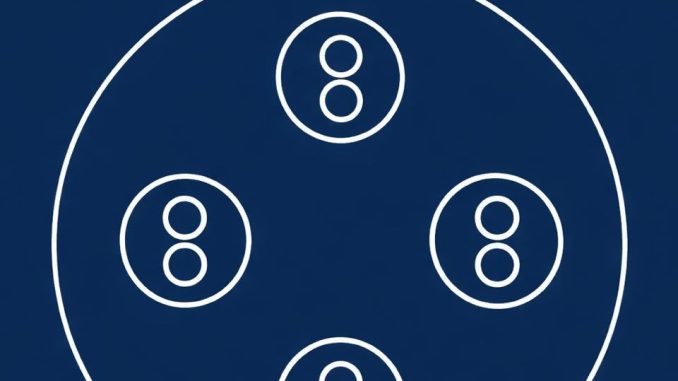
At first sight, this image seems very easy to solve. It presents a clean black-and-white design with one large outer circle and four smaller circular figures placed inside it. Because the arrangement is neat and symmetrical, many viewers assume the answer can be found immediately. However, this type of visual puzzle is designed to test attention to detail rather than mathematical ability. What makes it interesting is that the brain often groups shapes together too quickly, especially when they resemble familiar symbols.
The challenge comes from the fact that each of the four inner figures contains two smaller circles arranged one above the other. Because these two circles resemble the shape of the number eight, many people unconsciously stop counting them as separate parts. Instead, they view each pair as one complete symbol. That is the trick of the image. It relies on the speed of visual perception and on the tendency to simplify what we see.
To solve the puzzle correctly, the image must be examined slowly and in parts.
First, there is the one large outer circle that surrounds the entire figure. This is the biggest and most obvious circle in the picture.
Second, inside that outer circle there are four medium circles. One is positioned near the top, one near the bottom, one on the left side, and one on the right side. These circles are easy to identify once attention shifts from the overall shape to the internal arrangement.
Third, inside each of those four medium circles, there are two smaller circles. Since there are four medium circles and each contains two smaller ones, that gives a total of eight small circles.
Now the count can be added carefully:
- 1 outer circle
- 4 medium circles
- 8 small circles
When all of them are combined, the complete total is:
1 + 4 + 8 = 13
This puzzle is effective because it looks much simpler than it actually is. Many viewers rush to answer and miss part of the structure. Some count only the large outer circle and the four medium ones, arriving at five. Others notice the smaller circles but still make a mistake because they count the “8” shapes as one object instead of two separate circles. The real solution only becomes clear when every circular outline is counted individually.
In this way, the image is not only a puzzle but also a reminder of how easily the human mind can be influenced by appearance. When something looks familiar, the brain often stops observing and starts assuming. That is why simple visual challenges like this attract so much attention. They are less about difficulty and more about patience, focus, and careful observation.
A person who takes time to inspect each part of the image will arrive at the correct conclusion. The puzzle rewards those who do not rush and who are willing to look beyond the first impression.
Final Answer: 13 circles.