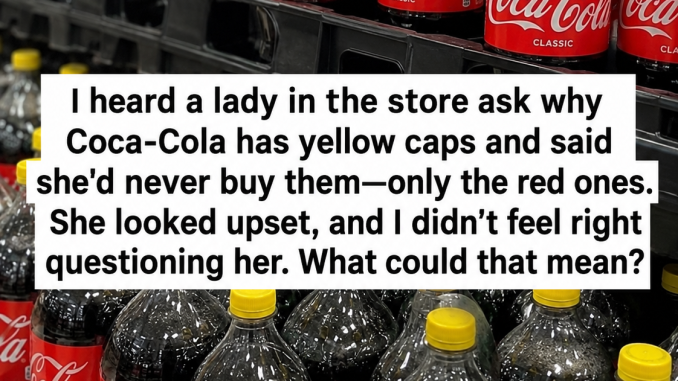
You’re walking through the grocery store, grabbing your usual Coke, when suddenly something catches your eye. The bottle cap is yellow instead of the classic red. Not black. Not holiday-themed. Just bright yellow.
At first glance, it seems random. Maybe a seasonal promotion or a limited-edition design. But the truth behind those yellow caps is much more interesting—and surprisingly meaningful.
Coca-Cola has been around since the late 1800s, and after all these years the company rarely changes its iconic design without a reason. So when the familiar red cap suddenly becomes yellow, there’s always a purpose behind it.
And in this case, the reason is connected to tradition, religion, and even the type of sugar used inside the bottle.
The yellow caps appear during Passover, an important Jewish holiday celebrated every spring. During Passover, many Jewish families avoid foods and ingredients considered non-kosher for the holiday. One of those ingredients is corn and corn-based products.
Regular Coca-Cola in the United States is sweetened with high-fructose corn syrup, which makes it unsuitable for many people observing Passover traditions.
So Coca-Cola makes a special version specifically for the holiday.
Instead of corn syrup, the Passover version uses real cane sugar. To help shoppers identify it quickly, Coca-Cola replaces the traditional red cap with a yellow one.
That small color change is actually a quiet signal that the drink inside follows Passover dietary guidelines.
Interestingly, many people who buy yellow-cap Coke aren’t even purchasing it for religious reasons. Some simply prefer the taste. Since it uses cane sugar instead of corn syrup, fans often describe it as smoother, cleaner, or more similar to the famous “Mexican Coke” flavor.
And despite being a specialty version, Coca-Cola usually sells it for the same price as regular Coke, which many people appreciate.
You’ll mostly spot yellow-cap Coke in areas with larger Jewish communities, especially around cities like New York, Chicago, Miami, and Los Angeles. It typically appears a few weeks before Passover and quietly disappears once the holiday season ends.
For some shoppers, the yellow cap is just another bottle design.
For others, it represents something more thoughtful—a small adjustment made so a tradition can still be honored without giving up something familiar.
So the next time you see a yellow Coca-Cola cap on the shelf, you’ll know it’s not a mistake or a marketing gimmick.
It’s a subtle symbol of inclusion, tradition, and one very specific recipe hiding inside an ordinary bottle of Coke.