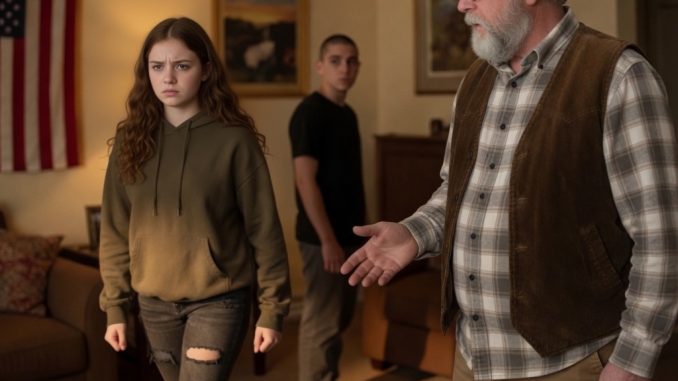
So I stopped calling them.
Growing up as the second daughter in the Martinez family meant learning how to live in someone else’s shadow. My older sister, Veronica, was the golden child from the beginning. Everything she did was celebrated. Every little achievement became proof that she was destined for something great.
And me?
I was always compared to her.
Veronica walked early. I walked late. Veronica made honor roll. I brought home mostly B’s, and my father acted like I had personally embarrassed him. Veronica played volleyball, and my dad never missed a game. I joined art club, and my mom forgot to pick me up so many times that my teacher started driving me home.
By the time I was old enough to understand what favoritism was, I had already been living inside it for years.
When Veronica turned sixteen, they bought her a car. When I turned sixteen, they took me to dinner and gave me a $50 gift card. My mother said I should be grateful they remembered, because things had been “so busy” with Veronica’s college applications.
College made everything worse.
Veronica got into UCLA, and my parents proudly paid whatever her scholarship didn’t cover. They threw her a big party, invited relatives, friends, and coworkers, and talked about her like she was proof they had done everything right as parents.
Two years later, I got accepted into a state school.
It wasn’t UCLA, but it was still college. It was still my future. I sat at the dinner table with my acceptance letter, hoping—just once—that they would be proud of me.
My father barely looked up from his plate.
“We’re not paying for that,” he said.
I thought I had heard him wrong.
“You paid for Veronica,” I said.
My mother gave me that calm, fake-sweet voice she always used when she wanted to make cruelty sound reasonable.
“Veronica earned her place at a prestigious school. You’re going to a state school. That’s different.”
Different.
That word followed me for years.
I took out student loans for every dollar. I worked two jobs through college—one at the campus library and another waiting tables at a diner that smelled like burnt coffee. I studied when I could, slept when my body finally gave out, and still managed to graduate.
My parents didn’t come.
They said the drive was too long for “just a state school graduation.”
But by then, I had already learned not to expect them to show up.
The real breaking point came later, at a family dinner I never should have attended.
Veronica called during dinner, glowing with excitement. She and her boyfriend had found the perfect house. Three bedrooms. A beautiful kitchen. A good neighborhood. The only problem was the down payment.
“We’re just a little short,” she said.
My father’s face softened in a way I had spent my whole life trying to earn.
“How much do you need, sweetheart?” he asked.
“One hundred thousand would make it comfortable,” Veronica said.
My parents looked at each other.
Then my dad nodded.
“Consider it done. We’ll wire it tomorrow.”
My fork slipped from my hand.
“You’re giving her $100,000?” I asked.
My mother corrected me immediately.
“We’re investing in her future.”
Something inside me finally cracked.
“You wouldn’t give me $30,000 for college,” I said. “But you’ll give her $100,000 for a house?”
My father looked at me with cold disappointment.
“Veronica has proven herself. She’s responsible. She’s building something. Look at you. You’re twenty-six, working freelance jobs, living in that awful apartment. You’ve accomplished nothing.”
Then he said the words I would never forget.
“You’re the failure of this family.”
Nobody defended me.
Not my mother.
Not Veronica.
Nobody.
I stood up from the table.
My mother told me to sit down, that I was being dramatic.
But I was done.
I walked out of that house and never looked back.
For the first few months, no contact felt strange. Painful, even. I kept reaching for my phone out of habit. Sundays were the worst, because that had always been the day I forced myself to call them.
Then slowly, the silence became peaceful.
I stopped hearing their voices every day. I stopped measuring my worth by their disappointment. I focused on work. I took every project I could find. I improved my design skills, learned UX, branding, motion graphics—anything that could help me grow.
Eventually, a tech company hired me full-time as a senior designer.
The salary changed my life.
I didn’t waste it. I invested. I paid down debt. I saved aggressively. I kept living below my means because I knew one thing clearly: nobody was coming to rescue me. Everything I built had to come from me.
A few years later, I found land.
Forty acres in Sonoma County. Rolling hills, oak trees, a seasonal creek, an old farmhouse, and several broken-down outbuildings. Most people saw problems.
I saw freedom.
I bought it, renovated the farmhouse, and started planting lavender. At first, it was just a dream. Then it became a business. I added beehives, goats, a processing barn, and an online store. I sold dried lavender, oils, honey, and handmade products.
The work was exhausting.
But for the first time in my life, I was tired from building something that belonged to me—not from trying to earn love from people who had already decided I wasn’t worth it.
Two years passed without my family knowing anything about my life.
Then one afternoon, my phone rang from an unknown number.
It was my dad.
His voice sounded different. Not angry. Not confident.
Shaken.
“Your sister drove past your property,” he said.
I froze.
Apparently, Veronica had been in the area for a wine tasting, taken a wrong turn, and spotted my truck outside a renovated farmhouse surrounded by lavender fields. Then she looked up the property records.
Forty acres.
My name.
A property worth over two million dollars.
There was a long silence before my father finally asked, “How?”
I almost laughed.
“Hard work,” I said. “Smart investing. Everything you said I wasn’t capable of.”
Suddenly, they wanted to talk.
Suddenly, they wanted to visit.
Suddenly, they wanted to be a family again.
My mother got on the phone and said Veronica had been crying all night. My sister said she never meant to hurt me and didn’t realize how differently our parents had treated us.
But she knew.
They all knew.
They had watched me struggle. They had watched me drown in loans. They had watched me work myself sick. They had watched me beg for support and receive nothing but criticism.
They only cared when they realized I had built something they could admire.
Something they could brag about.
Something they had no part in.
A few months later, a package arrived at my house.
Inside was a check for $100,000.
The exact amount they had given Veronica.
There was a note from my mother.
“We should have given you this for college. We’re sorry.”
I stared at that check for a long time.
That money could have helped. It could have paid off my loans. It could have expanded the farm. It could have made life easier.
But it couldn’t erase what they had done.
It couldn’t buy back the years I spent believing I was worthless.
So I tore it up.
I mailed the pieces back with one sentence:
“You can’t buy forgiveness.”
My father came to my gate once after that.
He stood outside looking older than I remembered and asked for five minutes.
I spoke through the intercom.
“You had twenty-six years,” I said. “You used them to tell me I wasn’t good enough. We’re done.”
He said he was wrong.
And maybe he was.
But being sorry after I succeeded didn’t erase the fact that he abandoned me when I was struggling.
I told him I could forgive him someday, but forgiveness didn’t mean reconciliation. It didn’t mean opening the door to people who only wanted me once I no longer needed them.
He left.
And this time, I didn’t cry.
My lavender farm just had its best season yet. The business is growing. I have friends who feel more like family than my own ever did. I have peace, animals, fields, work I’m proud of, and a life that finally feels like mine.
My parents gave my sister $100,000 and called it an investment.
They gave me nothing but doubt and called it motivation.
But in the end, they were wrong about both of us.
Because the daughter they called a failure became the one who built a life they could never take credit for.
And the day they finally wanted me back…
was the day I no longer needed them.