Her family threatened to have her declared incompetent.
I’m her neighbor, and I watched everything happen from apartment 4A. What her children didn’t know — what almost nobody knew — was the real reason behind her decision.
Her name was Dorothy Mitchell. She had lived in apartment 4B for forty-three years. Her husband, George, passed away in 2003. Her three children lived in different states and visited only a couple of times a year.
Dorothy was battling advanced Parkinson’s, osteoporosis, and the kind of loneliness that slowly wears a person down.
The home care agency sent a different nurse every few weeks. They helped her with meals, bathing, and medication, but they never stayed long enough to truly know her. Dorothy would try to talk, try to connect, but most of them treated her like another appointment on their schedule.
Eventually, she started leaving her apartment door slightly open during the day — just enough to hear someone walking in the hallway. Just enough to feel like she wasn’t completely alone.
Then one Tuesday morning in January, a biker appeared.
I heard Dorothy’s door open and looked through my peephole.
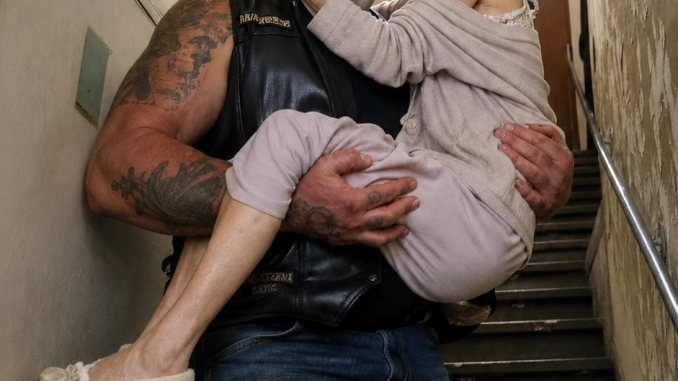
The man was huge — maybe 6’4”. Covered in tattoos. A long beard. A leather vest covered in patches. He was carrying grocery bags.
I opened my door immediately.
“Excuse me, can I help you?”
He turned around and smiled.
The kind of smile that completely changed his intimidating appearance.
“Just helping Miss Dorothy with her groceries. She called me.”
From inside, Dorothy called out:
“Michael, is that you? Come in! And bring my nosy neighbor too.”
I walked in, still suspicious.
But Dorothy looked different.
She was smiling. Really smiling. I hadn’t seen that in months.
“This is Michael,” she said. “He’s my new helper. I fired the agency yesterday.”
Michael unpacked her groceries like he had been doing it forever. He knew exactly where everything belonged. He brought her medication with a glass of water and handed it to her with such care that it almost surprised me.
I finally asked:
“How did you two meet?”
Dorothy smiled.
“He tried to steal my purse.”
Michael laughed.
“That’s not exactly how it happened.”
“Close enough,” she said. “Tell her.”
A few weeks earlier, Michael had been riding through the neighborhood when he saw Dorothy sitting outside on a freezing day. She had no coat, the elevator was broken, and she couldn’t make it back upstairs.
He stopped and asked if she needed help.
“I told him I couldn’t pay him,” Dorothy said.
“So he carried me up four flights of stairs anyway,” she continued.
When they reached her apartment, she tried to give him her purse.
She thought he wanted money.
“That’s what I learned over the years,” Dorothy admitted quietly. “Everyone wants something.”
Michael told her he didn’t want anything. He just saw someone who needed help.
She invited him in for tea.
He stayed for two hours.
Then he came back the next day.
And the day after that.
After a week, Dorothy fired the agency.
“They’re professionals,” I told her.
She looked at me seriously.
“They treat me like a responsibility. Michael treats me like a person.”
Michael explained that Dorothy reminded him of his grandmother.
“She passed away while I was deployed overseas,” he said. “I never got to say goodbye.”
His voice cracked.
“I promised myself I’d never ignore another elderly person who needed someone.”
Over the next few months, I watched their friendship grow.
Michael came every morning at nine.
He helped Dorothy get dressed, prepared breakfast, kept her company, and took her outside in a wheelchair he bought himself.
They went to the park, the library, and the café where Dorothy and George used to spend time together.
People stared.
A giant tattooed biker pushing a tiny elderly woman around the neighborhood.
Dorothy loved it.
“Let them stare,” she told me. “I have the most interesting caretaker in town.”
Michael even brought her to motorcycle club gatherings.
Dozens of bikers called her “Miss Dorothy” and competed over who could bring her the best dessert.
She told me one day with tears in her eyes:
“I haven’t felt this loved in years.”
Then her children found out.
Her daughter Sarah called me, furious.
She wanted to know why a “dangerous man” was around her mother.
I told her the truth.
Dorothy was happier. Healthier. Laughing again.
Sarah didn’t care.
Two weeks later, all three children arrived at Dorothy’s apartment.
They accused Michael of taking advantage of her.
They talked about elder abuse and exploitation.
Then something happened I never expected.
Dorothy stood up.
She rarely stood anymore.
But she stood.
“Get out of my home.”
Sarah reached toward her.
“Mom, we’re protecting you.”
Dorothy shook her head.
“Protecting me? Where were you when I was alone? Where were you on holidays? On my birthday?”
She pointed at Michael.
“He was here.”
“He showed up.”
“He cared.”
Then she looked at her children.
“When was the last time any of you made me feel like I mattered?”
The room went silent.
They threatened to request a competency evaluation.
Dorothy agreed.
“Let a judge see the truth.”
The court ruled Dorothy was completely capable of making her own choices.
The judge said her decision was unusual, but completely reasonable.
He even noted that her health had improved since Michael came into her life.
“Sometimes family is not just blood,” the judge said. “Sometimes it’s the people who show up.”
After that, her children stopped calling.
Dorothy was hurt, but she wasn’t surprised.
“They wanted what I had,” she said. “They didn’t want me.”
Months later, Dorothy fell and broke her hip.
Michael stayed by her side through the ambulance ride and surgery.
When she woke up, he was the first person she saw.
“You stayed,” she whispered.
“Always,” he answered.
The doctors suggested a care facility.
Michael refused.
“She’s coming home.”
He moved into her apartment and dedicated himself to caring for her.
He learned everything — medication schedules, physical therapy, wound care.
His motorcycle club friends helped too. They brought meals, cleaned the apartment, and checked on them.
Dorothy’s children came once more.
They asked if she was ready to move into a facility.
She told them:
“I already have a family.”
That was months ago.
Dorothy is weaker now. Her Parkinson’s has progressed.
But she’s happy.
She’s surrounded by people who truly care.
Before she passed, she held my hand and asked me for one favor.
“Tell people about Michael,” she said.
“Tell them that the man everyone feared gave me my happiest years.”
So I’m telling you.
The bikers come to apartment 4B every week. They bring food, flowers, and laughter.
Michael gave up his old life to care for Dorothy.
“Miss Dorothy gave me purpose,” he says.
So maybe the next time you see someone covered in tattoos and wearing a leather vest, don’t judge too quickly.
Because sometimes the people who look the most intimidating are the ones with the biggest hearts.
And sometimes the people who claim they’re protecting you are the ones who never showed up at all.