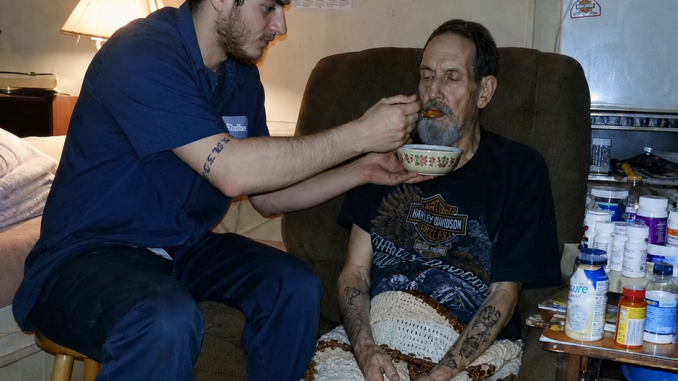
My grandfather spent more than five decades riding motorcycles. My parents spent just as long pretending that part of his life never existed.
No leather vest was ever welcome at family gatherings. His bike was never allowed in their driveway. Whenever someone asked about him, my father would simply say he was “retired,” carefully leaving out the years he proudly rode with his club.
To them, it was something to hide.
To me, Grandpa Ray was the kindest man I had ever known.
Everything changed the day doctors told him he had advanced cancer.
My parents mailed him a sympathy card, but rarely visited. They always had an excuse—too busy, too tired, too much going on.
I couldn’t stand the thought of him spending his final months alone, so at 22 years old I cut my warehouse job down to part-time and moved him into the small garage apartment I rented behind my parents’ house.
Yes, they charged me rent.
Seven hundred dollars every month.
To their own son.
At first, I managed to make it work. But cancer doesn’t just drain a person’s health—it empties your wallet.
There were endless trips to chemotherapy, prescriptions insurance refused to cover, nutritional drinks, special meals he could actually keep down, and days when I had to miss work just to care for him.
Slowly, the bills piled up.
Eventually I fell two months behind on rent.
I wasn’t asking my parents to forgive the debt.
I simply asked for a little more time.
Instead, one afternoon I opened my door and found a formal eviction notice lying on the floor.
My own father had hired an attorney to prepare it.
Against me.
I marched into the house hoping there had been some terrible misunderstanding.
There wasn’t.
My mother folded her arms, looked me straight in the eye, and calmly said,
“Someday you’ll thank us. Consider this eviction a lesson about responsibility and priorities.”
I couldn’t believe what I was hearing.
Forty feet away, their grandson was helping his dying grandfather eat soup because he no longer had the strength to lift a spoon.
And somehow they believed throwing us out would teach me a valuable lesson.
I walked away without another word.
The next week became the hardest week of my life.
Grandpa grew weaker every day.
Some mornings he could barely speak. Other days he’d ask me to wheel him outside so he could watch the sunset one more time.
He never complained.
Not once.
Eleven days before the eviction deadline, Grandpa Ray passed away peacefully, holding my hand.
His last words were simple.
“Don’t let bitterness become your burden.”
I promised him I wouldn’t.
A few days later, I stood beside his casket expecting a quiet funeral with a handful of relatives.
Instead, I heard motorcycles.
One after another.
The rumble grew louder until nearly forty bikes rolled into the church parking lot.
Every rider wore the same Road Saints patch.
Most had gray hair.
Some walked with canes.
Many had tears in their eyes.
These weren’t reckless bikers.
They were lifelong friends who had ridden beside Grandpa since returning home from Vietnam decades earlier.
Leading them was a broad-shouldered man everyone called Preacher.
He embraced me without saying much.
Then he quietly whispered,
“Ray left us a letter. He wanted us to read it after today.”
Across the room, I noticed my father’s expression change instantly.
For the first time in years, he looked genuinely nervous.
Because Grandpa hadn’t written an ordinary goodbye.
He had written the truth.
Every hospital visit.
Every unpaid bill.
Every meal we shared.
Every ignored phone call.
And every detail about the eviction notice his own son received while caring for a dying father.
When the funeral service ended, Preacher stepped to the front of the chapel.
He unfolded several handwritten pages and asked everyone to remain seated for just a few more minutes.
The room became completely silent.
Then he began reading Grandpa Ray’s final message.
With every sentence, people glanced toward my parents.
By the time Preacher reached the part describing the eviction, several guests were wiping away tears.
Others simply stared in disbelief.
My father couldn’t even look up.
Grandpa ended the letter with one final request.
“If my grandson ever finds himself alone after I’m gone, remind him that family isn’t defined by blood. It’s defined by the people who stand beside you when life gets hard.”
No one applauded.
No one spoke.
The silence carried more weight than words ever could.
Then every single biker stood.
One by one, they walked over and surrounded me.
Preacher placed a hand on my shoulder and smiled.
“You’re riding home with us today, son.”
That afternoon, those forty bikers helped me pack every box from the garage apartment.
Not because anyone asked.
Because that’s what they believed family did.
As my parents watched from their porch, the Road Saints loaded everything I owned into trucks and trailers.
Before leaving, Preacher turned toward my father.
He didn’t yell.
He didn’t threaten.
He simply said,
“The greatest lesson your son learned wasn’t from being evicted. It was discovering who his real family truly is.”
Then forty motorcycles started their engines.
The sound echoed through the neighborhood long after we were gone.