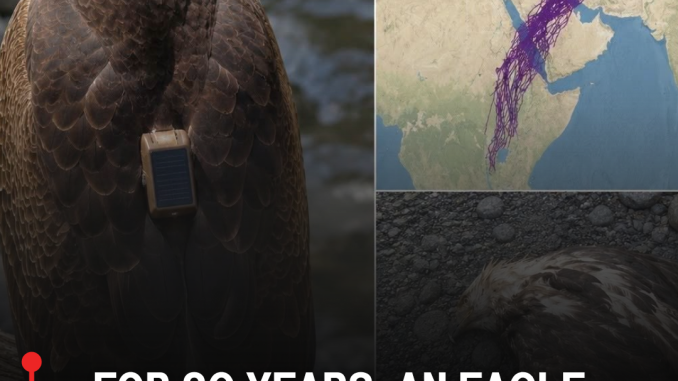
For twenty years, scientists tracked the movements of a single eagle, following a solitary bird whose life unfolded in ways no human could have predicted. When the first GPS data arrived, the map appeared chaotic—a tangled network of lines crossing mountains, rivers, plains, and even open stretches of sea. At first, the movements seemed random, unpredictable, and perhaps even reckless. But as the years passed and researchers combined the tracking data with detailed environmental information, a remarkable truth began to emerge: the eagle was not lost. It was navigating a world far more complicated than any conventional map could capture, using a language written in wind, thermals, weather, and instinct.
Every sudden turn, every unexpected pause, and every change in direction gradually began to make sense when compared with atmospheric conditions and shifting air currents. A sharp change in course might occur exactly where a column of warm air was rising, creating a thermal that allowed the eagle to gain altitude with little effort. A long glide across an apparently empty landscape could correspond with the bird anticipating changing weather or avoiding dangerous conditions. Each movement represented a constant interaction with its surroundings—a living calculation involving survival, energy conservation, and environmental awareness.
The eagle’s journey became a powerful lesson in adaptability. Scientists had often searched for predictable routes and repeatable patterns, but the bird demonstrated that survival could depend on flexibility rather than rigid behavior. Movements that initially appeared to be mistakes or unnecessary detours turned out to be sophisticated strategies developed through years of experience. Every route involved balancing risks: finding food, avoiding predators, navigating storms, and conserving precious energy. The GPS trails, once nothing more than dots and lines on a computer screen, had become evidence of a form of intelligence that was difficult to measure using traditional scientific models.
Over time, the eagle’s migrations revealed an extraordinary combination of consistency and variation. It returned to familiar roosting areas year after year, yet its exact routes often changed according to weather and environmental conditions. Some detours, which initially seemed inefficient, matched wind corridors that helped the bird conserve energy during long flights. Other changes appeared to coincide with seasonal shifts in prey availability or developing storms. The eagle’s life became a remarkable example of environmental awareness, showing researchers that survival is not necessarily about following fixed rules. Sometimes, it depends on recognizing and responding to the subtle rhythms of the world.
Perhaps the most humbling discovery was how strongly the eagle challenged conventional assumptions about animal behavior. For decades, researchers had relied on models that often portrayed animals as following relatively simple and predictable paths. Such behavior was easier to measure, analyze, and reproduce mathematically. But the eagle refused to fit neatly into those assumptions. Its movements were anything but linear. Decisions appeared to be made in real time, responding to conditions that were difficult for humans to detect. The bird was not simply traveling from one destination to another. It was continuously interacting with its environment, responding to invisible signals, and solving problems that researchers could only partially understand.
The eagle also demonstrated remarkable resilience. When unexpected storms appeared, it changed course. When thermals shifted, it adapted and found new currents to carry it forward. Instead of fighting the atmosphere, it appeared to work with it, using natural forces to reduce the enormous energy required for long-distance flight. Researchers were reminded that intelligence does not always resemble human reasoning. It can be quiet, instinctive, and deeply connected to survival. Sometimes, intelligence is not about consciously solving a problem but about possessing the ability to respond perfectly to a changing environment.
Beyond the scientific discoveries, the eagle’s journey carried a deeper philosophical meaning. Watching one animal move across continents for decades forced researchers to confront how much remains unknown about the natural world. Mountains, winds, oceans, weather systems, and wildlife are not separate pieces of nature; they are interconnected parts of a much larger system. The eagle’s route became more than a migration path. It became a record of how one living creature interacted with an entire planet.
The lessons extended far beyond the study of birds. By following the eagle for so many years, scientists were forced to reconsider their own assumptions about order, control, and predictability. They learned that understanding nature requires patience and humility. The natural world does not always behave according to the neat patterns humans create for it. What looks chaotic from one perspective may reveal remarkable organization when viewed through the right lens.
By the twentieth year of observation, the eagle had become a remarkable subject within the scientific community. Its movements contributed to research, inspired discussions about long-term animal tracking, and raised new questions about navigation, adaptation, and animal intelligence. Yet the most important lesson was perhaps simpler than any scientific paper could express: extraordinary intelligence can exist in forms humans may not immediately recognize.
In the end, the GPS lines that once looked like meaningless chaos had transformed into something resembling a living language. They told a story shaped by wind, weather, seasons, experience, and instinct. The eagle had not followed perfectly straight paths because the world itself was never perfectly predictable. Its precision came from the ability to read its surroundings, respond to changes, and adapt moment by moment.
Through two decades of observation, scientists gained a deeper appreciation for the complexity of animal intelligence and the interconnected systems that support life on Earth. The eagle’s journey became a powerful symbol of endurance, adaptability, and awareness. It demonstrated that survival requires more than physical strength—it requires observation, patience, flexibility, and an extraordinary ability to respond to an ever-changing world.
Ultimately, the story of this eagle reminds us that nature contains countless mysteries hiding in plain sight. With enough patience and careful observation, what initially appears to be chaos can reveal an astonishing level of order and intelligence. By following the flight of a single eagle for twenty years, scientists were given a rare glimpse into a world governed by instincts, environmental signals, and adaptations developed over generations.
The eagle never needed a classroom, a map, or a textbook. It simply flew—and in doing so, it revealed that the natural world may be far more intricate, intelligent, and alive than we often realize.