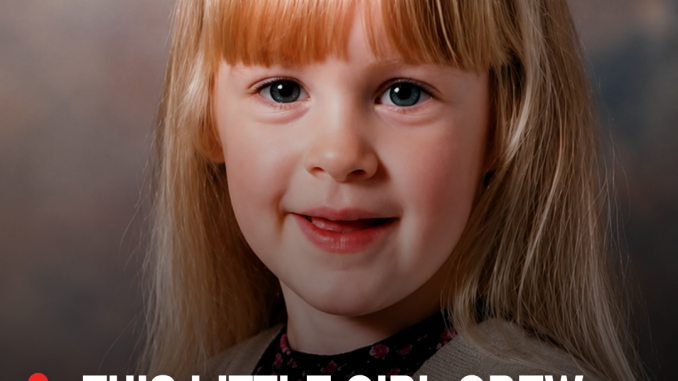
A small girl smiles at the camera in her school uniform — gap-toothed, bright-eyed, and carrying the kind of innocent joy that belongs only to childhood.
She looks like any ordinary child. The type of girl who might one day become a teacher, a doctor, or someone dedicated to helping others.
Instead, she became a nurse.
And for years, that is exactly how people saw her.
Parents placed their trust in her during the most terrifying moments of their lives — when their fragile newborn babies were fighting to survive their very first days. To families, she appeared caring, gentle, and dependable. Someone meant to protect life, not threaten it.
That trust would later become the center of one of the most disturbing criminal cases in modern British history.
An Ordinary Beginning
Born in 1990 in Hereford, England, Lucy Letby appeared to have a completely normal upbringing. Friends and neighbors described her childhood as quiet and uneventful. There were no obvious warning signs, no dramatic stories, and nothing that made her stand out from countless other children growing up across the country.
She was the only child of a furniture salesman and an accounts clerk. Her life seemed stable and ordinary.
As she grew older, she pursued a career in nursing and graduated from the University of Chester in 2011. Soon after, she began working at the Countess of Chester Hospital in the neonatal unit, caring for premature and critically ill babies.
Coworkers described her as hardworking and compassionate. She appeared deeply committed to her patients, remembered details about families, and participated in charity efforts connected to the hospital’s neonatal services.
To everyone around her, she seemed like exactly the kind of nurse parents would want beside their children.
But behind the hospital walls, something deeply troubling was unfolding.
The Pattern That Raised Alarm
Between 2015 and 2016, doctors in the neonatal unit began noticing an unusual and deeply concerning rise in medical emergencies involving newborn babies.
While complications sadly happen in neonatal care, staff members realized these incidents felt different. Babies who had appeared stable suddenly collapsed without clear explanation. Some deteriorated rapidly despite receiving treatment.
Doctors eventually began searching for a pattern.
One name repeatedly appeared during the incidents: Lucy Letby.
Dr. Stephen Brearey, the lead consultant neonatologist, became increasingly concerned after reviewing multiple unexplained collapses and deaths. Medical staff raised warnings internally, believing something was seriously wrong.
According to later reports, those concerns were not acted on quickly enough.
Police were finally contacted in 2017.
By then, investigators believed numerous babies had already been harmed.
The Allegations
What prosecutors later described in court shocked the public across the United Kingdom and beyond.
They alleged that Lucy Letby deliberately harmed newborn babies in several ways, including injecting air into bloodstreams, poisoning infants with insulin, and overfeeding babies with milk.
The victims were among the most vulnerable patients imaginable — premature and critically ill newborns who depended entirely on medical staff for survival.
Some parents were reportedly only feet away from their children when the incidents happened, unaware that investigators would later suspect deliberate harm.
Seven babies died, and several others suffered serious injuries.
During the investigation, police also discovered handwritten notes in Letby’s home. One note included the words:
“I am evil, I did this.”
She consistently denied all accusations against her.
Inside the Trial
Lucy Letby’s trial began in October 2022 at Manchester Crown Court and became one of the most closely watched criminal cases in recent British history.
Over many months, jurors heard testimony from medical experts, hospital staff, investigators, and grieving parents who described losing their newborn children under devastating circumstances.
Prosecutors argued the injuries and collapses could not be explained naturally.
Throughout the trial, Letby largely maintained a calm and emotionless appearance. She denied intentionally harming any child.
Police later described her outward personality as extremely ordinary — someone who appeared quiet, harmless, and unremarkable in everyday life.
On August 17, 2023, the jury delivered its verdict.
Lucy Letby was found guilty of murdering seven babies and attempting to murder several others. She received a whole-life prison sentence, meaning she will never be released.
The judge described the crimes as “calculated,” “cruel,” and “pitiless.”
Families inside the courtroom reacted with overwhelming emotion after years of unanswered questions and grief.
Questions That Continue
Even after the convictions, the case has continued to generate debate and discussion.
Some international medical experts later questioned parts of the evidence presented during the trial, suggesting that certain deaths may have been linked to natural medical complications or failures in hospital care rather than deliberate acts.
In 2025, a panel led by Canadian neonatologist Dr. Shoo Lee publicly stated they believed the evidence did not support murder conclusions in several cases.
However, British courts previously rejected Letby’s attempts to appeal her convictions, and the verdicts remain in place.
The case has since become the subject of documentaries, investigations, and continued public discussion, with many people still struggling to understand how someone trusted with caring for newborn babies became linked to one of the most horrifying criminal cases involving children in modern history.