Let me go back a bit.
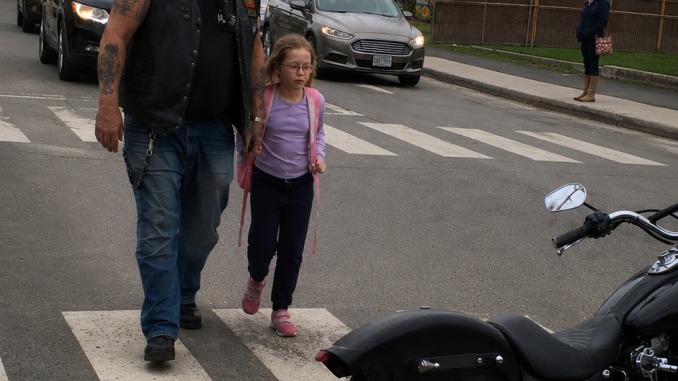
My daughter Lily is nine years old. She has Down syndrome. She’s the kind of child who notices beauty everywhere—she stops to watch butterflies longer than most people stop for red lights. She loves music, hums to herself constantly, and waves at strangers with pure excitement, even when they don’t wave back.
And most of them don’t.
We moved to this town about a year ago after my divorce. It was supposed to be a fresh start, but mornings quickly became the hardest part of our day. Every school morning, Lily and I walk four blocks. The final block is the worst.
There’s a crosswalk there, but no signal. Just faded white paint on the asphalt and a small sign that says “Yield to Pedestrians.” It sounds safe on paper. In reality, it’s not.
Because almost no one yields.
Traffic never slows. Cars rush through like the crosswalk doesn’t exist at all. Lily walks at her own pace—slow, careful, steady. What other kids cross in seconds takes her nearly a full minute.
And that minute became dangerous.
Drivers would honk. Some would rev their engines impatiently. Others would creep forward like she was an obstacle rather than a child trying to get to school. One man even rolled down his window and yelled at us to hurry up.
Lily never forgot that moment. After that day, she started to fear the crosswalk. Not just hesitate—freeze. Every morning she would reach that white line, grip my sleeve tightly, and stop completely.
“Scary,” she would whisper. “Cars scary, Mama.”
Eventually, she refused to step off the curb without me practically pulling her forward. It turned into a fight every morning, and I started dreading that corner more than she did.
I called the city. Asked for a crossing guard. They told me they would “review the request.”
Six months passed. Nothing changed.
Then came that Tuesday in March.
We reached the crosswalk like always. The same noise. The same rush of engines. The same fear rising in my chest as Lily froze in place again, her small hand locked around my sleeve so tight it hurt.
I was about to give up and turn back when I heard something different.
A motorcycle.
It came from behind us, loud and deep, cutting through the traffic noise. A man pulled up beside us slowly. He was older—maybe in his sixties—with a long gray beard and a worn leather vest covered in patches. He looked like someone who had seen a lot of roads and lived through them all.
He didn’t say anything at first.
He looked at Lily. Then at the crosswalk. Then at the cars that kept speeding through without a care.
And something in his expression changed.
He didn’t ask permission. He didn’t hesitate.
He killed his engine.
Then he swung his Harley sideways across both lanes, blocking traffic completely.
At first, a few drivers honked angrily. One shouted. But the biker didn’t move. He just sat there like a wall of steel and calm, staring straight ahead, one hand resting on the handlebar.
Then he looked back at us.
“Go ahead,” he said simply.
I hesitated. “We don’t want to cause trouble—”
He shook his head. “Ma’am, the only trouble here is nobody stopping for your kid.”
Lily looked up at him. For a moment, she didn’t move. Then she stepped forward.
Slowly. Carefully. One step at a time.
And for the first time in months, she crossed that street without fear.
Halfway across, the biker revved his engine once—not aggressively, but like a signal. A reminder to every driver watching: she mattered more than their schedule.
When we reached the other side, Lily turned back and waved at him. That same bright, trusting wave she always gives strangers.
And this time, he waved back.
We stood there for a moment, watching him finally pull out of the lane once we were safe. Traffic resumed, but something had shifted—at least for me.
Because it wasn’t just about that one crossing.
The next morning, he was there again.
And the next.
He never said much. Never asked for thanks. He just showed up, parked his bike at that crosswalk, and turned himself into a one-man crossing guard.
Over time, other drivers started noticing. Some slowed down. Some even stopped early. The chaos faded little by little.
And Lily?
She started smiling again at that corner.
Sometimes, it only takes one person deciding that something is wrong—and refusing to let it continue.
That biker didn’t just stop traffic.
He gave my daughter back her courage.