I was standing alone in the chapel of Morrison’s Funeral Home, staring at the single flower arrangement I could afford, when the doors opened and a group of bikers walked in as if they had been expected all along.
My grandfather had no one left.
His wife had passed away eleven years earlier. His two sons—my father and uncle—died in a car accident in 2015. His brothers, sisters, and closest friends were gone. Even the men he had served beside in Vietnam had passed away one after another.
In the end, there was only me.
A 24-year-old nursing student struggling with tuition, bills, and grief, trying to give a three-tour combat veteran the respectful farewell he deserved with barely enough money to cover the funeral expenses.
What hurt most wasn’t the cost.
It was knowing there would be no pallbearers.
The funeral director had kindly explained that staff members could carry the casket.
“It happens more often than you’d think,” she told me gently. “Families are smaller now. People move away. There’s nothing to be embarrassed about.”
But I was embarrassed.
My grandfather had spent his life carrying others.
He carried wounded soldiers through the jungles of Vietnam. He carried injured friends to safety. He carried memories and scars that never fully healed. Through it all, he never complained.
Now, at the end of his journey, there was nobody left to carry him.
Or so I thought.
As I sat alone in the front pew, I heard the unmistakable sound of motorcycles approaching. The deep rumble grew louder until it stopped outside the funeral home.
A few moments later, the chapel doors opened.
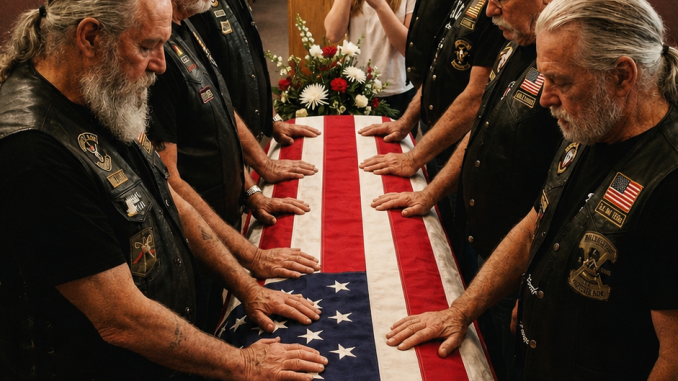
Eight older men stepped inside.
Their leather vests were covered with patches and military pins. Most had gray beards. Their faces showed the kind of wear that only comes from decades of living, serving, and surviving.
The man leading them removed his bandana and held it respectfully against his chest.
“Are you Margaret?” he asked softly. “Harold Whitmore’s granddaughter?”
I nodded.
“How do you know who I am?”
The man smiled.
“Because your grandfather was our brother.”
Confused, I shook my head.
“My grandfather wasn’t a biker.”
“No,” he replied. “But he was a veteran. And twenty years ago, when one of our members came home from Vietnam struggling with everything he’d seen, your grandfather was the only person who sat beside him every week at the VA hospital.”
The room went silent.
The man continued.
“He helped more veterans than you’ll ever know. Some of us are alive because he refused to give up on us.”
Another biker stepped forward.
“He never wanted recognition. Never told stories about what he did. But every one of us remembers.”
I felt tears rolling down my face.
For years, I had believed my grandfather spent his retirement quietly and alone.
I was wrong.
He had spent it helping broken men find their way back.
When the service ended, the bikers stood beside the casket.
Without being asked, they became his pallbearers.
They carried him with the same dignity and respect he had shown others throughout his life.
At the cemetery, they formed two lines leading to the grave. As the casket was lowered, every one of them saluted.
Not a military salute.
A salute from brothers.
Afterward, the man with the silver ponytail handed me a folded envelope.
Inside were dozens of handwritten notes.
Letters from veterans whose lives my grandfather had touched.
Men he had counseled.
Men he had comforted.
Men he had helped survive their darkest days.
I spent hours reading every single one.
That was the day I realized something important:
A person’s legacy isn’t measured by how many people attend their funeral.
It’s measured by the lives they quietly change while they’re alive.
My grandfather thought he was leaving this world alone.
But he wasn’t.
Because kindness never disappears.
It lives on in the people we help, and sometimes, years later, it comes roaring back on eight motorcycles to say goodbye.
The chapel may have started out empty, but by the end, my grandfather was surrounded by family he never knew he had. ❤️