My son Eli was diagnosed with leukemia just two weeks after his fourth birthday.
In a matter of days, our lives changed completely.
The hospital became our second home. Chemotherapy treatments, endless blood tests, sleepless nights in uncomfortable chairs, and the constant fear that every parent dreads.
There were days when Eli barely spoke.
Days when he was too weak to sit up.
Days when I wondered how much more a child could possibly endure.
Then one afternoon, something unexpected happened.
I stepped into the hallway to collect myself after another difficult treatment session. That’s when I heard a sound I hadn’t heard in weeks.
Laughter.
Real laughter.
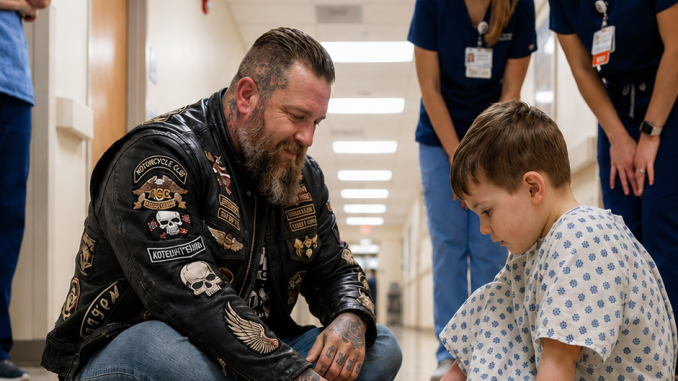
I rushed back toward Eli’s room and found a heavily tattooed biker sitting cross-legged on the floor beside my son’s bed.
Leather vest.
Long beard.
Hands covered in ink.
And a toy car in his hand.
“Vroom!” Eli shouted as he pushed a small red car across the floor.
The biker grinned and rolled a green one back toward him.
For the first time in what felt like forever, my son looked happy.
The man’s name was Wade.
He told me he volunteered at the hospital.
The nurses confirmed he was welcome there.
I thanked him and thought that would be the end of it.
But it wasn’t.
The next day he returned.
And the day after that.
And the day after that.
For an entire year, Wade showed up without fail.
Rain.
Snow.
Holidays.
Weekends.
Good days and terrible days.
He was always there.
He brought toy cars, miniature motorcycles, and little surprises that somehow managed to make a hospital room feel less frightening.
When Eli felt strong enough to play, Wade played with him for hours.
When chemotherapy left him exhausted, Wade simply sat nearby and kept him company.
Sometimes he would hold a toy car in front of Eli and say:
“Saving this race for when you’re feeling better, buddy.”
Eli adored him.
He started introducing him to visitors as “my friend Wade.”
Every time he said those words, I noticed something strange.
A shadow would pass across Wade’s face.
A sadness that appeared for only a moment before disappearing again.
I often wondered about it.
But I never asked.
I was simply grateful he was there.
One evening, nearly eleven months after meeting him, I overheard two nurses talking near the station.
“Next week marks three years,” one said quietly.
“Does he still come every day?” asked the other.
“Every single day.”
“I honestly don’t know how he does it after losing his little girl.”
I stopped walking.
My heart skipped.
His little girl?
The nurse noticed me standing there.
Her expression immediately changed.
But it was too late.
I had already heard enough.
After a long pause, she gently told me the story.
Three years earlier, Wade’s six-year-old daughter had been treated on the very same oncology floor.
She loved toy cars.
She carried them everywhere.
Every treatment.
Every appointment.
Every hospital stay.
For nearly two years, Wade sat beside her bed and played with those little cars while she fought for her life.
Then one day, she lost her battle.
The room she left behind became silent.
The toys remained.
And so did the unbearable grief.
For months, Wade couldn’t bring himself to stay away from the hospital.
Eventually he began visiting the children’s ward.
At first, he simply sat in the waiting room.
Then one day he brought one of his daughter’s toy cars.
A frightened little patient smiled.
And something inside him changed.
From that moment forward, he dedicated himself to being the person he wished someone had been for his daughter when she was scared.
Every toy car he brought carried a piece of her memory.
Every child he comforted helped keep her spirit alive.
I sat on the floor and cried harder than I had since Eli’s diagnosis.
Not because of sadness alone.
But because I finally understood.
The man who had helped my son survive the hardest year of his life was carrying a pain far greater than anything I had imagined.
A week later, I thanked Wade for everything he had done.
He listened quietly and nodded.
Then he reached into his jacket pocket and handed Eli a small blue toy car.
“My daughter’s favorite,” he said softly.
“It’s yours now.”
Today, Eli is cancer-free.
That little blue car still sits on a shelf in his room.
And every time I see it, I remember a lesson I’ll never forget:
Sometimes the people carrying the heaviest burdens are the ones who spend their lives helping others carry theirs.
And sometimes heroes don’t wear capes.
Sometimes they wear leather jackets, sit on hospital floors, and show up every single day when a child needs a friend.