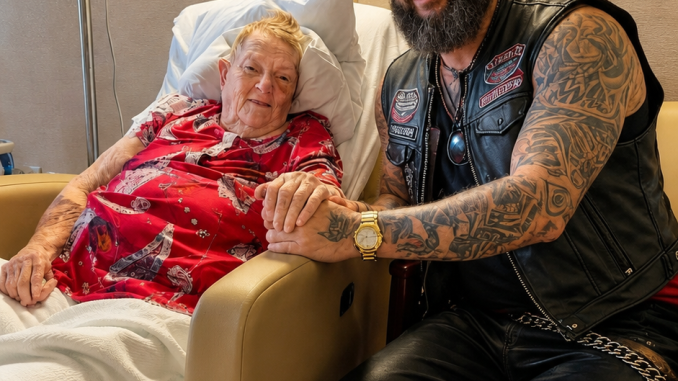
The biker walked into my mother’s hospice room at exactly 2 PM on a Thursday afternoon, and my first instinct was to call security.
My mother was 87 years old and nearing the end of her life. For two days she had barely spoken, barely opened her eyes, and barely responded to anyone around her.
I was her only daughter, and I had specifically asked the staff not to allow visitors.
Especially strangers.
So when I saw a large man covered in tattoos, wearing a leather vest filled with biker patches, step quietly through the doorway, I immediately assumed he had entered the wrong room.
I stood up and reached for the call button.
Then something happened that stopped me cold.
My mother slowly opened her eyes.
For the first time in nearly forty-eight hours.
She stared at the stranger standing near her bed and whispered a single word.
“Johnny?”
The biker froze.
His face immediately crumbled.
Tears streamed down his cheeks.
He walked to her bedside, gently took her hand, and said in a voice so soft it barely sounded like it belonged to him.
“No, ma’am. I’m not Johnny.”
He paused.
“But Johnny sent me.”
My mother began to cry.
The biker began to cry.
And I stood there completely confused.
Who was Johnny?
Why did my mother recognize him?
And why was this stranger acting as if he had known her his entire life?
What I didn’t know was that my mother had been carrying a secret for more than six decades.
A secret she had never shared with me.
Not once.
As the biker sat beside her bed, he began telling a story.
In 1963, my mother had been a young waitress working in a small roadside diner.
One evening, a nineteen-year-old young man named Johnny walked through the door wearing a military uniform.
He was preparing to leave for Vietnam.
The two of them spent months together before he deployed overseas.
They fell deeply in love.
According to the biker, they had planned to marry when he returned.
But life had other plans.
Johnny was reported missing during combat.
Months later, my mother received a letter informing her that he had been presumed dead.
Heartbroken, she eventually moved on.
Years later she married my father, raised a family, and never spoke about Johnny again.
What she never knew was that Johnny had survived.
He had been captured.
After years of unimaginable hardship, he eventually returned home.
By then, everything had changed.
Believing my mother had moved on and built a new life, he chose not to disrupt it.
Instead, he carried her memory quietly in his heart for the rest of his life.
The biker explained that Johnny had recently passed away.
Before he died, he shared a small box with him.
Inside were old photographs.
Letters.
A pressed flower.
And every card my mother had ever given him.
For sixty-three years, Johnny had kept every single one.
“He never stopped loving her,” the biker said softly.
“He talked about her until his very last day.”
The room fell silent.
My mother squeezed his hand.
Tears rolled down her face.
For a long moment, neither of them spoke.
Finally, she smiled.
A smile I hadn’t seen in years.
“Tell him,” she whispered, looking toward the ceiling, “that I never forgot him either.”
The biker nodded.
Neither of us could hold back our tears.
My mother passed away peacefully three days later.
But something changed in those final hours.
The questions she had carried for decades were finally answered.
The love story she thought had ended in tragedy finally found its ending.
And I learned something I will never forget.
We spend far too much time judging people by appearances.
I saw a tattooed biker and assumed he didn’t belong.
I thought he was lost.
I thought he was trouble.
Instead, he became the messenger who brought my mother peace during the final days of her life.
Sometimes the people carrying the most compassion are the ones the world misunderstands the most.
And sometimes, after a lifetime of waiting, love finally finds its way home.
Even if it takes sixty-three years.