For months, Eleanor had tried to be the “ideal” neighbor. She smiled through the inconveniences, ignored small boundary violations, and kept her frustrations to herself because she wanted to avoid unnecessary conflict. She believed that being patient and accommodating was simply part of being a good neighbor.
But Monica had slowly learned to take advantage of that kindness.
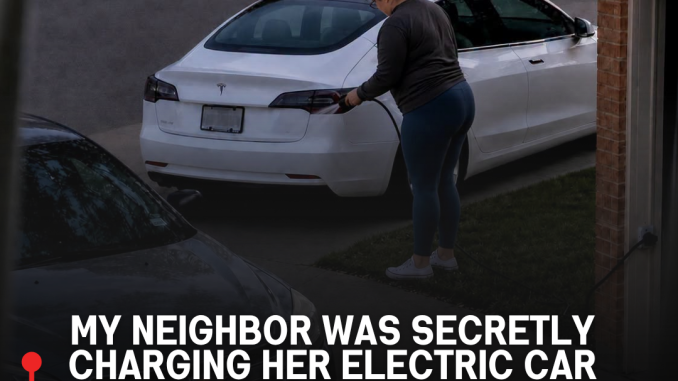
What began with harmless requests—a cup of sugar, borrowing a garden tool, or asking Eleanor to accept a package—gradually became something far more intrusive. Before long, Monica had developed a new habit: every night, she would pull her electric vehicle into her driveway and plug it into the outdoor electrical outlet on Eleanor’s property.
At first, Eleanor told herself it was probably temporary. Maybe Monica had forgotten to charge her car. Maybe she would eventually ask permission.
She never did.
Night after night, Monica charged her vehicle using electricity Eleanor was paying for. Every morning, Eleanor would watch Monica drive away with a fully charged battery, while the cost quietly appeared on Eleanor’s utility bill.
The electricity itself was frustrating, but that wasn’t what bothered Eleanor most.
It was the assumption behind it.
Monica acted as though Eleanor’s property, utilities, and generosity were automatically available to her. There was no request, no conversation, and certainly no apology. Eleanor’s silence had slowly been interpreted as permission.
The Moment Eleanor Finally Said Enough
For a long time, Eleanor remained quiet because she dreaded the confrontation. She could already imagine Monica accusing her of being unreasonable or “difficult.” She worried about awkward encounters, neighborhood gossip, and the uncomfortable tension that might follow.
Then one evening, Eleanor had a realization.
Her silence wasn’t creating peace.
It was simply allowing the problem to continue.
She decided that being kind did not mean allowing someone else to ignore her boundaries.
She started small.
Some of her garden decorations had been “borrowed” by Monica months earlier and never returned. Eleanor went to Monica’s yard, collected her belongings, and brought them home. She didn’t make a scene. She didn’t apologize. She simply took back what belonged to her.
Then she made her next decision.
She placed a clear sign on the exterior wall near the outlet:
Private Property. No Unauthorized Charging. Violators Will Be Reported.
It was a simple sign, but for Eleanor, it represented something much bigger. She was finally making her expectations clear.
She also installed a motion-activated sprinkler system near the area.
It wasn’t meant to hurt or humiliate anyone. It was simply another layer of security around her property—a harmless but effective way to discourage people from entering an area without permission.
The Cold Spray of Reality
The next evening, Monica arrived as usual.
She pulled into her driveway, stepped out of her car, and headed toward Eleanor’s outdoor outlet with the same confidence she had shown every night before.
She didn’t notice the sign immediately.
She certainly didn’t expect the sudden hiss of water.
The motion-activated sprinkler came to life, sending a burst of cold water across the area.
Monica jumped back in surprise.
Then she saw the sign.
For the first time, there was no ambiguity about Eleanor’s position.
The next morning, Monica confronted her.
“Seriously?” she asked, clearly annoyed.
Eleanor remained calm.
“This is my home,” she said. “I’m not comfortable with anyone using my utilities without permission.”
That was all.
She didn’t argue about the electricity bill. She didn’t list every previous offense. She didn’t apologize for protecting her own property.
Most importantly, she didn’t allow herself to be pulled into a debate.
The boundary had been stated.
That was enough.
One Boundary Started a Domino Effect
What happened afterward surprised Eleanor.
Word spread throughout the neighborhood, and she soon discovered that Monica’s behavior wasn’t limited to her.
Other neighbors began sharing their own experiences.
Someone had loaned Monica lawn equipment that was never returned. Another neighbor said Monica constantly asked intrusive questions about their schedules. Someone else described feeling as though Monica was always keeping track of where they went and when they came home.
Eleanor realized she hadn’t been imagining the problem.
She wasn’t the only person who felt uncomfortable.
She had simply been the first person willing to say, “Enough.”
Eventually, Monica offered a brief and somewhat reluctant apology. It wasn’t dramatic, and it didn’t erase everything that had happened, but something important had changed.
The dynamic between them was no longer the same.
Eleanor’s home felt different, too.
The tension that had followed her every evening seemed to disappear. She no longer looked outside wondering whether Monica was going to use her property again. She no longer felt obligated to tolerate behavior that made her uncomfortable.
For the first time in months, her home felt completely like hers again.
Real Kindness Has a Backbone
Eleanor learned something that many people struggle with for years:
Avoiding conflict isn’t always the same thing as creating peace.
Sometimes, what looks like peace is simply one person repeatedly sacrificing their comfort to keep another person happy.
Real peace can require boundaries.
Eleanor discovered that saying “no” didn’t make her cruel, selfish, or unfriendly. It simply meant she respected her own limits.
Kindness doesn’t require unlimited access to your time, your possessions, your money, or your property.
You can be generous without being taken advantage of.
You can be polite without being passive.
And you can care about your neighbors without allowing them to cross lines that make you uncomfortable.
Eleanor finally understood that protecting the boundary between her life and Monica’s wasn’t an act of hostility.
It was an act of self-respect.
Her home was no longer a resource that others could freely use whenever they wanted. It was her sanctuary—and this time, she was willing to protect it.