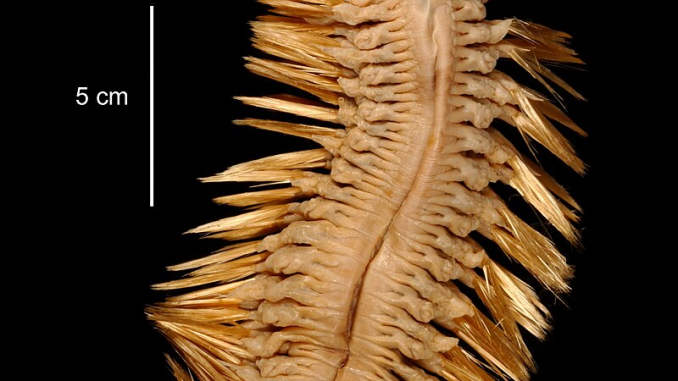
A strange and fascinating marine worm has recently gone viral across social media, and once you see it, it’s easy to understand the attention it’s getting. The creature, known as Eulagisca gigantea, looks more like something from a sci-fi horror film than an animal living quietly in the freezing waters around Antarctica.
With its glowing golden bristles and a mouth full of sharp, exposed teeth, it almost looks like a bizarre holiday decoration that went completely wrong.
Yet despite its unsettling appearance, this unusual worm has actually existed in the Southern Ocean for years. It has only recently gained popularity online after images of it began circulating widely.
Meet Eulagisca gigantea
So what exactly makes this worm so extraordinary? For starters, it can grow to around 8 inches long—roughly the size of a banana. Its most striking feature is its head, which isn’t what it seems: it’s actually a retractable throat.
When feeding, the worm extends this throat outward, revealing a set of sharp, menacing teeth. This allows it to scavenge or even hunt small marine organisms, proving it is far from a harmless seafloor dweller.
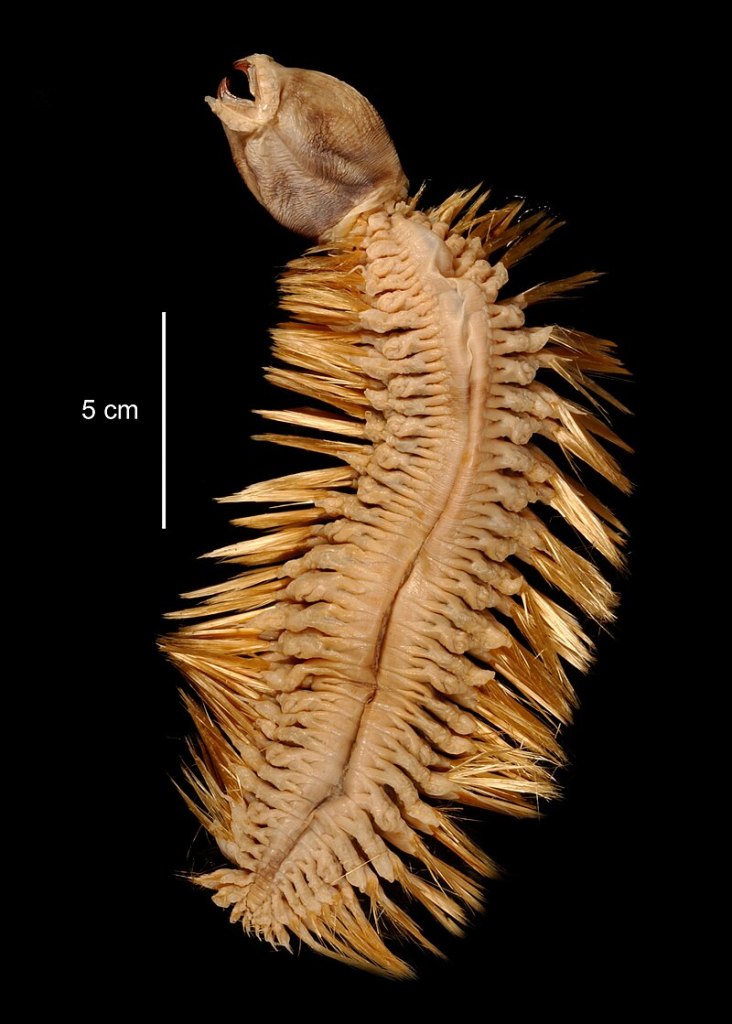
Its shimmering golden bristles aren’t just decorative either. Scientists believe they may help the worm move through water, crawl along the ocean floor, or even provide protection against predators. However, much about Eulagisca gigantea remains a mystery, as it has only been lightly studied since its discovery in 1939.
A deep-sea oddity
Worms like Eulagisca gigantea belong to a group called polychaetes, which are incredibly diverse and found in many ocean environments—from shallow reefs to the deepest hydrothermal vents. They come in countless shapes, sizes, and colors.
There are more than 8,000 known species of polychaete worms, and scientists suspect many more are still undiscovered. In fact, research suggests we may have only identified about half of the marine worm species living in the world’s oceans.
Despite their strange looks, these worms play an important role in marine ecosystems and are valuable for scientists studying life in extreme ocean environments.
A viral deep-sea discovery
Recently, a Facebook post showing a specimen of Eulagisca gigantea from the Antarctic Ocean went viral. The image highlighted its metallic golden bristles and its eerie, extended jaws, sparking both fascination and discomfort among viewers.
Even though it may look terrifying, creatures like this help researchers better understand the incredible biodiversity hidden in the deep sea.
As exploration of the oceans continues, it’s likely that even more unusual species will be discovered—reminding us that Earth’s oceans still hold mysteries stranger than fiction.