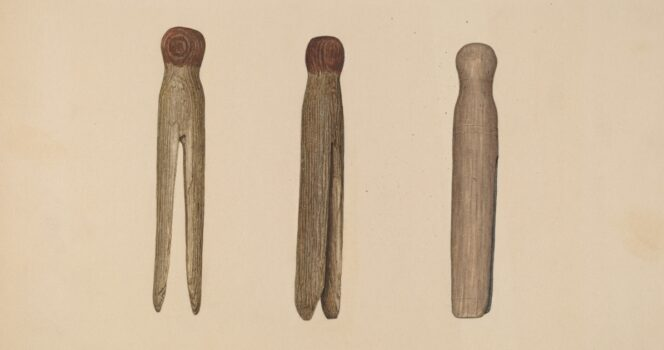
Long before washing machines and tumble dryers made laundry effortless, people relied on simple but clever handmade tools to keep their clothes clean and dry. One of the most interesting of these tools is the wooden clothespin—an everyday object with a surprisingly long history.
At first glance, it may seem like nothing more than a small wooden peg, but its purpose was essential. In earlier times, wet clothes were hung outside on long lines to dry in the open air. The biggest problem was the wind, which often blew garments away and caused frustration for anyone doing laundry. Washerwomen even described this as a “serious evil,” since socks, shirts, and other items could easily be lost or damaged.
To solve this problem, early households used simple wooden pegs made from natural materials like wood, bone, or stone. These early versions were often handcrafted and quite basic, but they served the important purpose of holding clothing in place while it dried in the sun. Over time, people continued to improve this design to make it more reliable and practical.
The clothespin as we know it today began to take shape in the 19th century. One of the most important improvements came in 1853, when American inventor David M. Smith patented a new version of the clothespin. His design introduced two wooden pieces connected by a wire hinge, allowing the peg to grip clothing more securely. This innovation made it much more effective at holding garments on a clothesline, even in strong wind.
Smith’s invention solved a common household problem and quickly became widely appreciated. His design ensured that the clothespin would stay closed when in use, firmly gripping fabric without damaging it. This small but important improvement transformed laundry routines for many families.
As industrialization expanded in the late 19th and early 20th centuries, clothespins began to be produced in factories. Instead of being handmade one by one, they could now be manufactured in large quantities at lower cost. This made them affordable and accessible to many households around the world. Most were made from durable woods such as maple or birch, and their design remained simple but effective.
Throughout the 20th century, wooden clothespins remained a common household item. Even as new materials and technologies appeared, they continued to be widely used for drying clothes outdoors. In many places, they became a symbol of everyday home life—simple, practical, and dependable.
Although plastic clothespins have replaced wooden ones in many modern homes due to lower cost and mass production, wooden versions are still used today. Many people prefer them for their durability, eco-friendly nature, and nostalgic charm. They are also popular in arts and crafts, decorations, and DIY projects.
Recently, when someone posted online about finding small wooden pieces with two legs, many users quickly recognized them as old-fashioned clothespins. For older generations, they are a reminder of times when laundry was hung outside under the sun, carried by wind and fresh air rather than machines.
In the end, the wooden clothespin is more than just a simple household object. It represents a long tradition of human creativity—turning basic materials into practical tools that made everyday life easier, one small invention at a time.