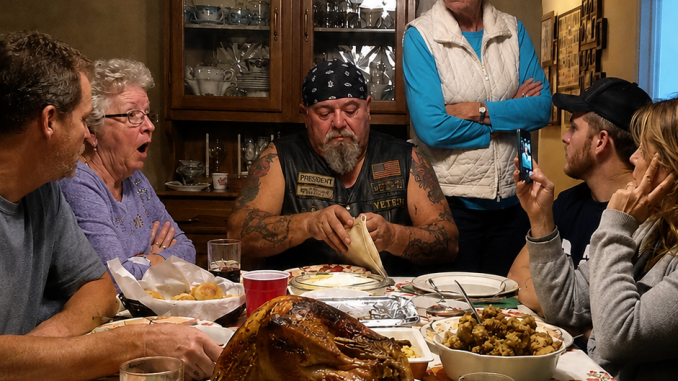
My mom had disliked my biker husband from the moment she met him.
For nine straight years, every family holiday felt the same. She barely spoke to him and refused to call him by his name. To her, he was always “that man.”
His name is Wade.
She never hid how she felt. She told anyone who would listen that I had settled for less than I deserved—a tattooed mechanic who rode with a motorcycle club instead of the successful attorney from her church she had always hoped I would marry.
Despite the constant criticism, Wade never argued back. He carved the Thanksgiving turkey, fixed things around her house whenever they broke, and once drove two hours through pouring rain after her car broke down on the highway.
She never thanked him.
Instead, she insisted he was only “playing the long game.”
Last Thanksgiving, she decided it was time to prove herself right.
As we passed the sweet potatoes around the table, she stood up, reached into her purse, and slid a thick manila folder across the table. It knocked over the gravy boat, but she didn’t even look at the mess.
“I hired a private investigator,” she announced proudly. “He followed Wade for thirty days. Everyone here deserves to know exactly what kind of man he really is.”
A smile spread across her face. My aunt gasped. My cousin quietly reached for his phone, expecting drama.
I turned toward Wade.
What unsettled me most wasn’t anger or fear.
It was that he looked completely calm.
He gently folded his napkin, set it beside his plate, and looked at my mother with something that almost resembled sympathy.
“Loretta,” he said softly, “did you read the entire file?”
Her smile began to fade.
“Because on day nine,” Wade continued, “your investigator came to see me. He spent nearly two hours sitting in my shop. Before he left, he asked if he could include one final note in the report before delivering it to you.”
The room fell silent.
Wade squeezed my hand and smiled at me.
“Open it,” he said. “Start with the last page.”
My hands trembled as I opened the folder. Tucked behind the report was a handwritten letter from the investigator.
It read:
“Ma’am, I’ve worked as a private investigator for twenty-two years. I’ve followed dishonest spouses, career criminals, scammers, and people hiding terrible secrets. In all that time, I’ve never refunded a client.
Your refund has already been processed.
On day six, I followed your son-in-law to a small brick building on Fremont Street. I expected to uncover something suspicious.
Instead, I watched him spend every Wednesday evening volunteering at a community center where he repaired bicycles for children whose families couldn’t afford new ones.
Over the next few weeks, I saw him quietly pay for groceries for an elderly widow, fix vehicles for struggling single parents without charging a dime, and visit a retired veteran every Friday just to share lunch and conversation.
Not once did he know I was watching.
The only person I found behaving dishonestly during this investigation was the one who hired me, hoping to destroy a good man’s reputation instead of trying to understand his character.
You already have an exceptional son-in-law.
Whether you choose to appreciate him is entirely up to you.”
When I looked up, no one said a word.
My mother’s face had turned pale.
For the first time in nearly a decade, she had nothing to say.
Wade quietly gathered the spilled gravy, handed my aunt a clean napkin, and sat back down as if nothing extraordinary had happened.
Just before dessert, my mother finally broke the silence.
“I’m… sorry, Wade.”
It wasn’t dramatic, and it didn’t erase years of hurt.
But it was honest.
Wade simply nodded.
“Thank you,” he replied. “That’s all I ever wanted.”
That Thanksgiving wasn’t remembered because of the argument or the investigation.
It became the day everyone at that table finally saw the man my husband had been all along—not because someone defended him, but because the truth spoke for itself.