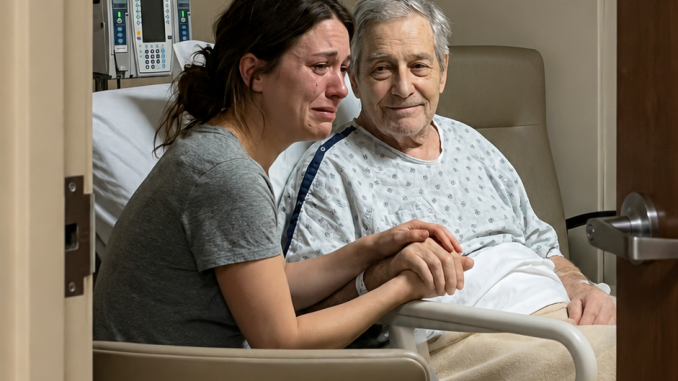
He only smiled and said, “I know.”
Then he died.
For forty-two years, my father lived that life. Leather vest. Harley in the garage. Club meetings every Thursday. Long rides on weekends. Patches, pins, brotherhood, loyalty — all the things he seemed to value more than anything.
To him, it was pride.
To me, it was embarrassment.
I hated the motorcycles parked in our driveway. I hated the loud men with beards and tattoos who came over for cookouts. I hated the way teachers looked at him during parent nights when he showed up wearing his biker vest.
By the time I was fifteen, I stopped telling people what my father was like. By eighteen, I barely came home.
I built my whole life trying to be the opposite of him.
College degree. Office job. Clean car. Button-down shirts. Quiet neighborhood. Everything polished. Everything respectable.
And through it all, he never judged me.
He called every Sunday just to ask how I was doing. Sometimes I answered. Sometimes I let it go to voicemail. Sometimes I forgot to call back for days.
Then the cancer came.
Three months. That was all it took.
From diagnosis to hospice.
On what the doctors said would likely be his final night, I drove to see him. He looked smaller than I had ever seen him. No leather vest. No loud laugh. No motorcycle keys in his pocket. Just a tired old man in a hospital bed, holding on quietly.
I sat beside him and took his hand.
And then, for reasons I still don’t fully understand, I said the cruelest words I have ever spoken.
“Dad,” I whispered, “I spent my whole life ashamed of who you were.”
He didn’t cry. He didn’t get angry.
He just squeezed my hand, looked at me with tired eyes, and smiled.
“I know, sweetheart,” he said softly. “I always knew. And when I’m gone, go to my closet. Top shelf. There’s a black box. Open it. Then you’ll understand.”
A few minutes later, he closed his eyes.
He never opened them again.
Two days after the funeral, I went to his house. The silence felt heavier than grief. His boots were still by the door. His coffee mug was still beside the sink. His leather vest hung in the hallway like it was waiting for him.
I went to his bedroom, opened the closet, and found the black box on the top shelf.
My hands were shaking when I lifted the lid.
Inside were dozens of photographs.
Not pictures of motorcycles.
Not club parties.
Not wild biker memories.
They were photos of children.
Children in hospital beds. Children at Christmas events. Children holding teddy bears. Children smiling beside my father and the same bikers I had spent my life judging.
Beneath the photos were letters.
Thank-you notes.
From families he had helped.
From widows whose bills he had paid.
From veterans he had driven to appointments.
From children whose medical treatments his club had quietly raised money for.
There were newspaper clippings, donation receipts, funeral programs, hospital bracelets, and folded notes written in shaky handwriting.
One letter stopped me cold.
It was from a woman whose son had cancer.
She wrote that my father and his biker brothers had paid for months of treatment when insurance failed. She said her boy had called my dad “the man with the loud bike and the kind heart.”
At the bottom, in a child’s handwriting, were the words:
“Thank you for helping me live.”
I collapsed on my father’s bedroom floor.
For years, I had seen leather and motorcycles and thought I understood him.
I had mistaken appearance for character.
I had been ashamed of the one man who had spent his life quietly saving strangers.
At the very bottom of the box was one final envelope.
My name was written on it.
Inside was a short note from my father.
“Sweetheart,
I knew you were embarrassed by me. I knew my world made you uncomfortable. But I was never ashamed of you. Not once.
I was proud of the life you built.
I only hope one day you understand that people are not always what they look like from the outside.
Love people deeper than appearances.
That’s all I ever tried to do.
Dad.”
I pressed that letter to my chest and cried harder than I had cried at the funeral.
The next Thursday, I went to his club meeting.
Twelve bikers stood when I walked in.
One of them handed me my father’s vest.
“He wanted you to have this,” he said.
I held it in my hands, feeling the weight of every patch, every mile, every story I had never bothered to ask about.
For the first time in my life, I wasn’t ashamed.
I was proud.
And I finally understood my father.
He hadn’t been just a biker.
He had been a good man.
And I had almost waited too long to see it.