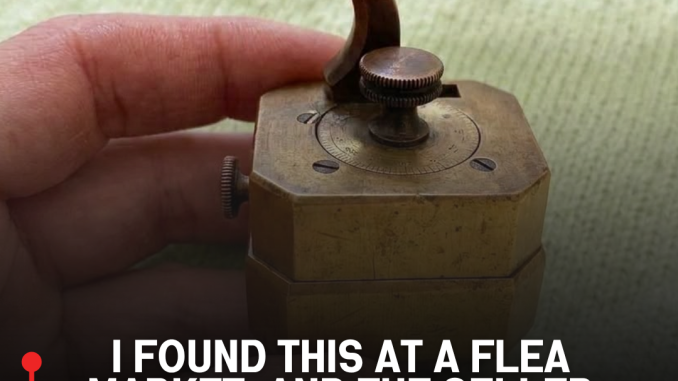
Flea markets are fascinating places. They’re filled with ordinary household items, forgotten treasures, and strange objects whose original purposes have long been forgotten. I went to the flea market that Saturday simply hoping to find something interesting—perhaps an unusual decoration for my living room or a quirky addition to my bookshelf.
Then I noticed a small metallic device unlike anything I had seen before.
Its polished brass exterior caught the sunlight, while several tiny, carefully crafted components suggested that it had once served a very specific purpose. I picked it up and was surprised by its weight. There was something strangely familiar about it, even though I couldn’t identify what it was.
I bought it on a whim, eager to discover its story.
When I got home, I examined the object more carefully. It was compact, with a smooth handle and a hinged top. Inside was a series of tiny, precisely aligned blades. At first, I thought it might be an antique tool or perhaps part of an old sewing kit.
Then I noticed the spring mechanism hidden inside.
I gently twisted the device, and the small blades suddenly snapped forward before retracting almost immediately.
My curiosity was instantly piqued.
What exactly was this strange little instrument designed to do?
After hours of research, I finally discovered the answer.
It was a scarificator, an antique medical instrument once used for bloodletting.
The discovery was fascinating—and more than a little unsettling.
Bloodletting was practiced for centuries because physicians believed that removing blood from the body could restore balance and help treat illness. Based on the ancient theory of the four humors, doctors believed that disease could result from an imbalance within the body. Removing blood was therefore considered a legitimate medical treatment for a wide range of conditions.
From ancient times through the 18th and 19th centuries, bloodletting remained a familiar part of medical practice.
And now I was holding one of the specialized instruments designed to perform it.
The scarificator itself was surprisingly sophisticated. Unlike a simple lancet or knife, it used a spring-loaded mechanism to release several tiny blades at once. The blades created multiple controlled cuts in a single movement, allowing practitioners to perform the procedure quickly and consistently.
For its time, the engineering was remarkably precise.
Every small component appeared carefully designed and fitted together. The brass casing, the springs, and the tiny blades reflected the craftsmanship of an era when medical instruments were often made by skilled metalworkers and instrument makers.
In an unusual way, the object was almost beautiful.
But knowing what it had been used for completely changed the way I looked at it.
I started imagining the people who had once encountered this instrument.
How many patients had nervously rolled up their sleeves and placed their trust in a physician holding something like this? How many doctors had used it with complete confidence, believing they were helping their patients recover?
That thought stayed with me.
To us, bloodletting can seem primitive or even frightening. But to the people who practiced it, it was not viewed as barbaric. It represented the medical knowledge available at the time and, most importantly, hope.
Physicians genuinely believed they were helping.
That is what makes historical medical objects so fascinating. They show us that scientific knowledge is constantly changing. Ideas that once seemed certain can eventually be questioned, tested, and replaced by better explanations.
The scarificator represented both human ingenuity and the limitations of the era in which it was created.
Its mechanism was carefully engineered, but the medical theory behind its use was eventually shown to be deeply flawed for most conditions.
Holding the instrument made me think about how much medicine has changed.
Modern medicine relies on scientific research, controlled studies, advanced technology, and a much deeper understanding of how the human body works. Treatments that were once based largely on tradition and observation can now be evaluated through evidence.
Yet progress did not happen overnight.
It came through generations of doctors, researchers, mistakes, discoveries, and people willing to question what had previously been accepted as fact.
That little antique suddenly felt like more than an old medical instrument.
It felt like a time capsule.
Every scratch on its brass surface seemed to hint at a history of its own. It had probably been handled countless times, cleaned, stored away, and eventually forgotten. Somewhere along the way, it went from being a useful medical instrument to becoming an object sitting unnoticed among other antiques.
And then, years later, I happened to find it.
I couldn’t help wondering about the rooms where it had once been used.
Perhaps a physician had carefully opened its mechanism under the dim light of an old clinic. Perhaps a nervous patient had watched as the instrument was prepared. Maybe it had been used hundreds of times before being placed in a drawer and eventually forgotten.
Those details are impossible to know.
But that uncertainty is part of what makes antiques so compelling.
They are not simply old objects.
They can preserve pieces of human history.
The scarificator reminded me that progress is not only about creating new technology. It is also about learning from the past. Sometimes, understanding what didn’t work is just as important as discovering what does.
It also reminded me to be humble about modern knowledge.
We like to believe that we have figured everything out, but future generations may look back at some of today’s practices with the same curiosity we feel when looking at old medical instruments.
What seems obvious to us now may eventually be challenged by new discoveries.
That is the nature of progress.
What fascinated me most was the human story behind the object. The doctors who used instruments like this probably believed they were doing the right thing. Their patients trusted them because they were relying on the best medical knowledge available at the time.
The instrument therefore represents more than an outdated treatment.
It represents people trying to understand illness with the knowledge they had.
It represents hope, curiosity, experimentation, and the constant desire to find better ways to help others.
I would never use the scarificator for its original purpose, of course. Today, it belongs on a shelf rather than in a medical bag.
But I look at it differently now.
What began as a strange object at a flea market became a small lesson in medical history. It showed me how dramatically our understanding of health has evolved and how important it is to continue questioning, researching, and learning.
Sometimes, the most interesting antiques aren’t the most valuable ones.
They are the ones that make you stop and wonder.
Who made this?
Who used it?
What did they believe?
And what can it teach us today?
My scarificator may be small, but its story stretches across centuries of medical history. It connects the present to a time when doctors relied on theories that now seem outdated and patients placed their trust in treatments that modern science has largely left behind.
In the end, I realized that the object was worth far more than the few dollars I paid for it.
It was a reminder that progress is a journey—one built through curiosity, mistakes, discovery, and an endless desire to understand the world around us.
So the next time you walk through a flea market, take a closer look at the strange objects sitting among the dusty books, old photographs, and forgotten trinkets.
You never know.
The smallest object might be carrying a story far bigger than itself.
For me, that strange brass device wasn’t just an antique.
It was a tangible reminder of how far humanity has come—and how much there is still left to learn.