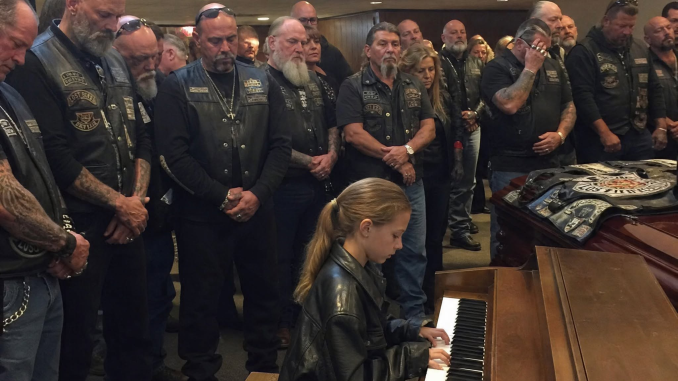
I never liked bikers.
To me, they were loud, intimidating, and usually surrounded by stereotypes I never cared to challenge.
That’s why it felt strange when I accepted a last-minute job to play piano at the funeral of an elderly biker named Walter “Ghost” McKenna.
The funeral director sounded embarrassed on the phone.
“There’s nobody coming,” he said quietly. “No family. No friends. We just need someone there.”
The pay was fifty dollars.
So that afternoon, I sat behind the chapel piano, facing a room filled with empty pews and one closed casket.
Seventy-four years of life, and apparently not a single person had come to say goodbye.
I began playing softly.
A few minutes later, the chapel doors suddenly burst open.
A young girl in a wheelchair rolled inside, tears streaming down her face.
She couldn’t have been older than nine.
Wrapped around her shoulders was an oversized leather biker jacket that nearly swallowed her tiny frame.
“Please don’t start yet!” she cried. “They’re coming. Ghost wouldn’t want to be alone.”
The funeral director looked confused.
“Are you related to Mr. McKenna?”
The girl shook her head.
“He’s my Ghost,” she answered firmly. “And he saved me.”
Then she looked toward the doors.
“They’re coming.”
Before anyone could ask another question, we heard it.
Motorcycles.
Lots of them.
The sound grew louder and louder until the entire building seemed to vibrate.
The little girl smiled through her tears.
“I told you.”
Moments later the doors opened again.
Bikers poured into the chapel.
Then came nurses.
Doctors.
Teachers.
Veterans.
Parents carrying children.
Elderly men and women using walkers.
The crowd kept growing until every seat was taken, the hallways filled, and people stood outside on the lawn.
A woman in business clothes hurried through the crowd.
“Mia!” she shouted.
The little girl turned.
“Mom.”
“You can’t leave the hospital without telling anyone!”
“But it’s Ghost,” Mia replied. “I had to come.”
Her mother looked at the casket and immediately broke down.
“He died?”
The funeral director explained that Walter had no emergency contacts, no listed family, and no known relatives.
That’s when a large biker wearing a ROAD CAPTAIN patch stepped forward.
“That’s because Ghost never wanted recognition,” he said.
He faced the room.
“How many of you knew his real name was Walter McKenna?”
No hands rose.
“How many knew where he lived?”
Again, silence.
Then he asked one final question.
“How many of you were helped by Ghost?”
Every hand in the room went up.
Every single one.
Including Mia’s.
The biker nodded.
“That was Ghost. He lived like a shadow but changed lives everywhere he went.”
Stories began pouring out.
An elderly widow explained how groceries mysteriously appeared on her porch every week after her husband died.
A doctor shared how Ghost once rescued a teenager from an overdose and personally paid for his rehabilitation.
That teenager eventually turned his life around and was now attending college.
A Paralympic athlete described how Ghost helped her believe in herself after losing both legs.
Others spoke of wheelchair ramps he built, medical bills he paid, veterans he helped, and families he supported during their darkest moments.
But Mia’s story touched everyone the most.
Two years earlier, a terrible accident had left her paralyzed.
Her father abandoned the family.
Her mother lost her job.
Eventually they were forced to live in their car.
One evening Ghost found them in a parking lot.
Mia was crying because she thought she would never return to school.
The next day he arrived with a custom wheelchair.
A day later he organized bikers to build ramps at her school.
Within a week he had arranged transportation, therapy, and medical equipment.
He never asked for anything in return.
He never even gave them his name.
“He always appeared when we needed him,” Mia said softly. “Then he disappeared before we could thank him.”
“That’s why I called him Ghost.”
Every week he visited her.
He brought books.
He encouraged her.
He taught her piano using an old keyboard he had repaired himself.
“He said music is like riding a motorcycle,” she smiled through tears. “You just have to find your rhythm.”
Then she looked at me.
“Can you play Amazing Grace? It was his favorite.”
I nodded.
As the melody filled the room, something extraordinary happened.
One by one, the bikers removed their leather vests and placed them on Ghost’s casket.
Each patch represented years of friendship, loyalty, and respect.
It was their final salute.
Someone asked why nobody knew Ghost had been sick.
An older biker answered.
“He had cancer for three years. Never told anyone.”
The room fell silent.
“He kept helping people until the very end.”
The funeral director then brought out an old photo album found in Ghost’s apartment.
Inside were almost no pictures of Ghost himself.
Instead, every page contained photos of people he had helped.
Children.
Veterans.
Recovering addicts.
Cancer survivors.
Families.
Beside each photograph was a handwritten note.
“Mia got straight A’s.”
“Tom celebrated another year sober.”
“Maria’s cancer is gone.”
Ghost had quietly celebrated everyone else’s victories while expecting no recognition for his own sacrifices.
Near the back of the album was one photograph that stopped the room cold.
A younger Ghost stood beside a smiling woman and a young boy.
The Road Captain looked down.
“That’s his wife Jenny and his son Walter Jr.”
His voice trembled.
“They were killed by a drunk driver in 1998.”
Nobody spoke.
“Ghost witnessed the entire accident.”
The room became completely silent.
“He couldn’t save his own family,” the biker continued. “So he spent the rest of his life saving everyone else’s.”
Mia slowly rolled toward the piano.
“Can I play something?”
I helped her onto the bench.
Her small fingers found the keys.
The melody was simple.
Imperfect.
But filled with so much love that grown men openly wiped tears from their eyes.
“He said I’d play at Carnegie Hall someday,” she whispered.
The funeral that began with empty seats became a celebration lasting more than three hours.
The procession to the cemetery stretched for miles.
Hundreds of motorcycles followed behind.
People stopped on roadsides and stepped out of their homes to watch.
At the gravesite, Mia insisted on throwing the first handful of dirt.
“Thank you, Ghost,” she said. “For teaching me that helping other people is the best way to heal yourself.”
Later, as everyone prepared to leave, the Road Captain handed Mia’s mother an envelope discovered in Ghost’s apartment.
Inside was five thousand dollars in cash.
There was also a letter.
Ghost had left the money for piano lessons.
Not rent.
Not bills.
Not groceries.
Piano lessons.
He believed in Mia’s dream even after he knew he was dying.
The final line read:
“We are not defined by what happens to us. We are defined by how we help others through what happened to us.”
Three years have passed since that day.
Mia was accepted into one of the nation’s most prestigious adaptive music programs.
The Ghost Riders continue his mission every weekend, helping people quietly and anonymously.
And me?
The Road Captain gave me the keys to Ghost’s old Harley after the funeral.
According to a note Ghost left behind, it was meant for whoever played piano at his service.
His reason was simple:
“Anyone willing to play for an empty room understands that the most important audiences are often the ones we cannot see.”
I never expected a biker to change my life.
But Ghost did.
He died believing he was alone.
What he never realized was that he had spent decades making sure nobody else ever felt that way.
And because of him, none of us do anymore.