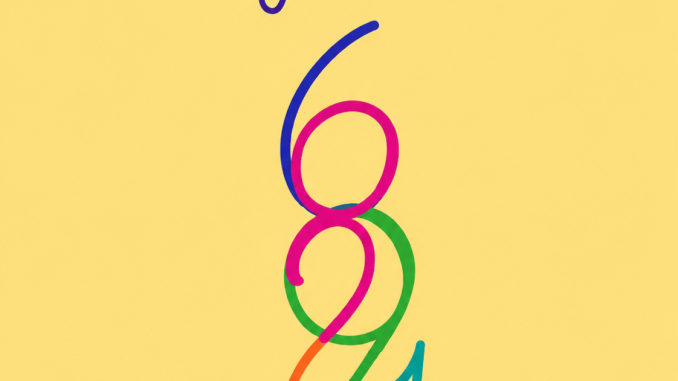
At first glance, this image looks like a simple visual puzzle. The question is straightforward:
“How many numbers do you see?”
But the answer is not as obvious as it seems. The drawing is made by overlapping several digits on top of one another, creating an optical illusion that challenges your observation skills.
Many people immediately spot only a few numbers, while others notice several more after taking a closer look. The key is to examine each line and curve carefully.
Step 1: Find the Number 6
Look at the upper portion of the figure. The large curved line looping downward forms a clear 6. This is usually the first number most people recognize.
Step 2: Spot the Number 8
Next, focus on the two circles stacked vertically in the center. Together they create the shape of an 8.
Step 3: Identify the Number 9
Now look at the upper circle combined with the curved line extending downward. This forms the number 9.
Step 4: Find the Number 2
The diagonal curved stroke running from the middle toward the lower left side creates the shape of a 2.
Step 5: Notice the Number 4
In the lower section of the drawing, the horizontal line crossing a vertical line forms a clear 4.
Step 6: Look for the Number 1
The straight vertical line on the right side can also be seen as the number 1.
The Final Answer
Depending on how you interpret the overlapping lines, most people can identify the following numbers:
1, 2, 4, 6, 8, and 9
That gives a total of 6 numbers hidden in the image.
Why Do People See Different Answers?
Visual puzzles like this are designed to test pattern recognition. Our brains naturally search for familiar shapes, but not everyone focuses on the same details. Some people quickly recognize the obvious digits, while others spend more time finding the hidden ones.
This is what makes optical puzzles so interesting. There is often more than one way to interpret the same image, and different viewers may notice different patterns.
Challenge Your Friends
Now that you know the solution, share this puzzle with your friends and family. Ask them how many numbers they can find before revealing the answer. You may be surprised by how many different responses you get.
So, how many numbers did you see before reading the explanation?