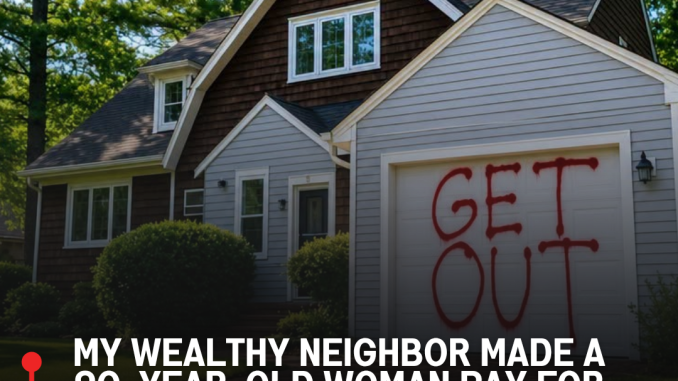
“How dare you!”
I slowly opened the door.
“What exactly did I do?”
He pointed toward the street.
“My house! What did you do to my house?”
I looked past him.
His lawn was brown.
The flower beds were overgrown.
Leaves and small branches were scattered across the walkway.
Nothing had been damaged beyond what the hurricane had already caused.
“What about it?” I asked.
“You know exactly what happened!”
I didn’t.
Or at least, I wanted him to tell me.
Gavin stepped closer.
“You told the landscaping company to stop servicing my property!”
“No,” I said calmly. “I didn’t.”
“You absolutely did!”
“I made one phone call.”
His face tightened.
“To whom?”
“The landscaping company you hired.”
He stared at me.
“And what did you tell them?”
“That they should send the invoices to the person who actually agreed to pay them.”
His mouth opened, but for a moment, no words came out.
Then I added, “You.”
Gavin finally understood.
For six months, our ninety-year-old neighbor, Ms. Darlene, had been paying the $80 monthly landscaping bill for his property.
I had simply made sure the company knew who was actually responsible.
Gavin scoffed.
“She volunteered!”
“No,” I said. “You asked her to do it.”
“She agreed.”
“She agreed because you promised to reimburse her.”
His face turned red.
“That was a misunderstanding.”
“A misunderstanding that cost a ninety-year-old woman $480.”
He looked away.
“I’ll deal with her later.”
“No.”
He turned back.
“You’ll deal with her now.”
He laughed.
“You don’t tell me what to do.”
I stepped onto the porch.
“No. But the neighborhood can decide what kind of neighbor you are.”
That made him pause.
Because by then, everyone knew what had happened.
After the hurricane, people throughout the neighborhood had been helping one another.
Neighbors brought food.
Teenagers cleared fallen branches.
A retired firefighter repaired damaged fences.
Others organized cleanup crews for elderly residents.
But Gavin had done something very different.
He had made sure his empty investment property received professional landscaping while a ninety-year-old woman living alone was left to handle her own storm damage.
And everyone had noticed.
The next morning, I was sitting at my kitchen table when I heard a truck outside.
Then another.
Then another.
I looked through the window.
Three landscaping trucks were parked in front of Ms. Darlene’s house.
Behind them were six men carrying chainsaws, rakes, wheelbarrows, and ladders.
I hurried outside.
“What’s going on?”
One of the workers smiled.
“Community cleanup.”
“Who hired you?”
He pointed down the street.
“Everyone.”
Within an hour, the entire block was working.
One neighbor repaired Ms. Darlene’s fence.
Another hauled away fallen branches.
A teenager cleaned her gutters.
Two women replanted the flowers destroyed by the storm.
The landscaping crew completely cleared her yard.
Ms. Darlene stood on her porch with tears in her eyes.
“I don’t know how to thank everyone.”
“You don’t have to,” I told her.
She smiled.
Then she looked toward Gavin’s house.
“What about him?”
I shrugged.
“He can afford his own lawn.”
Later that afternoon, Gavin finally came outside.
He stood in his driveway, watching everyone help Ms. Darlene.
Nobody said anything to him.
Nobody had to.
Eventually, he walked over.
“Darlene?”
She turned.
“Yes?”
“I owe you money.”
She nodded.
“$480.”
Gavin reached into his pocket and pulled out his wallet.
Then he stopped.
“I’ll give it to you tomorrow.”
She looked at him for a long moment.
“No.”
He frowned.
“What?”
“I don’t want it tomorrow.”
He looked confused.
“I want it today.”
The entire street seemed to go silent.
Gavin pulled out his phone.
“Fine.”
He transferred the money.
Ms. Darlene checked her account.
Then she smiled.
“Thank you.”
Gavin looked embarrassed.
But I wasn’t finished.
I handed him a folder.
He stared at it.
“What’s this?”
“Your receipts.”
Inside were copies of every landscaping payment Ms. Darlene had made over the previous six months.
$480.
I had also included photographs of her storm-damaged property, copies of the messages she had sent asking Gavin to reimburse her, and screenshots showing that he had ignored her requests.
His expression changed.
“Why did you keep all of this?”
“Because you told me you didn’t have time to deal with it.”
He looked down at the papers.
“You’ve been keeping records?”
“No.”
I pointed toward the neighbors.
“They have.”
Several people nodded.
Gavin looked around.
For the first time, he realized this wasn’t just one person confronting him.
It was an entire community watching.
Then Ms. Darlene surprised everyone.
She stepped toward him.
“Gavin, I don’t hate you.”
He looked at her.
“But I don’t want you asking me for favors again.”
He lowered his eyes.
“I understand.”
She nodded.
“And if you ever need someone to watch your house, hire someone.”
A few neighbors laughed.
Even Gavin managed a small smile.
Then he said something none of us expected.
“I’m sorry.”
Ms. Darlene studied him.
“Are you?”
“Yes.”
“For what?”
He took a breath.
“For treating you like you didn’t matter.”
Nobody spoke.
Then Ms. Darlene smiled.
“That’s better.”
Gavin walked away.
His Porsche was still sitting in the driveway.
But somehow, the expensive car didn’t seem nearly as impressive as it had a few days earlier.
A week later, something else happened.
Gavin hired a professional gardener.
This time, he paid every invoice himself.
Then he did something unexpected.
He paid for repairs to Ms. Darlene’s fence.
When she tried to refuse, he simply said, “Let me do this.”
Eventually, she accepted.
The neighborhood never forgot what happened.
But the real lesson wasn’t about Gavin’s wealth or his expensive car.
It was about something much simpler.
Having money doesn’t make someone important.
How you treat people does.
Sometimes the most powerful way to teach someone a lesson isn’t by humiliating them.
It’s by showing them what they should have done in the first place.
For Ms. Darlene, that meant finally receiving the kind of help she had spent years giving everyone else.
And for Gavin, it meant learning that in a good neighborhood, nobody gets to treat the kindest person on the street as though she doesn’t matter.