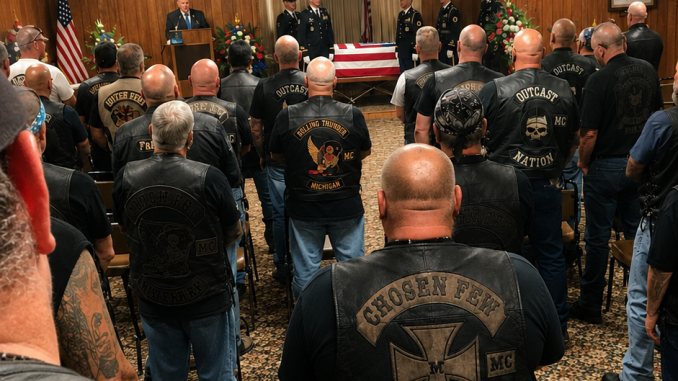
The funeral home director had called every motorcycle club within a hundred miles.
A 71-year-old Vietnam veteran named Richard “Doc” Patterson had passed away alone in a VA hospital. Estranged from his children and with no family willing to claim him, he was on the verge of being cremated without a service, without military honors, and without anyone there to remember the 32 years he spent serving his country as a combat medic.
The call reached our clubhouse on a Tuesday afternoon.
My name is Jack, and I’m the president of the Iron Brotherhood MC. We’ve received all kinds of requests over the years, but this one felt different.
“He has nobody,” the funeral director told me. “His daughter said she couldn’t be bothered to come. His son hung up when I called. This man served his country for decades, and now he’s about to leave this world as if none of it mattered.”
“When and where?” I asked.
There was a pause.
“You never even knew him.”
“He’s a veteran,” I replied. “That’s enough. Send me the details.”
That evening, I spread the word.
I contacted our chapter, neighboring clubs, veteran rider groups, and anyone who might care. The message was simple:
Vietnam veteran. Died alone. Family won’t attend. Funeral Friday at 2 p.m. Let’s make sure he’s not forgotten.
The response was overwhelming.
Everyone asked the same question.
“Did you know him?”
“No,” I said. “But that doesn’t matter.”
By Friday morning, motorcycles lined the streets around the funeral home.
The funeral director called sounding almost overwhelmed. The VA had arranged an honor guard. An Army chaplain had volunteered to officiate. A local news station had shared the story, and overnight it had spread throughout the community.
By 1 p.m., fifty-three bikers stood in full colors outside the chapel.
They weren’t alone.
More than two hundred local residents had come after hearing about the veteran who was about to be buried without anyone by his side.
As we entered, the funeral director greeted us with tears in her eyes.
“I’ve never seen anything like this,” she whispered.
I looked around.
“Has the family arrived?”
She shook her head.
“Not a word.”
The service began quietly.
The chaplain spoke about sacrifice, duty, and selflessness. The honor guard performed every movement with precision and dignity. Yet when the time came to present the folded American flag, there was no family member waiting to receive it.
Then, from the back row, an elderly man slowly stood.
Using a cane for support, he made his way forward.
“My name is Robert Martinez,” he said. “I knew Doc.”
The room fell silent.
“It was 1968, outside Da Nang. I was nineteen years old and bleeding to death in a rice field after being shot in the stomach. Richard Patterson ran through enemy fire to reach me. He carried me to an evacuation helicopter and saved my life.”
He held up an old photograph.
The image showed a young medic carrying a medical bag.
The face was unmistakable.
It was Doc.
“I saw the news last night,” Robert continued. “I recognized him immediately. I’ve carried this photograph for more than fifty years. The man in this picture gave me my life back. And now I find out his own children won’t even come to bury him.”
Many people openly wiped away tears.
Then a woman stood.
“My brother served with Doc,” she said. “He didn’t survive Vietnam. But Doc stayed with him during his final moments and later wrote our family a letter describing how brave he was. We still have that letter today.”
One story became another.
And another.
A VA nurse spoke next.
She described how Doc spent his later years volunteering with veterans suffering from PTSD.
Even while struggling with homelessness himself, he continued helping others.
“He gave away everything,” she said. “His pension. His disability checks. Any money he had. If another veteran needed housing or food, Doc would help them first. He sacrificed his own comfort to make sure someone else survived.”
Suddenly, the image of a forgotten homeless veteran looked very different.
He wasn’t forgotten at all.
He was a man who had spent his life putting others before himself.
Then the chapel doors suddenly opened.
A sharply dressed woman entered, followed by a man in an expensive suit.
Doc’s children.
The daughter looked around the packed room.
“What is all this?” she demanded.
The funeral director stepped forward.
“This is your father’s funeral,” she said calmly. “The one you said you couldn’t be bothered to attend.”
“We’re here now,” the son replied. “We’ll take care of everything from here.”
“Not happening,” I said.
Fifty-two bikers stood beside me.
The daughter looked annoyed.
“And who are you people?”
“We’re the ones who showed up,” I answered. “Where were you?”
“He was homeless,” she snapped. “He embarrassed our family. He always chose strangers over his own children.”
The VA nurse quietly spoke from across the room.
“You mean when he gave your college money to a veteran’s widow whose husband died by suicide?”
The daughter’s face tightened.
“That wasn’t his responsibility.”
“No,” the nurse replied. “But helping people was who he was.”
Robert Martinez stepped forward.
“Your father saved my life,” he said. “I spent decades trying to find him. While I built a successful business, he continued serving others until the very end.”
He pulled out his phone and made a call right there.
“This is Robert Martinez. I want arrangements made immediately for a full military burial at Arlington National Cemetery. I’ll cover every expense.”
Then he looked directly at Doc’s children.
“You may have abandoned him. But you do not get to decide his legacy.”
The room erupted in applause.
The daughter shook her head.
“He chose them over us.”
“No,” the nurse corrected gently. “He chose service over selfishness.”
Without another word, the siblings turned and left.
Their chance for reconciliation disappeared with them.
Two weeks later, Doc was buried at Arlington with full military honors.
More than three hundred bikers rode in tribute.
As the notes of Taps echoed across the cemetery and the American flag was carefully folded, hundreds stood silently in respect for a man many had never met.
Yet somehow, they all knew exactly who he was.
A hero.
Inspired by his life, Robert Martinez established the Richard Patterson Memorial Fund.
Within months, it raised more than $400,000 for homeless veterans and mental health support programs.
At the dedication ceremony, a plaque was unveiled featuring a photograph of Doc from his Vietnam days—young, determined, and carrying the medical bag that had saved so many lives.
The inscription read:
Richard “Doc” Patterson
Combat Medic
Served Others in War and in Peace
Never Forgotten
Every year since then, bikers, veterans, and community members gather at his gravesite.
Stories are shared.
Promises are renewed.
And one message remains unchanged:
No veteran left behind. No brother forgotten. No hero buried alone.
Sometimes, on long rides, I think about Doc.
I think about a man who spent his life helping strangers and died believing he had been forgotten.
But he wasn’t.
Fifty-three bikers—and hundreds more—made sure of that.
Because family isn’t always the people you’re born to.
Sometimes, family is the people who show up when everyone else walks away.
And that may be the greatest legacy Richard “Doc” Patterson ever left behind.