Some moments don’t feel real right away. Not because they’re dramatic, but because they unfold so quietly and unexpectedly that your mind needs time to catch up with what your eyes are seeing. They begin subtly… and then turn into something far more impactful than you ever imagined.
This was one of those moments.
And like many situations that leave a lasting impression, it didn’t start with anything unusual. No warning signs. No rising tension. Nothing to suggest that something significant was about to happen.
It started as just another normal day.
A Routine That Suddenly Shifted
I was at work, halfway through a quick lunch, checking emails and planning the rest of my day. Everything felt predictable—the kind of routine that blends into every other weekday.
Then my phone rang.
It was my sister, Mara.
That alone wasn’t strange—but the timing was. She almost never called during work hours unless something truly urgent came up.
So I answered immediately.
“Hey, what’s going on?”
There was a pause. I could hear wind on her end, like she was outside.
“You need to come home,” she said.
Her voice wasn’t panicked—but it was controlled in a way that made it clear something wasn’t right.
“What happened?” I asked.
“Just come,” she replied. “I’ll explain when you get here.”
That was all I needed.
The Drive That Didn’t Feel the Same
I left right away.
It was a drive I’d done countless times—the same roads, the same turns, the same transition from busy streets to quiet surroundings.
Nothing looked different.
But something felt different.
There’s a certain instinct that kicks in when you know something has changed… even if you haven’t seen it yet.
As I turned onto the dirt road leading to the house, that feeling grew stronger.
Then I saw it.
What Was Missing Said Everything
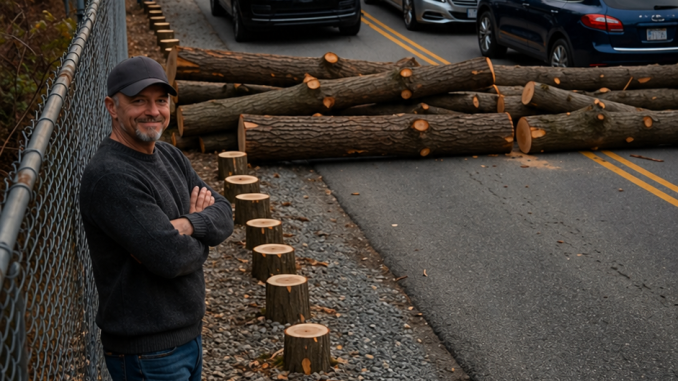
Along the eastern edge of my property, there had always been six sycamore trees.
They weren’t just trees—they were part of the land’s identity. They gave privacy, framed the property, and carried years of history. Three had been planted by my father when I was a kid.
They had always been there.
Until now.
In their place were six cleanly cut stumps.
No mess. No debris. Just precision.
Final.
Trying to Make Sense of It
I stepped out of the car slowly, almost as if moving too fast might somehow change what I was seeing.
It didn’t.
Mara stood nearby, arms crossed.
“I tried to stop them,” she said.
Earlier that morning, two trucks had arrived. Workers unloaded equipment and started cutting immediately. When she approached them, they told her they had a work order.
“From who?” I asked.
She hesitated.
“The Cedar Ridge Estates HOA.”
A Boundary That Should Have Been Clear
Cedar Ridge Estates sits on the ridge above my property—a well-maintained development with clear rules and boundaries.
But it’s separate from my land.
Different ownership. No overlap.
At least, that’s what I had always believed.
“We’re not part of that community,” I said.
“I know,” Mara replied.
When Assumptions Replace Facts
A business card had been left on my windshield. I called the company immediately.
After checking their records, the representative confirmed it.
“We received a request from the homeowners’ association,” he said. “They wanted clearing along their boundary.”
“That boundary isn’t theirs,” I replied. “Those trees were on my property.”
There was a pause.
“They said the trees were blocking their view,” he added.
And just like that, everything made sense.
Choosing How to Respond
At that moment, I had a choice.
I could escalate immediately—lawyers, complaints, confrontation.
Or I could slow down, understand the situation fully, and respond with intention.
I chose the second option.
A Conversation Instead of Conflict
I reached out to the HOA and asked for a meeting.
No accusations. Just facts.
A few days later, we sat down together.
I brought documentation—property maps, surveys, clear proof of the boundary.
There was no ambiguity.
And to their credit, they listened.
Accountability and Resolution
As the conversation unfolded, it became clear this wasn’t done out of malice—it was a failure in process.
A decision made without proper verification.
And once that was understood, the tone shifted.
They acknowledged the mistake.
And that changed everything.
Rebuilding More Than Trees
We agreed on a solution:
- The trees would be replaced with mature plantings
- All costs would be covered
- Property boundaries would be formally documented
- Future work near boundaries would require confirmation
We also clarified the access road agreement to avoid future confusion.
A few weeks later, new trees were planted.
They weren’t the same—but they restored something important.
What Really Changed
The biggest impact wasn’t the replacement.
It was what came after.
Better communication.
Clearer awareness.
More careful decision-making.
What started as a mistake became an opportunity to improve.
Final Thought
In the end, this wasn’t just about trees.
It was about boundaries—and how easily they can be crossed when assumptions replace facts.
The outcome wasn’t shaped by the problem itself…
…but by how it was handled.
And sometimes, that makes all the difference.