I didn’t understand why my mother insisted on going into that store.
“Mom, just tell me what we’re doing here,” I asked as we stepped inside.
She didn’t answer.
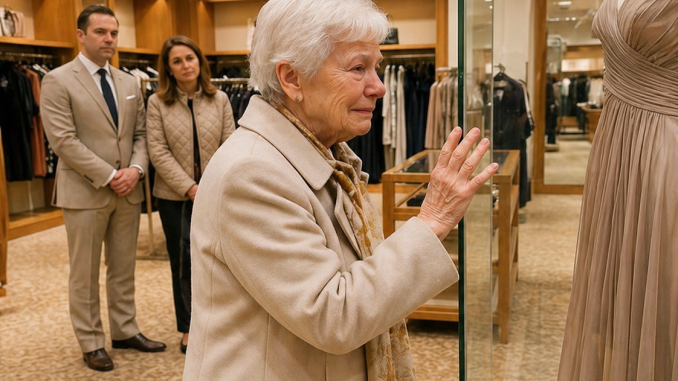
She simply walked forward, her cane tapping softly against the polished floor. In that space, she looked small—not fragile, just… easy to overlook. Her coat was worn, her shoes practical, her gray hair pinned back the same way it had been for years.
To most people, she probably looked like someone who had wandered in by mistake.
I noticed the glances immediately. Quiet whispers. Curious looks. Assumptions forming without a single word spoken.
But my mother moved with quiet purpose.
She went straight to the formalwear section, slowing as she reached the racks. Her fingers brushed across the fabrics—silk, lace, velvet—carefully, almost reverently. She checked seams, turned sleeves inside out, studied the stitching.
I had seen that look before.
It was the same expression she used to have years ago, sitting late at the kitchen table, sewing dresses for other people. Prom nights. Weddings. Special occasions. She spent decades creating beauty for others, while asking for very little in return.
Then she stopped.
In the display window stood a midnight-blue gown under soft lights. Elegant. Timeless. Every detail carefully crafted. A small sign beside it mentioned it was part of a heritage collection from decades ago.
My mother slowly raised her hand and touched the glass.
Her eyes filled with tears almost instantly.
That was when a manager approached us, his voice polite but cautious.
“Can I help you?”
“We’re just looking,” I replied.
But he didn’t leave. Soon, another staff member appeared. Then security. Three people watching an elderly woman quietly standing in front of a dress.
It felt… unnecessary.
My mother didn’t react. She kept looking at the gown like it held something she couldn’t let go of.
Then a young clerk stepped forward.
“Wait,” she said.
Before anyone could stop her, she carefully opened the display and lifted the gown. She turned the lining inside out… then paused.
She looked at my mother.
“Ma’am… is your name Evelyn?”
My mother blinked. “It used to be,” she said softly.
The clerk gently showed us the inside lining.
There it was—stitched in small, careful letters. A name. And a date.
My mother had made that dress.
Over forty years ago.
The room fell completely silent.
Everything shifted in an instant. The suspicion. The distance. The judgment. It all turned into something else—something closer to respect… and a quiet kind of embarrassment.
My mother’s hands trembled as she reached for the gown. The clerk placed it carefully into her arms.
She touched every detail—the collar, the buttons, the seams—like she was reconnecting with a part of herself.
“I wanted to see it again,” she said softly. “Before my hands forget how.”
That moment said everything.
Time had changed her hands. Slowed them. Made simple tasks harder. But it hadn’t erased what they had once created.
The store grew quiet in a different way—not the usual shopping silence, but something deeper. Reflective.
I spoke before I could stop myself.
“You saw an older woman standing here,” I said, “and assumed she didn’t belong.”
No one argued.
Because it was true.
A senior manager stepped in, more focused on policy, speaking about the gown as an item—something valuable, something protected.
My mother looked at him calmly.
“Before I return it,” she said, “can I ask you something? Do you always speak about work like it belongs to the building… instead of the person who created it?”
That question changed everything again.
Because it was never just about the dress.
It was about recognition. About the people behind the work—the ones whose stories are often forgotten.
The young clerk asked gently, “Why did you come today?”
My mother looked down at the gown.
“Because some days I remember everything,” she said. “And some days I don’t.”
She smiled faintly, tears still in her eyes, as if she were speaking to an old friend.
In that moment, I understood something I hadn’t fully seen before.
Every older person carries a lifetime inside them—skills, memories, sacrifices, creations. Entire chapters the world rarely pauses to acknowledge.
We focus on what we see now.
And forget everything that came before.
My mother didn’t come to that store to shop.
She came to find a piece of herself.
And for a brief moment, everyone in that room saw her not as someone out of place…
…but as someone who had always belonged.