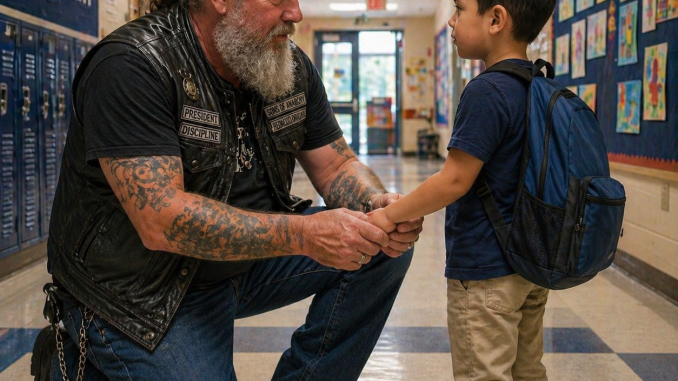
I saw him standing outside my son’s classroom, and my heart nearly stopped.
He was a big man, tall and broad, wearing a black biker vest and covered in tattoos. To me, he looked intimidating. Dangerous, even.
Then I saw him kneeling beside my eight-year-old son, Jake.
I didn’t stop to ask questions. I didn’t try to understand. I simply reacted.
I rushed over, grabbed Jake’s hand, and pulled him away.
“Excuse me,” I said coldly. “Can I help you?”
The man slowly stood up. He looked older than I expected, maybe in his sixties. His voice was calm.
“No, ma’am,” he said. “I was just saying hello to Jake. We’ve been—”
“Jake, go to class,” I interrupted.
My son looked like he wanted to say something, but I didn’t let him. I pointed toward the classroom.
“Now.”
Jake walked away, looking back at the man with a strange sadness in his eyes.
The second my son was gone, I turned back to the biker.
“I don’t know who you are,” I said, “but I don’t want you anywhere near my child.”
He took a breath. “Ma’am, my name is Ray Garrett. I’m a volunteer here. I’ve been cleared by the district. I have a background check—”
“I don’t care,” I said. “You don’t look like someone who should be around children.”
The words came out before I truly understood how cruel they were.
I went straight to the principal’s office.
Principal Henderson listened quietly as I explained what had happened. He didn’t seem surprised by the man’s presence.
“Mrs. Matthews,” he said gently, “Mr. Garrett has volunteered at this school for two years. He’s a retired veteran. He’s passed every required background check. The children love him.”
But I wouldn’t listen.
“He is covered in tattoos,” I said. “He looks completely inappropriate. If he stays, I’ll go to the school board. I’ll go to the superintendent. I’ll go to the news.”
The principal looked tired. Finally, he nodded.
“I’ll ask Mr. Garrett to volunteer somewhere else.”
I walked out feeling like I had won.
I thought I had protected my son.
But later that afternoon, Jake came home crying.
Not just small tears. He was sobbing so hard his shoulders shook.
“You made Mr. Ray leave!” he shouted.
I froze.
“Mr. Ray?”
“The biker!” Jake cried. “He was helping me read! He’s the only one who understands me!”
My stomach dropped.
Jake had severe dyslexia. Reading had always been a battle for him. We had tried tutors, specialists, programs, and extra help after school. Nothing seemed to work for long.
He was falling behind. Other kids had started calling him stupid. Slowly, I watched my little boy lose confidence in himself.
And now he was telling me that the man I had removed from the school was the only person helping him.
“He has dyslexia too,” Jake said through tears. “He knows how to make the letters stop jumping. He uses colored paper and special tricks. He never gets mad when I mess up.”
I could barely breathe.
“How long has he been helping you?” I asked.
“Six months,” Jake whispered.
Six months.
This man had been helping my son for six months, and I didn’t even know.
Then Jake said the words that destroyed me.
“You didn’t even ask, Mom. You just looked at him and decided he was bad.”
I had no answer.
Because he was right.
Later, I found an old permission slip in a stack of papers on my desk. It mentioned after-school reading support. I had signed it months earlier without truly reading it.
I had been too busy.
Too distracted.
Too careless.
And then, when I finally saw the man helping my son, I judged him by his appearance.
The next morning, I searched for Ray Garrett online. I found a local newspaper article about a veterans motorcycle club that had started a reading program for children with dyslexia.
There was Ray’s picture.
He was a Vietnam veteran who had struggled with undiagnosed dyslexia for most of his life. He had learned to read late and had promised himself he would help children who felt the same shame he once felt.
I sat there staring at his photo, feeling smaller than I had ever felt.
I had called that man dangerous.
I had called him inappropriate.
And all he had done was help my son.
That afternoon, I drove to the motorcycle club listed in the article.
When I walked inside, everyone knew who I was.
A man at the door looked at me coldly.
“You’re the mother who got Ray kicked out.”
I swallowed hard.
“Yes,” I said. “And I need to apologize.”
He stared at me for a long moment, then stepped aside.
Ray was sitting at a table in the back with colored paper, markers, and children’s books in front of him.
When he saw me, his face changed. Not angry. Just guarded.
“Mr. Garrett,” I said, my voice shaking, “I am so sorry.”
He said nothing.
“I judged you because of how you looked. I didn’t ask who you were. I didn’t ask what you were doing for my son. I was wrong.”
My eyes filled with tears.
“Jake told me everything. He told me you helped him read. He told me you made him feel smart again.”
Ray looked down at the table.
“That boy is smart,” he said quietly. “He just needs the right tools.”
“I know that now,” I whispered. “And I’m begging you to keep helping him. Anywhere you want. The library. My house. I’ll drive him wherever I need to.”
Ray was silent for a long time.
Finally, he said, “I don’t want your money.”
“I understand.”
“But I’ll help Jake at the library twice a week,” he said. “On one condition.”
“Anything.”
“You stay for every lesson. You watch. You learn. You understand what your son needs.”
I nodded immediately.
“I will.”
That Thursday, I took Jake to the library.
The moment he saw Ray, he ran into his arms.
“Mr. Ray!”
Ray hugged him gently.
“Hey, buddy,” he said. “Ready to get back to work?”
Jake nodded, smiling for the first time in days.
I sat nearby and watched.
Ray used yellow paper, colored overlays, larger fonts, and simple tracking exercises. He let Jake move at his own speed. He celebrated every small success. When Jake made a mistake, Ray never sighed. Never looked disappointed.
He simply said, “Try again. Your brain is working hard. Give it time.”
For the first time, I watched my son read without fear.
Slowly, yes.
Carefully, yes.
But he was reading.
And he was proud.
During a break, Ray told me about his own childhood. He told me how he had been called lazy and stupid because he couldn’t read like other kids. He told me about joining the military and hiding his struggle for years.
Then he told me about the soldier who finally taught him.
“He saved my life,” Ray said. “Not from war. From believing I was worthless.”
I looked at him with tears in my eyes.
“And I treated you like you were someone to fear.”
Ray gave a sad smile.
“People have looked at me that way most of my life,” he said. “You weren’t the first.”
“That doesn’t make it right,” I said.
“No,” he replied. “It doesn’t.”
Over the next three months, Jake changed.
His reading improved. His confidence returned. He started raising his hand in class. He stopped calling himself stupid.
His teacher called me one afternoon, almost in shock.
“Whatever you’re doing,” she said, “keep doing it.”
But it wasn’t me.
It was Ray.
And I knew I had to make things right.
At the next school board meeting, I stood in front of everyone and told the truth.
“My name is Jennifer Matthews,” I said. “A few months ago, I demanded that Ray Garrett be removed from Jefferson Elementary because of the way he looked. I was wrong.”
The room went quiet.
I told them about Jake. About the tutoring. About the dyslexia. About the man behind the leather vest and tattoos.
Then Jake stood beside me.
“Mr. Ray is not scary,” my son said clearly. “He is my hero. He taught me I’m not stupid. I’m just wired different.”
That was the moment everything changed.
The school board voted to bring Ray back.
Not only that — they created a paid part-time position for him as a reading support specialist for children with dyslexia.
When I called Ray to tell him, he was quiet.
“They want to pay me?” he asked.
“Yes,” I said. “Because what you do matters.”
On his first day back, the children were waiting for him with handmade posters.
“Mr. Ray helped me read.”
“Mr. Ray never gave up on me.”
“Mr. Ray made me feel smart.”
That strong, tattooed biker stood there surrounded by children and cried.
And I cried too.
Because I finally saw him.
Not the tattoos.
Not the vest.
Not the image I had created in my mind.
I saw the man.
A veteran. A teacher. A mentor. A person with a huge heart who had spent years helping children believe in themselves.
Later that evening, Ray sat on my porch drinking coffee.
“You know,” he said, “that day in the hallway hurt. Not because you were protective. Parents should protect their children. It hurt because you looked at me and decided you already knew who I was.”
I looked down.
“I’m sorry,” I said again.
Ray nodded.
“But you changed,” he said. “That matters. A lot of people apologize. Not many people learn.”
Jake is in fifth grade now. He reads above his grade level. Ray’s program has helped more than a hundred children.
And Jake says that when he grows up, he wants to be a teacher.
“Like Mr. Ray,” he says. “I want to help kids who think they’re stupid learn the truth.”
Last month, Ray took Jake for a short motorcycle ride around the block. The old version of me would have said no immediately.
But this time, I watched my son put on his helmet and climb onto that Harley with the biggest smile on his face.
Ray rode slowly down the street, careful and steady.
And I realized something.
Ray had taught my son how to read.
But he had taught me something even harder.
He taught me how to see people.
Really see them.
Past the tattoos.
Past the leather.
Past the assumptions.
Sometimes, the person who looks the scariest is the safest person in the room.
Sometimes, behind ink and leather, there is the kindest heart you will ever meet.
I almost let my prejudice take away the best teacher my son ever had.
But Ray gave us a second chance.
And I will spend the rest of my life trying to deserve it.