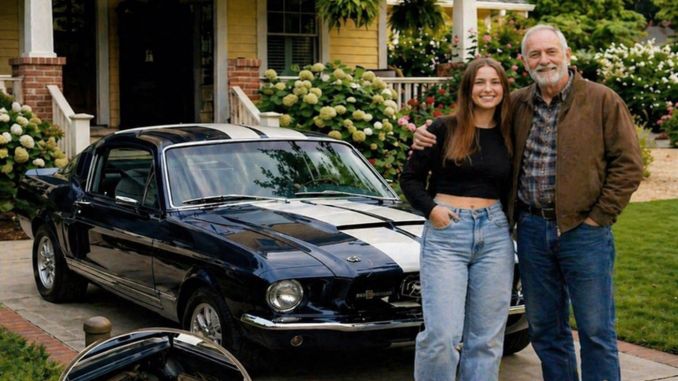
On the morning of her father’s funeral, Hazel woke before sunrise, as if her body already sensed the heaviness of the day ahead. The house was quiet, wrapped in that strange silence that follows loss—where even familiar things feel distant. She sat at the kitchen table, holding a cup of coffee that slowly went cold as she scrolled through old photos on her phone. There he was—her father—standing proudly beside his car. The same car he cared for every Sunday, not because of its features, but because of the memories tied to it. Road trips. Long conversations. Moments that mattered.
To him, it was never just a car.
And now, it felt like one of the last real pieces of him she still had.
Her phone buzzed, breaking the silence. The name on the screen made her uneasy.
Karen.
Hazel answered, already expecting something difficult.
“I won’t be coming today,” her stepmother said, her tone distant. “It’s just… too much.”
Hazel paused.
“I understand,” she replied softly, even if part of her didn’t fully believe it.
When the call ended, the weight of everything settled even more heavily. Now, she was alone—not just in grief, but in responsibility.
Her eyes drifted toward the driveway, where the car sat.
Her father’s Shelby.
Without thinking too much, she made her choice. She would drive it to the funeral. It felt right—like bringing a piece of him along for the final goodbye.
The service passed in a blur.
Hazel stood before a room of people who had known her father in different ways—friends, neighbors, coworkers. She spoke with quiet strength, though her voice trembled at times.
She spoke about his patience.
About how he truly listened. About how he never rushed through life.
And then, almost naturally, she spoke about the car.
Not as an object—but as a symbol.
“He cared for it the same way he cared for people,” she said. “With consistency. With pride. With love.”
There were soft nods, quiet tears, understanding.
For a brief moment, everything felt aligned.
But outside, that fragile peace shattered.
Hazel stepped into the sunlight—and froze.
The space where the Shelby had been parked was empty.
A tow truck stood in its place.
Her breath caught.
Then she saw Karen.
Standing calmly, as if nothing unusual had happened.
Hazel approached, her steps heavy.
“Where is the car?” she asked.
“I sold it,” Karen replied plainly. “It was time.”
The words hit hard.
“You did what? Today?” Hazel couldn’t hide her shock.
Karen sighed. “It’s just a car, Hazel. We have to move on. Holding onto things like that—it’s not healthy.”
Not healthy.
Hazel stared at her, stunned.
“That wasn’t just a thing,” she said, her voice shaking. “It meant something—to him… and to me.”
Karen crossed her arms. “Well, it’s gone now. Life continues.”
But this wasn’t just about the car anymore.
It felt like something meaningful had been taken too soon—before she had the chance to say goodbye.
Before Hazel could respond, a pickup truck pulled in.
A man stepped out, holding a small sealed bag.
“Are you Hazel?” he asked.
She nodded.
“I work at the shop that handled the car,” he said. “We found this inside.”
Inside the bag was an envelope.
Worn. Carefully sealed.
Hazel opened it with trembling hands.
Inside—a letter.
Her father’s handwriting.
She knew it instantly.
As she read, everything else faded away.
He wrote about plans he never got to share.
About a trip he had dreamed of—just the two of them, driving with no schedule, no distractions.
He wrote about the car—not as a possession, but as a place filled with memories.
Moments. Meaning.
And then one line stayed with her:
“Some things are worth holding onto—not because they’re perfect, but because they carry pieces of us we don’t want to lose.”
Hazel lowered the letter slowly.
Something inside her shifted.
Not gone—but different.
In the days that followed, things became quieter. Not easier—but clearer.
She read the letter again and again, finding new meaning each time.
Her anger slowly softened—not into instant acceptance, but into understanding.
She realized the car had mattered—but it was never the only thing that mattered.
What it represented… still remained.
Even Karen began to soften, just a little.
They talked—carefully at first.
Not perfectly. Not easily.
But with more understanding than before.
Later, Hazel visited the shop where the car had been taken.
She didn’t expect anything.
Just closure.
Standing there, she realized something unexpected:
The car might be gone.
But what it meant to her… wasn’t.
And maybe never would be.
What began as a painful loss slowly became something else.
A turning point.
A reminder that meaning isn’t always tied to what we can hold.
Sometimes, even when something disappears—
what it stands for stays with us.
Quiet. Lasting.
Still there.