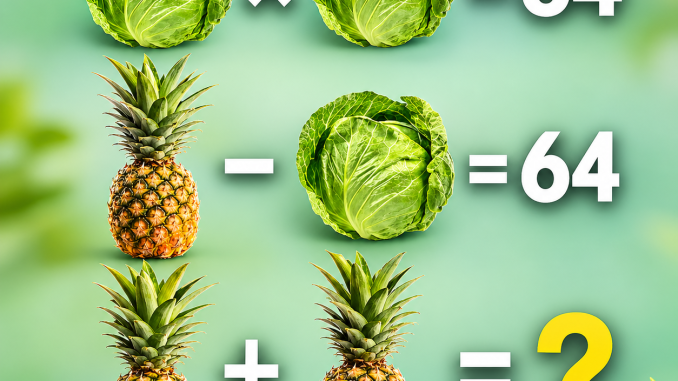
At first glance, this image looks like a simple and playful math puzzle built around everyday fruits and vegetables. But like many visual riddles, its simplicity is exactly what makes it engaging. It invites you to slow down, observe carefully, and think step by step.
The puzzle presents three separate equations using cabbages and pineapples. Each item represents a hidden numerical value, and your goal is to figure out what those values are before solving the final line.
The first equation shows a cabbage multiplied by another cabbage, and the result is 64. This immediately gives us a strong starting point. If the same object multiplied by itself equals 64, then we are dealing with a square number. The number that multiplied by itself gives 64 is 8. So from this, we can conclude that each cabbage represents the value 8.
Once we understand that cabbage equals 8, we can move on to the second equation. This one shows a pineapple minus a cabbage, and the result is again 64. Now that we already know the value of the cabbage, we substitute it into the equation. This gives us pineapple minus 8 equals 64. To find the value of the pineapple, we simply add 8 to both sides. That means the pineapple must be equal to 72.
Now we have both values: cabbage equals 8, and pineapple equals 72.
The final step is the easiest one, but only if the previous steps were done correctly. The last line asks for the result of pineapple plus pineapple. Since one pineapple is worth 72, adding two of them together gives 144.
What makes puzzles like this so effective is not their difficulty, but their ability to test attention and logical thinking. Many people rush through them and miss simple details, while others take a moment to break each step down and arrive at the correct answer.
In the end, the solution is clear: the final result is 144.