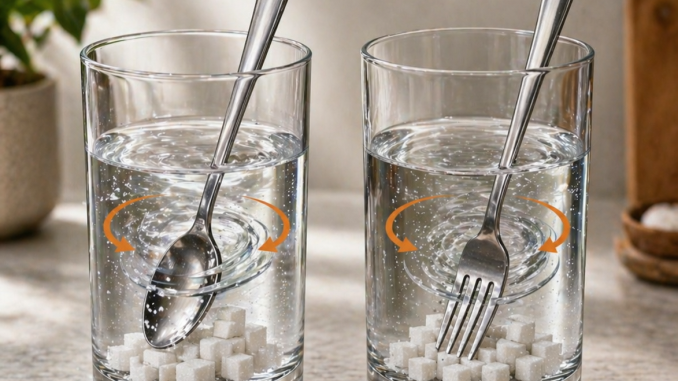
At first glance, many people assume that option B (stirring with a fork) will dissolve the sugar cubes faster because the fork has gaps that might seem to “break” the water more effectively. Others believe the spoon (A) is better because it has a larger surface and can move more water at once. However, when you look at the science behind it, the answer becomes much clearer.
The speed at which sugar dissolves in water depends primarily on how quickly fresh water comes into contact with the surface of the sugar cubes. When sugar sits still at the bottom of a glass, the water around it becomes saturated, and the dissolving process slows down. Stirring solves this problem by constantly moving the water, bringing unsaturated water into contact with the sugar and carrying dissolved particles away.
This process is called agitation, and it is the main factor that increases the rate of dissolving.
Both the spoon and the fork are simply tools used to create that movement. As long as you stir at the same speed and with similar intensity, both utensils will create enough circulation in the water to dissolve the sugar efficiently. While there may be very small differences in how the water flows—such as slightly smoother motion with a spoon or slightly more turbulence with a fork—these differences are not significant enough to noticeably change the outcome.
In real conditions, what matters most is:
- How fast you stir
- How consistently you stir
- The temperature of the water (warmer water dissolves sugar faster)
- The size of the sugar cubes (smaller pieces dissolve quicker)
The type of utensil plays only a minor role compared to these factors.
Final conclusion: There is no meaningful difference between A and B. Sugar will dissolve at nearly the same rate in both cases if the stirring speed and conditions are the same. The key factor is the movement of the water, not whether you use a spoon or a fork.