I always believed rock bottom would come with a warning.
Something obvious. A moment to brace myself.
But instead, it arrived quietly—like everything in my life had been slowly falling apart without me even noticing.
At 34 weeks pregnant, I stood in a house that no longer felt like home. Bills kept piling up, and the person I thought I could count on was gone. When I told Daniel I was keeping the baby, he didn’t argue—he just walked away, like I had suddenly become too much.
Then came the call that made everything real.
Foreclosure.
I don’t even remember hanging up. I just stood there, one hand on my stomach, whispering to my unborn daughter.
“I’m trying,” I said softly. “I really am.”
She kicked back—strong and steady—like she already understood.
I stepped outside just to breathe. The heat hit me instantly, thick and overwhelming, but it was still better than being alone with my thoughts.
That’s when I saw my neighbor, Mrs. Carter.
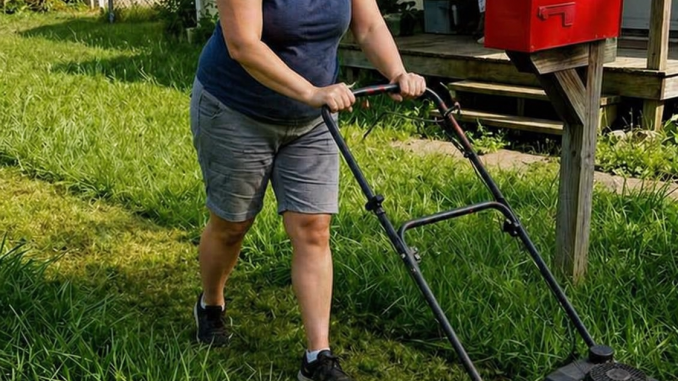
At 82, she was struggling with an old lawn mower, trying to cut grass that had grown far too tall. She smiled at me, but her eyes told a different story.
“Beautiful day,” she said, despite the heat.
I should have gone back inside.
I was exhausted. Everything hurt. My life felt like it was collapsing.
But something about her—her determination, the way she refused to give up—stopped me.
“Let me help,” I said.
At first, she refused. Pride doesn’t disappear easily, especially after a lifetime of independence. But eventually, she stepped aside.
And I took over.
Every step was harder than the last. The heat made it hard to breathe, and my body resisted with every movement. Still, I kept going.
Because helping her felt easier than facing my own problems.
When I finally sat down, shaky and drained, she handed me a glass of cold lemonade.
We sat in silence for a while.
Then she asked gently, “Who’s there for you right now?”
I didn’t lie.
“No one,” I said.
She didn’t offer pity or empty words. She simply nodded, like she understood.
“Being strong doesn’t mean doing everything alone,” she said quietly.
I finished her lawn that day, went home, and collapsed into bed feeling just a little lighter.
I had no idea it would be the last time I saw her.
The next morning, sirens woke me.
Flashing lights. Neighbors gathering. That heavy feeling that something was wrong.
When the sheriff knocked on my door, I already knew.
Mrs. Carter had passed away.
The words barely sank in—until he said something unexpected.
“She left something for you.”
Confused, I followed him outside.
Inside my mailbox were two envelopes.
One had my name on it.
The other had bold red letters:
PAID IN FULL.
For a moment, I couldn’t breathe.
I opened the letter with trembling hands.
She had somehow found out about my foreclosure.
And without telling me, she did something unimaginable.
She contacted her bank and used what she called her late husband Arthur’s “rainy day fund” to pay off everything I owed.
Just like that.
No warning. No expectations. No conditions.
She simply helped.
Her words were written clearly in the letter:
“Women take care of each other, especially when no one else does.”
That’s when it all hit me.
I broke down completely—standing there, holding a letter from someone who had so little left, yet chose to give anyway.
She didn’t just help me.
She gave my child a future.
Later that day, my phone rang.
It was Daniel.
I stared at the screen for a moment.
Then I let it ring.
Because for the first time in months, I didn’t feel alone.
I felt seen. Supported.
That evening, I sat on my porch with her letter in my lap, my hand resting gently on my belly.
“We’re staying,” I whispered.
My daughter moved softly, like she agreed.
That house wasn’t just a home anymore.
It was a second chance.
A reminder that kindness doesn’t disappear—it grows in ways we don’t always expect.
As the sun set, I smiled through quiet tears.
“I know what your name will be,” I whispered.
Clara.
And for the first time in a long time, the future didn’t feel uncertain.
It felt full of hope.