My daughter had been mentioning a teacher who kept embarrassing her in class. At first, I didn’t think much of it… until I saw the name listed as the coordinator of her school’s charity fair.
It was the same woman who had humiliated me years ago.
And this time, she had chosen the wrong student.
School had been the hardest time of my life. I tried my best, but one teacher made sure I never left her classroom feeling good about myself.
Her name was Mrs. Carter.
She mocked my clothes. Called me “cheap” in front of everyone like it was something to laugh about. Once, she looked straight at me and said, “Girls like you grow up to be broke, bitter, and embarrassing.”
I was only 13.
That day, I went home and skipped dinner. I never told my parents—I was too afraid she’d fail me in her class. Some classmates were already teasing me for my braces. I didn’t want to make things worse.
The day I graduated, I left that town with one suitcase and a promise to myself: I would never think about her again.
Years passed. I built a new life. A home. Stability.
So why was her name suddenly back in my world?
It started when my daughter, Lily, came home unusually quiet.
She’s 14, bright, talkative, always full of energy. But that evening, she just sat at the table, pushing her food around.
“What’s wrong?” I asked.
“Nothing, Mom… there’s just this teacher.”
She explained how a new teacher had been putting her down in front of the class—calling her “not very bright” and making her feel like a joke.
“What’s her name?” I asked.
“I don’t know yet… and please don’t come to school,” she said quickly. “The other kids will make fun of me. I can handle it.”
But I could see she couldn’t.
Something about it felt too familiar.
I planned to meet the teacher, but the very next day, I got hit with a bad respiratory infection and was stuck in bed for two weeks.
My mother came to help—handling everything while I lay there feeling completely powerless, knowing Lily had to face that classroom every day.
Then the school announced a charity fair.
And suddenly, Lily changed.
She signed up immediately and started making reusable tote bags from donated fabric.
Every night, I’d find her at the kitchen table, sewing carefully under the dim light.
“You don’t have to push yourself this hard,” I told her.
She just smiled. “People will actually use them, Mom.”
I was proud—but I couldn’t stop thinking about that teacher.
A few days later, I saw the flyer.
Under “Faculty Coordinator,” there it was:
Mrs. Carter.
My stomach dropped.
I checked the school website—and there she was. Older, sure, but the same expression. The same presence.
She was the one doing this to my daughter.
And I knew I wouldn’t stay silent.
The day of the fair, the gym was full of life—kids, parents, laughter, the smell of popcorn and cinnamon.
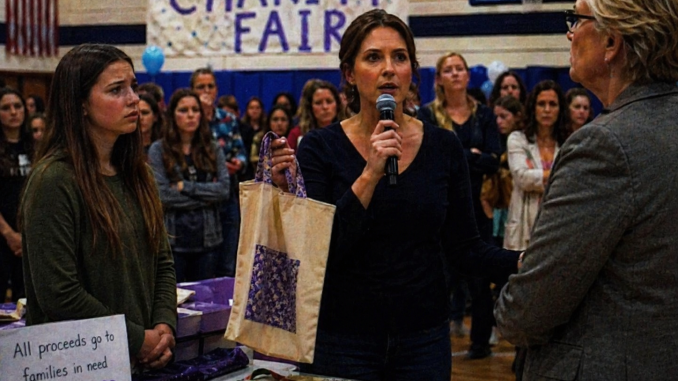
Lily’s table was near the entrance. She had lined up 21 handmade bags, each one carefully stitched.
Within minutes, people started buying them.
She was glowing.
For a moment, I thought… maybe today would be okay.
Then I saw her.
Mrs. Carter walked toward us.
She recognized me instantly.
“Anna?” she said.
“I was planning to speak with you,” I replied calmly.
She turned to Lily’s table, picked up one of the bags, and held it like it was something dirty.
Then, just loud enough for me to hear, she said:
“Well… like mother, like daughter. Cheap fabric. Cheap work.”
She smiled politely and added that Lily “wasn’t as bright as the others.”
I watched her walk away.
Then I looked at my daughter—standing there, hands pressed against the table, staring down at the work she had poured her heart into.
And something inside me finally broke free.
Someone had just set the microphone down.
I picked it up.
“I think everyone should hear this,” I said.
The room went quiet.
“When I was 13,” I continued, “this same teacher told me I would grow up to be ‘broke, bitter, and embarrassing.’”
People turned.
“And today, she said something very similar to my daughter.”
I held up one of Lily’s bags.
“This was made by a 14-year-old who stayed up every night for two weeks, using donated fabric, to help families she doesn’t even know.”
Silence filled the room.
“She didn’t do it for a grade. She did it to help.”
Then I asked:
“How many of you have heard this teacher speak to students like that?”
At first, nothing.
Then one hand went up.
Then another.
Then more.
Parents spoke. Students spoke.
“She told my son he wouldn’t succeed.”
“She said I wasn’t worth the effort.”
It wasn’t chaos.
It was truth.
“I’m not here to argue,” I said. “I just want the truth to be heard.”
Then I looked directly at her.
“You don’t get to decide who these children become.”
I took a breath.
“You once told me what I’d become. You were wrong.”
“I may not be rich. But I worked hard. I raised my daughter with respect. And I don’t tear others down to feel better.”
I held up the bag again.
“This is who I raised.”
Then I turned to Lily.
“She is kind. She works hard. She gives.”
And finally:
“You don’t get to define her.”
The room stayed silent for a second.
Then applause filled the gym.
The principal stepped in and asked Mrs. Carter to leave.
No one defended her.
By the end of the fair, every single one of Lily’s bags was sold.
That night, Lily leaned against me.
“Mom… I was so scared.”
“I know,” I said.
She paused.
“Why weren’t you?”
I smiled softly.
“Because I’ve been scared of her before… and I’m not anymore.”