My daughter, Alice, is eight years old.
A year and nine months ago, she lost her father.
He was deployed overseas when it happened. We were told he died in action—words that never really feel real, no matter how many times you hear them.
When I sat Alice down to tell her, I expected tears. I expected questions. I expected her world to shatter right there in front of me.
But she didn’t cry.
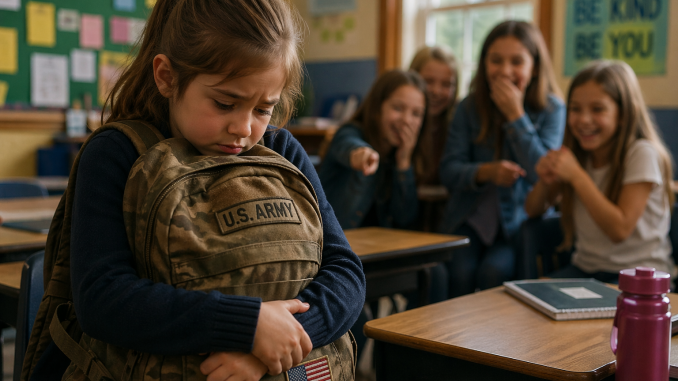
She just sat quietly on the floor, staring at the one thing the military had returned to us—his old backpack.
It was worn down, faded from sun and time. The straps were frayed, one zipper barely holding on. It wasn’t something anyone would call valuable.
But to Alice… it was everything.
She picked it up gently, almost like it might break in her hands, and held it close.
“Daddy carried this,” she whispered.
From that moment on, she refused to let it out of her sight.
She carried it around the house. Slept with it beside her bed. Took it with her everywhere she went.
Including school.
At first, I tried to convince her otherwise.
“Sweetheart, how about we get you a new backpack?” I suggested one afternoon, showing her bright, cheerful options—pink ones with sparkles, cartoon characters, things that most little girls would get excited about.
She didn’t even hesitate.
“I want this one,” she said softly.
There was no anger in her voice. No tantrum.
Just something deeper. Final.
One evening, as she ran her small fingers over the worn fabric, she looked up at me and said,
“He used to call me Alice-bug… I think he’d want me to keep it.”
After that, I stopped trying to change her mind.
Even though a part of me knew how cruel children could be.
At first, it was subtle.
A few looks. Quiet whispers when she walked by.
Then it grew louder.
Giggling. Pointing. Kids turning to each other and covering their mouths.
And then, last week, it crossed a line.
One girl laughed out loud and said,
“Why does she carry that thing? It looks like a trash bag. Are they that poor?”
The classroom went quiet for a second.
Alice didn’t respond.
She didn’t defend herself.
She just gripped the straps tighter, her knuckles turning pale.
That afternoon, she came home and didn’t say a word.
She walked straight past me, still wearing the backpack, went into her room, and closed the door.
A few minutes later, I heard it.
That quiet, broken crying—the kind a child makes when they’re trying not to be heard.
I sat outside her door, my hand pressed against it, listening… feeling like the worst kind of parent for not being able to protect her from the world.
The next morning, I thought maybe she’d leave it behind.
Maybe it had become too much.
But when she came into the kitchen, the backpack was already on her shoulders.
“I’m not leaving him at home,” she whispered.
That was all she said.
So I let her go.
Even though my chest felt tight the entire time.
Even though something told me the day wouldn’t go well.
At exactly 11:12 a.m., my phone rang.
The school.
My stomach dropped instantly.
A thousand thoughts rushed through my head—
Did someone hurt her?
Did she finally break down?
Did something happen to that backpack?
I answered with shaking hands.
It was her teacher.
Her voice didn’t sound normal. It was unsteady… almost emotional.
“Ma’am… I need you to come to the school. Right now.”
My heart started pounding.
“What happened to my daughter?” I asked, already grabbing my keys.
There was a pause on the other end.
A long one.
Then she spoke again, softer this time.
“Ma’am… you won’t believe what they did to her.”
I froze for a second.
My mind went straight to the worst possible things.
But there was something in her tone…
It wasn’t anger.
It wasn’t panic.
It was something else.
Something I couldn’t quite place.
And as I rushed out the door, one thought kept repeating in my head—
Whatever happened…
This was going to change everything.