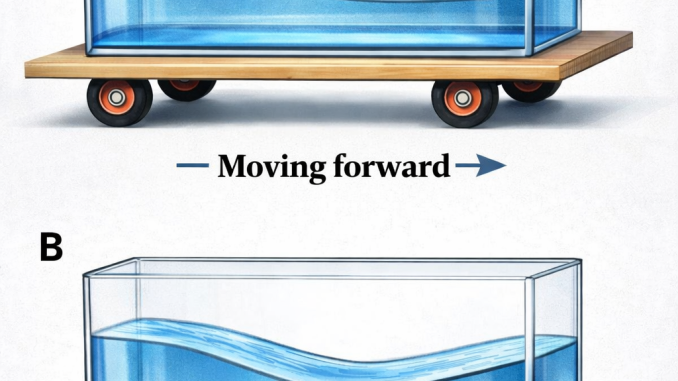
At first glance, the situation appears very simple: a glass container filled with water is placed on a cart that is moving forward. Two different cases are presented, labeled A and B.
The question is straightforward:
Which one correctly shows how the water behaves when the cart moves forward?
Although it looks easy, many people answer incorrectly because they rely on intuition instead of understanding the physics behind it.
The Key Concept: Inertia
To understand what is happening, we need to focus on a fundamental principle of physics known as inertia.
Inertia is the tendency of an object to resist any change in its state of motion. This means that if something is at rest, it wants to stay at rest, and if it is moving, it wants to continue moving at the same speed unless a force acts on it.
Water, even though it is a liquid, follows the same rule.
What Happens When the Cart Moves Forward
When the cart begins to move forward, especially if it accelerates, the water inside does not instantly move along with it.
Instead, due to inertia, the water tends to remain in its original state. As a result, relative to the cart, the water appears to move backward.
This creates a noticeable effect on the surface of the water.
The Shape of the Water Surface
Because the water is effectively “left behind” when the cart accelerates forward, the surface of the water tilts.
Specifically:
- The water level becomes higher at the back of the container
- The water level becomes lower at the front
This happens because the backward force caused by inertia pushes the liquid toward the rear.
Analysis of the Two Cases
Case A shows the water higher at the front and lower at the back.
This would only be correct if the cart were slowing down or moving in the opposite direction.
Case B shows the water higher at the back and lower at the front.
This is exactly what we expect when the cart is accelerating forward.
A Real-Life Comparison
This effect is something people experience regularly.
When a car accelerates, passengers feel pushed backward into their seats. When the car brakes, they move forward.
The water behaves in the same way as the passengers.
Conclusion
Understanding this situation depends on recognizing that the important factor is not just motion, but acceleration.
When the cart accelerates forward, the water resists that change and shifts backward.
Final Answer
The correct case is B.
This is because the water moves opposite to the direction of acceleration due to inertia, causing the level to rise at the back and fall at the front.