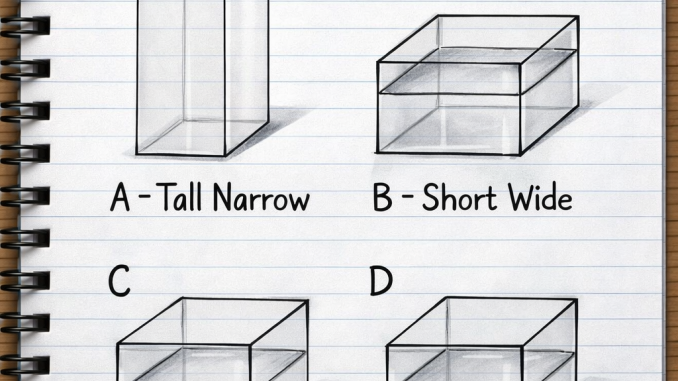
At first glance, this looks like a simple drawing on a notebook page. Four transparent boxes labeled A, B, C, and D are shown, each with a slightly different shape. The question seems easy: which box holds more air?
But this is exactly the kind of puzzle that tricks your eyes and challenges your intuition.
Understanding the Boxes
- Box A (Tall Narrow): This one is tall and slim. It looks like it should hold a lot because of its height.
- Box B (Short Wide): This box is shorter but spreads out more horizontally.
- Box C (Deep Box): This one appears balanced, with depth emphasized.
- Box D (Cube): A classic cube, equal on all sides.
At first, many people assume that one of these must clearly hold more air based on how it looks. Some choose the tall one (A), thinking height means more space. Others go for the wide one (B), believing width gives it an advantage.
The Trick Behind the Puzzle
The key detail is easy to miss:
All four boxes are actually designed to have the same volume.
Even though they look different, each box has dimensions that multiply to the same total space. In other words:
- A tall but narrow box
- A short but wide box
- A deep box
- A perfect cube
All can have identical volume if their length × width × height equals the same value.
This is a classic visual illusion where shape differences make our brain assume different capacities, even when the math says otherwise.
Final Answer
All boxes (A, B, C, and D) hold the same amount of air.
The puzzle is not about guessing which is bigger—it’s about realizing that appearances can be misleading.