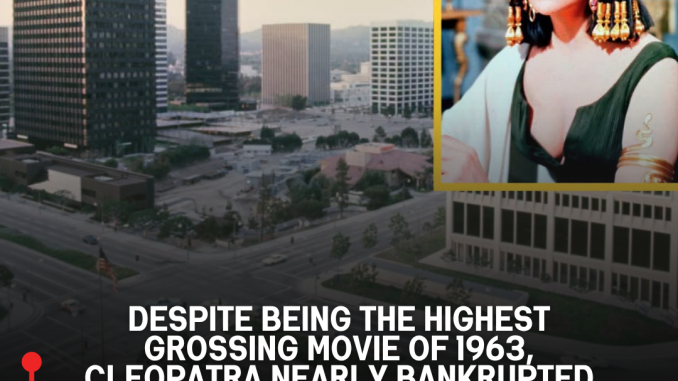
When Cleopatra arrived in theaters in 1963, it looked like the ultimate Hollywood triumph.
Starring Elizabeth Taylor as the legendary Egyptian queen, Richard Burton as Mark Antony, and Rex Harrison as Julius Caesar, the film was enormous in almost every possible way. It featured lavish costumes, massive sets, an international production, a celebrated cast, and a running time of nearly four hours.
It also became the highest-grossing movie of 1963 in North America.
But behind the glamorous premiere was one of the most financially troubled productions in Hollywood history.
The making of Cleopatra had become so expensive and complicated that 20th Century Fox faced a serious financial crisis. The studio ultimately sold a huge portion of its Los Angeles backlot, land that would later become the famous Century City.
The story has become part of Hollywood mythology: one of the most extravagant movies ever made helped transform a movie studio’s property into one of Los Angeles’ most recognizable business districts.
And at the center of it all was Elizabeth Taylor.
A Movie That Started With Big Ambitions
When 20th Century Fox decided to make another version of Cleopatra, the studio expected a major spectacle.
The project began in the late 1950s, initially with a much smaller budget than the enormous production it would eventually become. Elizabeth Taylor was persuaded to take the title role, reportedly receiving an extraordinary salary for the time.
The movie was supposed to be a prestigious historical epic.
Instead, production quickly became a nightmare.
Filming began in Britain, but the project encountered serious problems almost immediately. Sets were expensive, production was slow, and the weather created additional difficulties. Taylor also became seriously ill during the production, forcing the studio to halt work.
Eventually, much of the British material was abandoned.
The production was moved to Rome’s Cinecittà studios, and Joseph L. Mankiewicz replaced the original director, Rouben Mamoulian.
The movie was essentially being rebuilt while enormous amounts of money were already being spent.
According to Turner Classic Movies, the production had originally been expected to cost only a few million dollars, but the budget eventually exploded to more than $45 million according to some contemporary estimates.
Elizabeth Taylor and Richard Burton Changed the Story
Then Hollywood received another shock.
Elizabeth Taylor and Richard Burton began a highly publicized romance while both were married to other people.
The relationship became an international scandal.
Newspapers and magazines around the world followed their every move, turning the actors into one of the most famous celebrity couples on Earth.
Ironically, the controversy also generated enormous publicity for Cleopatra.
Audiences were fascinated not only by the historical story but by the real-life drama surrounding its two stars.
Taylor’s Cleopatra became inseparable from the image of Hollywood excess, beauty and scandal.
But publicity could not solve the studio’s financial problems.
The Production Became Enormous
The scale of Cleopatra was extraordinary.
The filmmakers constructed enormous sets and created thousands of costumes and props. The production required armies of extras and huge amounts of logistical planning.
But the film did not have a finished script when much of the production was taking place.
Director Joseph Mankiewicz later described his original vision as something much larger than the theatrical version that audiences eventually saw. The production continued to evolve as filming progressed.
The result was a movie that took years to complete and consumed enormous studio resources.
The Los Angeles Times later described Cleopatra as a production that helped push Fox toward a severe financial crisis. By early 1962, the film was reportedly the only picture in production at the studio as Fox attempted to deal with its losses.
Fox Was Running Out of Money
The problem was bigger than one movie.
20th Century Fox was already struggling financially in the early 1960s. Several expensive productions had performed poorly, while Hollywood itself was going through a period of major change.
Then came Cleopatra.
The film became a financial monster.
Fox was spending enormous amounts of money before the picture had even reached theaters, while production delays continued to increase the bill.
Eventually, the studio took drastic measures.
One of the most famous consequences was the sale of a large portion of Fox’s Los Angeles property.
The Backlot That Became Century City
This is where the story gets particularly fascinating.
The enormous Fox property in West Los Angeles had been used for decades as a movie backlot. It contained streets, sets and open spaces where Hollywood productions could create everything from cities to battlefields and historical locations.
But in the early 1960s, Fox needed cash.
In 1961, the studio sold a large portion of its property to the Aluminum Company of America, better known as Alcoa, in partnership with developer William Zeckendorf.
The exact acreage is sometimes reported differently depending on how the property is defined. Contemporary and historical sources describe the transaction as involving roughly 180 acres in one account, while other accounts refer to a larger 260-acre Fox lot. The Fox lot itself had reached roughly 285 acres at its height.
What is not disputed is what happened next.
The old movie backlot was transformed into something completely different.
It became Century City.
From Movie Sets to a “City Within a City”
The developers envisioned something ambitious: a modern urban center in the middle of Los Angeles.
The idea was to create what planners described as a “city within a city,” combining office buildings, shopping, entertainment and residential development.
The transformation was remarkable.
Places that had once been filled with Hollywood sets and movie crews would eventually be replaced by skyscrapers, hotels, corporate headquarters and busy streets.
The Century City Chamber of Commerce’s historical timeline records that the Fox property was purchased in 1961 and that Alcoa developed the area into the modern complex that became Century City.
Today, few people walking through Century City would realize that the area once served as one of Hollywood’s giant outdoor movie backlots.
Did ‘Cleopatra’ Really Cause the Sale?
This is where the popular version of the story needs some clarification.
It is tempting to say:
Elizabeth Taylor’s Cleopatra nearly bankrupted Fox, so the studio sold 300 acres and Century City was born.
There is truth behind that dramatic version — but history is more complicated.
Plans to redevelop the Fox property had actually existed before Cleopatra became the financial disaster it was feared to be.
The Century City Chamber of Commerce says the decision to sell the property was made in 1958, around the beginning of Cleopatra‘s pre-production, before the movie’s cost overruns had reached their worst point.
A University of Southern California research paper examining the history of Century City similarly argues that the popular belief that Cleopatra alone forced Fox to sell its land is something of a “creation myth.” The studio had already been considering development of the property years earlier.
Still, Cleopatra unquestionably intensified Fox’s financial problems.
The studio was desperate for cash, and the sale of the property became an important part of its effort to survive.
So while it would be misleading to say Cleopatra single-handedly created Century City, it is fair to say that the movie’s extraordinary financial problems were part of the crisis surrounding Fox’s decision to monetize its valuable real estate.
The Movie Finally Arrived
After years of production problems, Cleopatra finally premiered in New York on June 12, 1963.
It was an event.
The film ran for almost four hours and featured some of the most extravagant imagery Hollywood had ever put on screen.
Elizabeth Taylor appeared in elaborate costumes and towering sets, while Richard Burton brought his own star power to the role of Mark Antony.
Despite the troubled production, audiences came.
And they came in huge numbers.
Cleopatra became the highest-grossing film of 1963 in North America, with domestic box-office receipts of roughly $57.7 million.
On paper, that sounded like a spectacular success.
But the financial picture was far more complicated.
The Biggest Hit That Wasn’t Immediately a Profit
The movie had cost so much that its impressive box-office performance did not immediately make it profitable for Fox.
Production expenses and marketing costs had reached extraordinary levels.
One commonly cited estimate puts the total production and marketing cost at around $44 million. The film’s box-office performance was enormous, but the studio did not simply receive every dollar paid by moviegoers.
Theaters kept part of the ticket revenue, and the studio had distribution and marketing expenses to consider.
As a result, Cleopatra initially struggled to recover its massive investment.
It eventually became profitable over time, helped by later revenue streams, including television rights.
But the damage to Fox’s finances during production had already been done.
Elizabeth Taylor Became the Face of the Production
Because Elizabeth Taylor was the movie’s biggest star, much of the attention surrounding Cleopatra naturally focused on her.
She was already one of Hollywood’s most famous actresses.
But Cleopatra elevated her celebrity to another level.
She became synonymous with the image of the film — the elaborate costumes, the extravagant sets, the publicity surrounding her relationship with Burton, and the enormous financial controversy.
Taylor was not responsible for every decision that caused the production to spiral out of control.
The problems involved directors, scripts, production changes, illness, reshoots, changing locations and the studio’s own management decisions.
Yet because she played Cleopatra, she became one of the most visible symbols of the movie’s excess.
A Disaster That Became Hollywood History
In retrospect, the story of Cleopatra is fascinating because it doesn’t fit neatly into the category of “failure.”
The movie was enormously expensive.
It nearly pushed its studio to the brink.
It became one of the most notorious examples of Hollywood excess.
And yet audiences made it the biggest movie of 1963.
It also won four Academy Awards, including awards for Art Direction, Cinematography, Visual Effects and Costume Design.
Over time, the movie’s reputation changed.
What was once seen primarily as a symbol of Hollywood extravagance became a historical landmark in filmmaking.
Its enormous sets, costumes and performances remain part of the mythology of classic Hollywood.
The Strange Legacy of Cleopatra
Perhaps the most remarkable part of the story is what happened to the land around the studio.
The old Fox backlot did not simply disappear.
It was transformed.
The streets where movie crews once filmed elaborate scenes became streets filled with office towers and businesses.
The land that once represented Hollywood’s fantasy world became one of Los Angeles’ most important commercial districts.
Century City eventually became home to major corporations, hotels and iconic buildings.
And the Fox studio remained nearby, maintaining a physical connection to the movie industry’s past.
The Los Angeles Times has noted that the Fox property originally purchased by William Fox grew to roughly 285 acres at its peak before shrinking after the studio’s financial difficulties and the sale of nearly 180 acres in 1961.
From Cleopatra’s Egypt to Modern Los Angeles
There is something almost poetic about the transformation.
In Cleopatra, Elizabeth Taylor played a queen surrounded by monumental architecture, wealth and political power.
At the same time, just a few miles away from the heart of Hollywood, the studio producing her movie was fighting for its financial survival.
The enormous production consumed resources on a scale that seemed almost impossible.
And while the film eventually became a major box-office success, the crisis surrounding it contributed to a dramatic transformation of Fox’s physical and financial landscape.
The movie’s legacy therefore extends far beyond the screen.
It is visible in the skyline of Los Angeles.
A Hollywood Legend With a Complicated Truth
The popular story says that Cleopatra nearly bankrupted 20th Century Fox and forced the studio to sell its 300-acre backlot, creating modern Century City.
The reality is slightly more complicated.
Fox had already been considering the development and sale of its property before the full extent of Cleopatra‘s financial problems became apparent.
But the movie’s staggering cost, production delays and financial pressure came at a critical moment for the studio.
The sale helped Fox raise desperately needed money.
And the land eventually became Century City — one of the most recognizable urban centers in Los Angeles.
So the enduring connection between Cleopatra and Century City is not simply a Hollywood myth.
It is a story about how a spectacular movie, an ambitious studio, a financial crisis and a piece of Los Angeles real estate collided at exactly the right moment in history.
Elizabeth Taylor’s Cleopatra was supposed to conquer the ancient world.
Instead, the movie helped leave an unexpected mark on the modern city of Los Angeles.
And decades later, Century City’s towers stand as a fascinating reminder of just how much one Hollywood production could change the industry — both on screen and far beyond it.