Sometimes the easiest questions are the ones people answer too quickly. At first, this looks like a basic money problem, something a child might solve in class or something you might hear in a casual conversation. But that is exactly why it grabs attention. It is short, clear, and relatable. Almost everyone can picture the situation immediately.
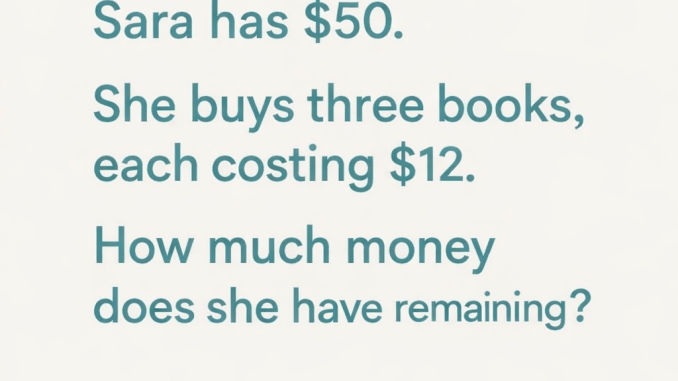
Imagine Sara walking into a bookstore with $50 in her hand. She is excited to buy a few books, maybe for school, maybe for fun, or maybe just because she loves reading. She looks around, chooses the ones she wants, and finally picks three books. Each of those books costs $12.
Now the question is simple:
How much money does she have left after buying them?
A lot of people read a question like this and rush straight to the answer. Some try to do the math in their head too fast. Others may mix up the numbers. That is what makes these small brain teasers so fun. They are not hard because the numbers are big. They are tricky only because people often do not slow down enough to think through the steps carefully.
So let’s look at it in the clearest way possible.
Sara starts with $50.
She buys 3 books.
Each book costs $12.
Before we can find out how much money she has left, we first need to know how much she spent in total. Since every book costs the same amount, we multiply:
3 × 12 = 36
That means Sara spent $36 altogether on the books.
Now that we know her total spending, we compare it to the money she had at the beginning. She had $50, and she spent $36, so now we subtract:
50 – 36 = 14
That leaves Sara with $14.
What makes this kind of question fun is that it is based on a real-life situation that feels familiar. It is not just about numbers on a page. It is about shopping, budgeting, and being aware of how much money is being spent. In everyday life, people often make these same kinds of calculations without even noticing it. Whether it is buying groceries, paying for clothes, or ordering food, the same logic applies: first calculate the total cost, then subtract it from the money you started with.
This is also why simple math questions are so effective on social media, in school, or even in conversation. They invite people to pause, think, and test themselves. Some answer immediately. Some get it wrong because they read too quickly. Others enjoy working it out step by step and feeling that little moment of satisfaction when they get it right.
If you think about it, questions like this are not only about arithmetic. They also test patience and focus. In a fast-moving world, many people are used to reacting instantly. But a short problem like this quietly reminds us that the right answer usually comes from slowing down and looking at each detail one by one.
Sara did not buy one book. She bought three.
Each one was not $3 or $10. Each one was $12.
So the key is not to guess. The key is to calculate the full amount she spent first.
Once you do that, the rest becomes easy.
She spent $36 in total.
She started with $50.
So the money left in her hand after paying is:
$14
That is the full answer, and it is a good reminder that even the simplest-looking questions can catch people off guard if they do not pay attention.
Answer: Sara has $14 left.