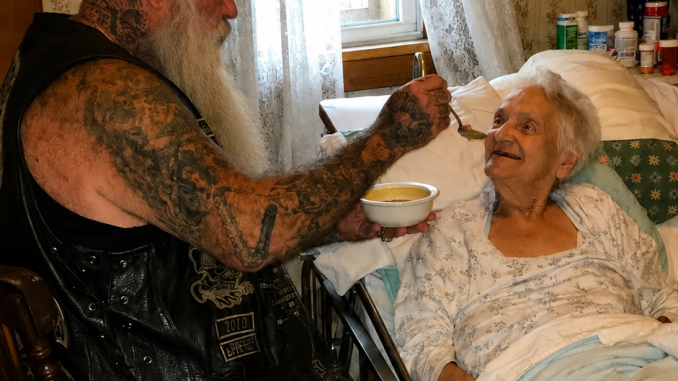
My mom let go of the church caregiver who had looked after her for years and replaced her with a biker. Then she begged me not to ask any questions.
To understand why, I have to go back.
My mother is 81 years old. Twelve years ago, she suffered a devastating stroke that left her confined to bed. Since then, one person had cared for her every single day—Brenda, a kind woman from church who hummed hymns while she cooked, never complained, and rarely missed a day.
Then, two months ago, my phone rang while I was at work.
It was Brenda.
She was crying so hard I could barely understand her.
“Your mother told me not to come back,” she said. “She already hired someone else… and trust me, you’re not going to believe who it is.”
Before I could ask another question, the call ended.
I drove home faster than I ever should have, my mind racing the entire way.
When I reached Mom’s bedroom, I froze.
A huge man sat beside her bed.
He wore a black leather vest, heavy boots, and had a long gray beard. Tattoos covered his neck and both of his hands.
Carefully, he lifted a spoonful of chicken soup to my mother’s lips, waiting patiently between every bite.
She looked at him with a warmth I’d never seen before.
“Mom…” I finally said. “Who is he?”
Her smile faded.
She looked at the biker, and they shared a glance that spoke of decades of unspoken memories.
Then she turned back to me.
“Please,” she whispered. “Not yet.”
I didn’t know what to think.
For the next three weeks, I kept my distance and simply watched.
Every morning, he arrived at the same time.
He brushed her hair, read novels aloud, adjusted her blankets, and held her hand while she slept.
There was nothing rough about him.
Only patience.
Only kindness.
Still, I needed answers.
I searched public records, ran his license plate, and asked around town.
No one seemed to know much about him.
Then, one Tuesday afternoon, I came home early.
As I walked down the hallway, I heard my mother crying.
Not from pain.
From relief.
I quietly opened the bedroom door.
The biker was kneeling beside her bed, gently holding both of her hands.
He looked up at me with tears filling his eyes.
“It’s time,” he said softly. “You deserve to know.”
He took a slow breath.
“Fifty-three years ago, your mother and I fell deeply in love.”
I stared at him, speechless.
He explained that they had been engaged in their twenties, planning a future together.
But my grandparents strongly disapproved of him because he rode motorcycles and came from a poor family.
They forced my mother to choose.
Heartbroken, she ended the engagement.
A few years later, she married my father.
He moved away, eventually joining a motorcycle club and building a completely different life.
Neither of them ever forgot the other.
After my father passed away several years ago, my mother quietly searched for him. It took months, but she finally found him through an old mutual friend.
When she learned Brenda planned to retire soon, she made one unexpected request.
She asked the only man she had never stopped loving if he would spend whatever time she had left by her side.
He said yes without hesitation.
He wasn’t there for money.
He refused every paycheck she offered.
Instead, he cooked her meals, read to her, helped with her medications, and sat beside her through the long nights when she couldn’t sleep.
Before I could say a word, my mother reached for my hand.
“I loved your father,” she said gently. “He gave me a beautiful family, and I never regretted our life together. But everyone carries one chapter they never truly finish. He was mine.”
The biker quietly stood to leave, thinking I needed time to process everything.
Instead, I stopped him.
I walked across the room and wrapped my arms around the man I had judged without ever knowing him.
“Thank you,” I said.
“For giving my mom peace.”
She passed away four months later.
At her funeral, he stood quietly in the back, saying almost nothing.
As everyone began leaving, he placed a faded black-and-white photograph on her casket.
It showed two young people laughing beside an old motorcycle.
On the back, in faded ink, were just six words:
“I never stopped loving you, Annie.”
Only then did I truly understand why my mother had asked me not to ask—not until she was ready to tell the story herself.