I’ve been an emergency room doctor for more than two decades, and I’ve witnessed tragedies that most people couldn’t imagine. But there is one night I’ll never forget.
It was a quiet Tuesday, a little after midnight. The ER was calm, and we were catching up on paperwork when the entrance doors slammed open so hard one of the hinges nearly snapped off.
A massive biker stepped inside.
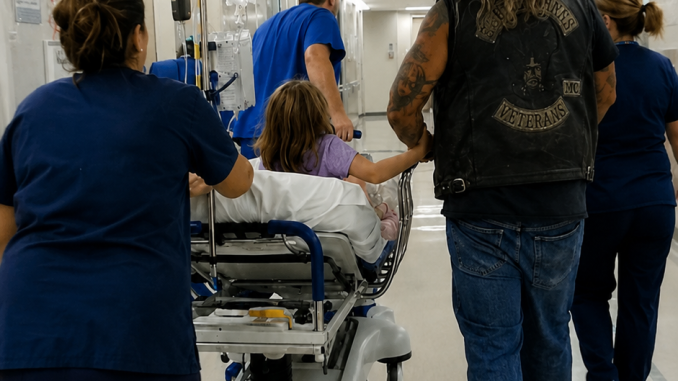
He wore a worn leather vest covered in road dust, heavy boots, and his gray beard suggested he’d spent countless years on the highway. Cradled carefully in his arms was a little girl—no older than seven years old—wrapped tightly inside his biker jacket.
She was drenched, trembling uncontrollably, and barely conscious.
The moment I saw her, my instincts took over.
Severe hypothermia. Dehydration. Exhaustion.
Then I noticed the bruises.
Not the kind caused by a bicycle fall or playground accident.
These bruises were older… layered over newer ones… scattered across places no child should ever have injuries.
After 21 years in emergency medicine, you learn to recognize the difference.
Someone had been hurting her.
We rushed her into a trauma room.
The second one of our nurses tried to remove the oversized leather jacket, the little girl let out a scream so raw and terrified that everyone in the room froze.
Instead of reaching for one of us…
She grabbed the biker’s sleeve with both tiny hands.
She refused to let go.
Hospital policy doesn’t usually allow family—or strangers—to remain during active treatment. But every time security or a nurse tried to move him away, her panic became unbearable.
Her heart rate skyrocketed.
She cried until she could barely breathe.
So I made the call.
“Let him stay.”
He stood silently beside the bed while we warmed her body, started IV fluids, cleaned her wounds, and monitored her breathing.
She never released his fingers.
Not once.
Registration repeatedly asked for information.
“What is her name?”
Silence.
“Sir, what’s your name?”
Nothing.
“Are you related to her?”
He simply shook his head.
The police arrived about thirty minutes later.
Naturally, they had questions.
A biker carrying an injured child into an emergency room without identifying himself raises every possible alarm.
They escorted him outside.
Within seconds, the little girl’s monitors began sounding alarms.
Her pulse jumped dangerously high.
She woke up screaming his name—or at least the nickname she used for him.
The officers looked through the window.
One of them sighed.
“Bring him back.”
The instant he returned, she grabbed his hand again.
Within minutes, she calmed down.
For the next four hours, he never sat down.
He never complained.
He simply stood there, letting this frightened little girl hold onto two of his weathered fingers as if they were the only safe thing left in the world.
Around four in the morning, after medication, warm blankets, and hours of reassurance, she finally drifted into a peaceful sleep.
Still holding his hand.
The room became quiet.
That’s when he finally spoke.
His voice was rough, exhausted, and barely above a whisper.
“You’ve all been asking if I’m her father.”
He paused for several seconds.
“I’m not.”
He reached into the inside pocket of his leather vest and carefully unfolded an old photograph that had clearly been folded and unfolded hundreds of times.
The edges were torn.
The colors had faded.
He handed it to me.
It showed a little girl standing beside him.
She couldn’t have been more than six years old.
She wore pink rain boots and had the biggest smile imaginable.
“My daughter,” he whispered.
“She died fourteen years ago.”
No one in the room spoke.
He swallowed hard before continuing.
“She was abused.”
His hands began shaking.
“I didn’t know.”
“I worked long-haul trucking back then.”
“I believed every lie.”
“I believed she was clumsy.”
“I believed she kept falling.”
“I believed the excuses.”
His eyes filled with tears.
“By the time I learned the truth…”
“…it was too late.”
The room fell completely silent.
He looked toward the sleeping child.
“I promised my little girl at her funeral that if I ever saw another child who looked as scared as she did… I’d never walk away again.”
Earlier that evening, he had stopped at a small gas station several miles outside town.
Behind the building, hidden near a dumpster, he noticed movement.
The little girl was curled into a ball.
Cold.
Hungry.
Covered in bruises.
Terrified.
She flinched every time someone walked by.
He slowly took off his leather jacket, wrapped it around her shoulders, and asked only one question.
“Are you hurt?”
She nodded.
Then she whispered four words that still haunt me.
“Please don’t leave me.”
He didn’t.
He carried her to his motorcycle.
Instead of taking her anywhere else, he drove straight to the nearest emergency room.
Ours.
The investigation that followed uncovered years of horrific abuse.
Several arrests were eventually made.
The little girl entered protective care and later found a permanent adoptive family who loved her unconditionally.
As for the biker…
He refused every attempt to be recognized.
He declined interviews.
He never accepted rewards.
He simply disappeared once he knew she was safe.
Months later, I received a handwritten card from the little girl.
Inside was a drawing.
She had drawn herself holding hands with a very large man wearing a leather vest.
Above the picture she had written:
“Some heroes don’t wear capes. Mine wore leather.”
To this day, I still keep that drawing inside my desk.
Medicine saved her life.
But compassion gave her a future.
And every time I hear the rumble of motorcycles passing the hospital, I can’t help wondering if one of them belongs to the quiet stranger who kept a promise he made fourteen years earlier—to a daughter he could never save, by saving someone else’s.