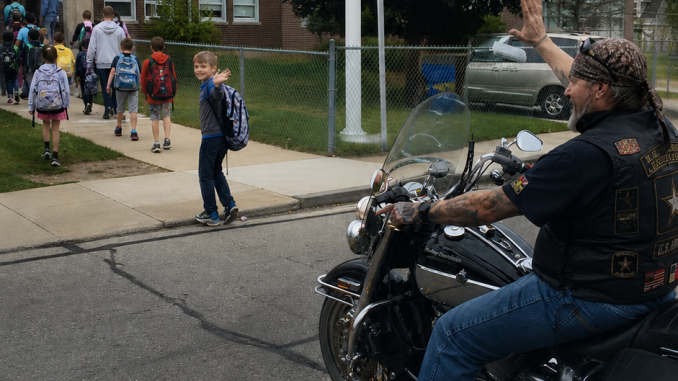
Every day when I dropped off my seven-year-old, Caleb, there was a man parked across from the school on a motorcycle. Leather vest, bandana, arms crossed—just watching the kids go in. At first, I was uneasy. I even thought about calling the police.
But Caleb always waved at him. Every single morning. Big, happy wave. And the biker always waved back.
“Do you know him?” I asked once.
“That’s my friend,” Caleb said simply.
I tried to ignore it, but it kept happening—rain or shine. Two months straight. Caleb would wave, and the man would always return it.
Eventually, I couldn’t hold it in anymore.
“Caleb, how do you know that man?” I asked.
He got quiet, then said something that hit me hard.
“The kids used to push me off the swings and take my lunch. Every day. They called me stupid and said nobody wanted to be my friend.”
I felt my stomach drop.
“Then one day, the motorcycle man was there when it happened,” he continued. “After school, by the fence. He didn’t say anything. He just revved his engine really loud and stared at them. They got scared and ran away.”
My hands started shaking.
“He comes every day now. The kids stopped bullying me because they think he’s my bodyguard.”
Tears filled my eyes.
“He keeps me safe, Mom. That’s why I wave. Because nobody else did.”
I couldn’t breathe after that.
My son had been suffering in silence, and a complete stranger had noticed before I did.
I went to the school that morning. The biker was still there in his usual spot. When I approached him, he already looked tense—like he knew this moment was coming.
Up close, he was about fifty-five. Weathered face, gray beard, military patches on his vest—Marine Corps, Desert Storm.
“I’m Caleb’s mom,” I said.
He nodded. “The kid who waves.”
I told him what my son had said, how he’d been protecting him.
He rubbed his face. “I didn’t plan it like that,” he said. “One day I was passing by and saw your boy by the fence. Three kids had him on the ground, kicking his backpack, throwing his things.”
My heart sank.
“He wasn’t even crying. Just sitting there. Like it was normal.”
“Why didn’t you report it?” I asked.
“I tried,” he said. “Called the school. They said they’d handle it. Nothing changed. I came back a week later and it was happening again.”
“So you stayed?”
“Every school day.”
“For how long?”
“Three months.”
“Why?”
That’s when his voice changed.
“Because I didn’t do it for my own son.”
His name was Ray Dalton. He told me he had a son—Nathan. Quiet kid, loved drawing, didn’t fit in. He was bullied for years.
Ray told him to toughen up. Stand up for himself. That’s what he was taught.
But Nathan didn’t get stronger. He got quieter. He stopped talking about it.
Then one day in 2011, Ray came home and found his son gone.
He didn’t say much about what happened. He didn’t have to.
Nathan had left a note: he was tired of being scared, tired of being alone, and felt like no one was coming to help.
Ray carried that guilt every day since.
“When I saw your boy on the ground,” he said, “I saw my son. I couldn’t ride past.”
After that, everything changed.
I went straight to the school and reported everything. Slowly, things improved—counseling, supervision, intervention. Not perfect, but better.
And Ray kept showing up every morning.
I started bringing him coffee. We’d talk briefly while the kids went inside.
He told me he joined veterans’ groups, started charity rides, trying to deal with his grief.
“You can’t outrun it,” he said. “It just stays with you.”
One day, Caleb made him a card—thanked him for being his friend. Drew a motorcycle and wrote that he was brave and cool.
When I gave it to Ray, he broke down right there in the parking lot. A grown Marine, quietly crying while holding a child’s drawing over his heart.
After that, something changed between them.
Months later, Ray was invited to speak at a school assembly about bullying. At first, he refused. Then Caleb asked him personally.
So he went.
He stood in front of hundreds of kids and told them about his son. About bullying. About not ignoring the quiet kids who suffer alone.
“If you see someone being picked on, don’t walk away,” he said. “That kid might think nobody is coming for them.”
The entire gym stood up and applauded.
Ray just nodded, like something inside him had finally found peace.
Caleb still waves at him every morning. And Ray still waves back.
A simple wave that means: I see you. You matter. I’m here.
And somehow, between a broken-hearted biker and a lonely little boy, both of them were saved.