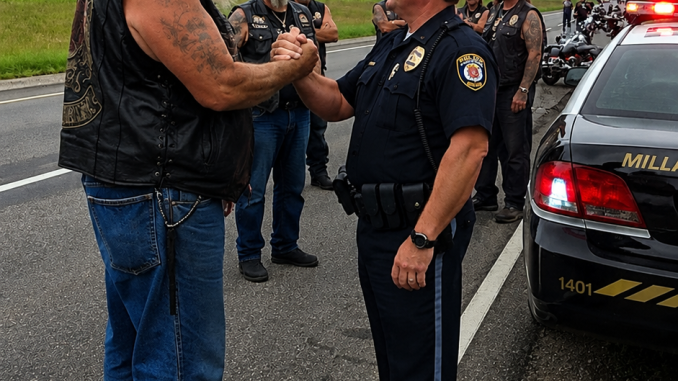
Thirty bikers came roaring down Route 9 that morning, their engines shaking the quiet road before I even saw them.
From a distance, they looked like trouble.
Leather vests. Tattoos. Bandanas. Bikes lined up in a tight formation like they owned the highway.
I had been a police officer for nineteen years, long enough to know that when a group that big moved together, you paid attention. So I hit the lights on my cruiser and pulled them over one by one until all thirty motorcycles were parked along the shoulder.
Before stepping out, I called for backup.
My hand stayed close to my holster as I walked toward the lead rider.
He was a giant of a man, with a gray beard down to his chest and arms covered in old tattoos. His leather vest was worn, patched, and faded from years on the road.
“License and registration,” I said, keeping my voice firm.
The man didn’t argue. He didn’t get loud. He didn’t even look offended.
He simply looked at me with tired eyes and said, “Officer, we’re not here to cause trouble. We’re here for a little girl.”
I almost didn’t believe him.
In my line of work, I had heard every excuse imaginable. People said anything when they wanted to avoid a ticket or explain something they shouldn’t have been doing.
Then the biker slowly reached into his vest.
My body reacted before my mind could. My hand moved toward my gun. Backup was still several minutes away, and I was standing alone in front of thirty men I didn’t know.
But he didn’t pull out a weapon.
He pulled out a folded photograph.
The edges were worn soft, like it had been carried, held, and looked at hundreds of times. He opened it carefully and held it out toward me.
When I saw the face in that picture, my stomach dropped.
It was a little girl I knew.
Not personally, but every officer in our department knew her name. Her case had haunted all of us for months.
She was eight years old. Sick, fragile, and fighting a battle no child should ever have to face. Her family had contacted the department weeks earlier because her biggest dream was to see a motorcycle parade. She loved bikes. Her father had ridden one before he passed away, and somehow the sound of motorcycles made her feel close to him again.
I looked back at the biker.
“How do you know her?” I asked.
His face changed.
“She wrote to us,” he said quietly. “Said she wanted one last ride-by outside the hospital window. Her mom didn’t know if anyone would come. So we came.”
I turned and looked down the line of bikers.
Thirty men who I had judged before they said a word.
Some were holding flowers. One had a teddy bear strapped to the back of his motorcycle. Another had a small pink helmet tied carefully to his seat.
They weren’t headed to cause trouble.
They were headed to bring joy to a little girl who had very little time left.
For a moment, I couldn’t speak.
The lead biker looked at me and said, “We’re sorry if we were too loud, Officer. We just wanted her to hear us coming.”
That sentence hit me harder than I expected.
I had spent nearly two decades wearing a badge. I had learned to be cautious. I had learned to protect myself. But somewhere along the way, I had also learned to assume the worst too quickly.
That morning, standing on the side of Route 9, I realized I had been wrong.
I lowered my hand from my belt and looked at the long line of motorcycles.
Then I said, “Follow me.”
The biker blinked. “What?”
I walked back to my cruiser, opened the door, and turned on the lights again.
“If that little girl is waiting for a parade,” I said, “then she’s getting a police escort.”
The lead biker’s eyes filled with tears.
A few minutes later, we rolled toward the hospital together. My cruiser led the way, lights flashing. Behind me came thirty motorcycles, engines rumbling like thunder.
And when we reached the hospital, there she was.
A tiny little girl wrapped in a blanket, sitting by the window with her mother behind her. The second she heard the bikes, her face lit up.
The bikers parked below her window and waved. Some cried. Some bowed their heads. The giant biker who had shown me the photograph placed his hand over his heart.
That little girl smiled like the whole world had come just for her.
And in a way, it had.
I went home that night a different man.
Because that day taught me something I should have remembered long ago:
Sometimes the people we judge by their appearance are the very people carrying the most kindness in their hearts.
And sometimes, the loudest engines are not a warning.
Sometimes, they are a promise that someone, somewhere, still cares.