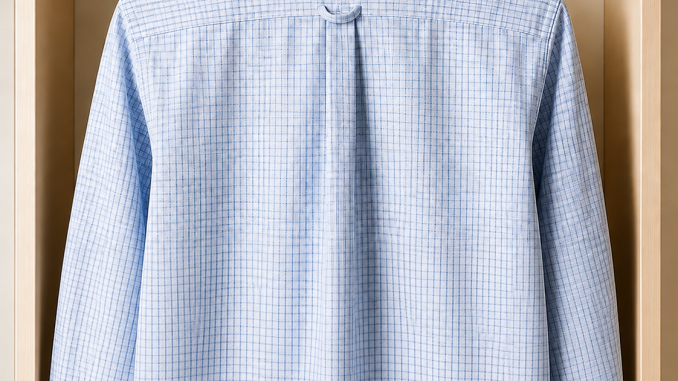
You’ve probably noticed that tiny fabric loop on the back of certain button-down shirts, right below the collar. Most people barely pay attention to it — and honestly, many never even realize it’s there. For years, I assumed it was just some random extra piece added during manufacturing with no real purpose behind it. I even asked my husband about it once because a few of his shirts had them, and he looked just as confused as I was. Turns out, though, that little loop actually has a surprisingly interesting history.
The story goes back to the early 1900s and the U.S. Navy. Sailors lived in cramped quarters aboard ships where storage space was extremely limited. Their uniforms needed to be practical, durable, and easy to hang in tight spaces. That’s where the small loop came in. Known as a “locker loop,” it allowed sailors to hang their shirts on hooks instead of folding them or tossing them onto crowded shelves. It was a simple solution that helped keep uniforms off the floor and reduced wrinkles while at sea.
What’s fascinating is how such a small detail became such a lasting feature in clothing design. A simple loop of fabric might not sound revolutionary, but on a crowded ship where every inch of space mattered, it made a real difference. And somehow, the idea stuck around.
A few decades later, the loop started showing up far away from naval ships — on Ivy League college campuses. Students began wearing button-down shirts featuring these loops, not because they needed them for lockers on ships, but because they liked the clean, classic style. Over time, the loop became associated with that polished, preppy look: Oxford shirts, loafers, khakis, and timeless Americana fashion.
Before long, clothing brands adopted the detail simply because it looked good. Even when people no longer used hooks or tiny lockers, the loop remained as a nod to tradition. It became one of those subtle design touches that many people recognized without actually knowing the reason behind it.
And honestly, the loop can still be useful today. Travelers especially appreciate it because it makes it easy to hang a shirt on a hook in a hotel room, inside a garment bag, or behind a bathroom door without needing a hanger. It’s one of those small features you rarely think about until you suddenly need it.
Over the years, fashion brands have also turned the loop into a subtle style statement. Some add contrast stitching, different fabrics, or unique colors to make it stand out. For menswear fans, it can even become a recognizable signature detail tied to certain brands or styles.
There’s also an old college rumor tied to these loops. According to the story, some students used to cut the loop off their shirts once they were in a relationship — almost like a signal that they were “taken.” Meanwhile, their girlfriends would wear the guy’s college scarf or pin. Whether that actually happened everywhere or not is hard to say, but it definitely adds another fun layer to the history.
Today, whether your shirt has a loop usually depends on the brand and style you buy. Some companies still include them on nearly every button-down, while others leave them out entirely. But next time you notice that tiny loop hanging on the back of a shirt, you’ll know it’s more than just an extra piece of fabric. It carries a bit of history — from Navy ships to Ivy League fashion and all the way into modern style today.