Step-by-Step Explanation:
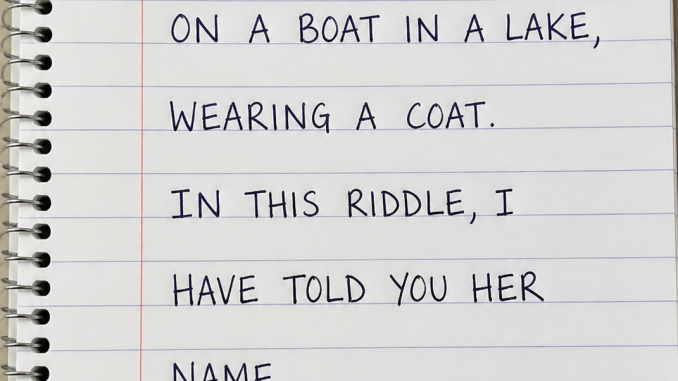
At first, this riddle sounds like a simple description:
- A woman
- Sitting on a boat
- In a lake
- Wearing a coat
Naturally, your brain starts searching for clues:
- Is her name hidden in the sentence?
- Is it something related to “boat,” “lake,” or “coat”?
- Is there a wordplay or hidden meaning?
That’s exactly what the riddle wants you to do — overthink it.
The Key Line:
The most important part is:
“I have told you her name.”
This tells you the name is already in the sentence — not hidden, not coded, just plainly stated.
The Trick:
Look at the very beginning:
“There’s a woman…”
Break it down:
- “There’s” = “There is”
So the first word is “There.”
The Answer:
Her name is “There.”
Why This Works:
The riddle uses a common word (“There”) in a way that makes you ignore it. Since we’re used to seeing “there” as just part of a sentence, we don’t think of it as a name.
But the riddle cleverly says:
“I have told you her name”
And it did — right at the beginning.
Final Thought:
This is a classic example of a riddle that plays with attention and assumption, not logic or math. The answer is simple once you stop overanalyzing and read it literally.