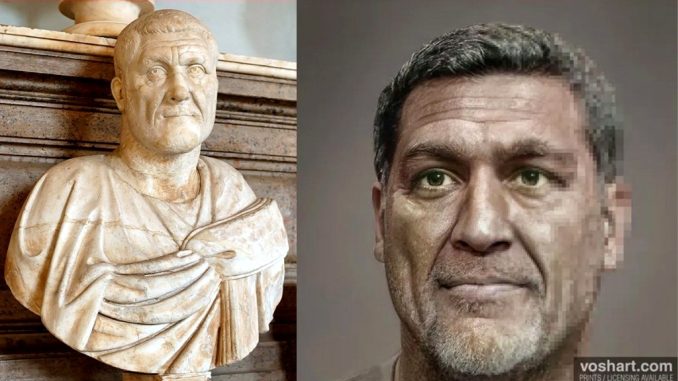
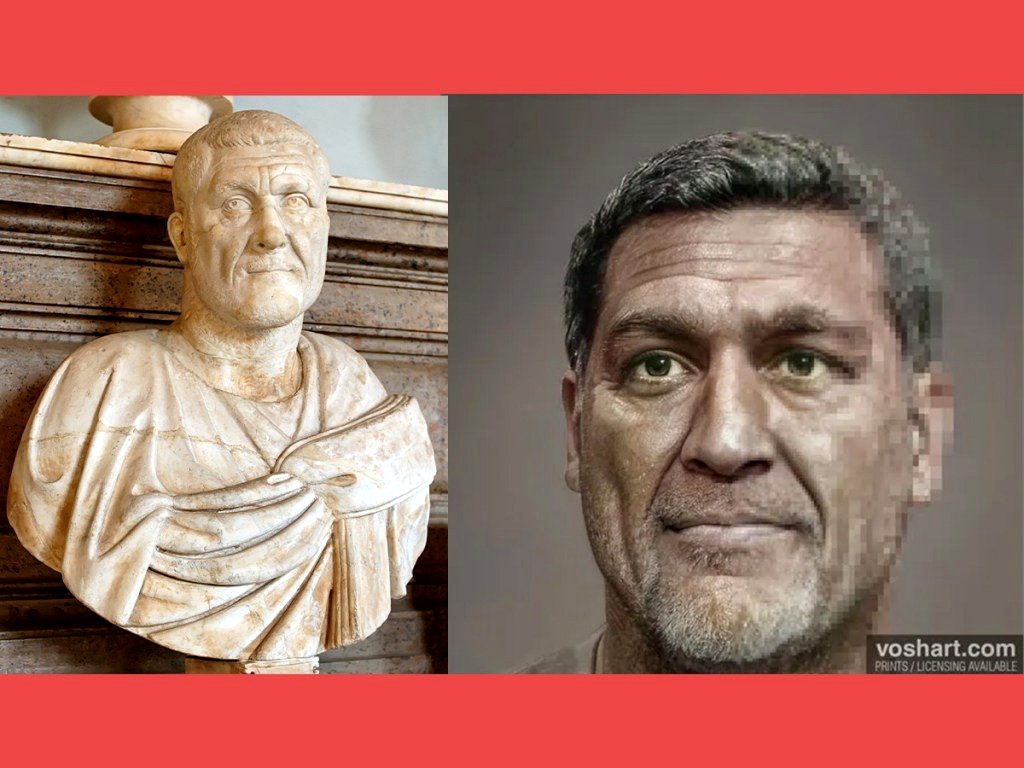
Canadian designer Daniel Voshart has created realistic digital portraits of ancient Roman emperors. He based his work on historical sculptures and other sources to recreate their faces with detailed accuracy. Some of these emperors, who lived nearly 2,000 years ago, resemble people you might see today during your daily commute. Voshart’s Roman Emperor Project started in 2020, focusing on creating lifelike digital images of Roman rulers. Over time, the project expanded to include 54 emperors from the Principate period, which spans from 27 BC to 285 AD, providing a vivid view of powerful figures from history that are often seen only in marble.
Voshart explained to Upworthy that he didn’t initially have a strong interest in Roman history. He thinks that this lack of bias actually helped him in his work. He aimed to focus only on aspects that could affect how the emperors looked. Voshart was not preoccupied with studying their lives as individuals.
Instead of examining their personalities or historical reputations, Voshart concentrated on details that could influence their physical appearances. Among the figures he portrayed were Marcus Aurelius and his adopted brother Lucius Verus, who jointly ruled the Roman Empire. Their reign from 161 to 169 CE was marked by wars and a severe epidemic.
One of the difficulties in recreating the faces of these ancient figures is figuring out how accurately surviving sculptures represent them. Roman portraits did not always strive for perfect likeness. According to The Metropolitan Museum of Art, some sculptures were idealized and may not truthfully reflect the emperors’ actual ages or appearances.
Voshart found that understanding when certain sculptures were created and the ages of the emperors at those times influenced how he portrayed their faces. Learning about the vanity involved in creating these portraits made him realize that an uninformed representation would simply repeat a version of history that might not be accurate.
There are also challenges with additional details. While marble sculptures can capture facial features and hairstyles, they often do not show a person’s natural hair or eye color. However, an emperor’s place of birth and ancestry can provide hints to guide the interpretations. Voshart’s portraits are recreations rather than exact representations. Still, by adding realistic skin, hair, and eye colors, the faces feel much more relatable than their stone versions.
Interestingly, some of the emperors in Voshart’s collection could easily fit into modern life. For instance, Hadrian’s beard and short hairstyle wouldn’t seem out of place today. Similarly, Marcus Aurelius, with his thick curls and full beard, might remind someone of people they know.
What do you think about these modern interpretations of ancient figures?
Sources:
Source: Upworthy, by Mark Wales