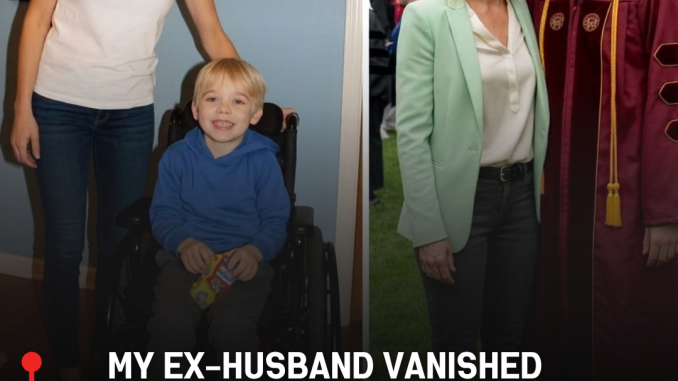
The day my son was born should have been the happiest day of my life.
Instead, it became the moment everything changed.
There was the future I had imagined for our family—and then there was the life I suddenly had to build on my own.
Henry was barely three hours old when the doctor entered the room.
I can still remember the smell of antiseptic, the quiet beeping of the machines, and the tiny weight of my newborn against my chest. His little fingers were wrapped around the fabric of my hospital gown as though he already knew he needed something to hold on to.
The neurologist spoke softly.
Almost too softly.
She explained that Henry had a neurological condition that would affect his motor development. He would need therapy, ongoing support, and a level of care that would make his childhood different from what most parents expected.
I listened and nodded, even though my mind was struggling to process everything.
But Warren—my husband—understood.
He didn’t ask questions.
He didn’t come closer.
He didn’t reach for our son.
He simply stood near the window, staring outside as though he wanted to be anywhere but there.
Then he turned toward me.
His face was distant.
Cold.
“I’m not doing this, Bella.”
Six words.
That was all.
He picked up his jacket, took his keys, and walked out of the hospital room without looking back.
There was no argument.
No shouting.
No dramatic goodbye.
Just absence.
I stayed.
Because I had no choice.
Because Henry deserved someone who would.
The years that followed weren’t the kind of inspirational story people like to imagine. There was no perfect montage of progress and triumph.
There was exhaustion.
There were bills.
There were insurance forms, endless phone calls, appointments, and paperwork.
There were nights when I sat on the floor beside Henry’s bed, carefully stretching his legs while he cried from frustration and I fought back my own tears.
Physical therapy became part of our routine.
So did fighting with systems that seemed determined to make everything harder.
I learned something very quickly:
Pity doesn’t help.
It only makes people feel better about themselves.
People occasionally asked about Warren.
They always lowered their voices, as if his absence were something delicate.
“How is he coping?”
Eventually, I stopped pretending.
“He left,” I’d say. “He walked out before we even left the hospital.”
The shocked expressions on their faces never lasted long.
Because after everyone went home, I still had to be the one figuring out what came next.
But Henry kept surprising everyone.
Including me.
By the time he was seven, he had already developed a sharp mind and an even stronger determination.
He refused to accept limitations simply because someone else had decided they existed.
I remember sitting in a school office while a counselor gently suggested that Henry consider a “less demanding path.”
Henry looked directly at her.
“Do you think I can’t do it,” he asked, “or do you just not want to help me try?”
I almost laughed.
That was the moment I truly understood him.
He wasn’t defined by what he couldn’t do.
He was defined by what he refused to give up on.
Therapy didn’t just make him physically stronger.
It taught him discipline.
He worked harder than anyone I’d ever known.
While other teenagers were outside having fun after school, Henry was studying.
By fifteen, he was reading medical articles at the kitchen table, turning pages as casually as if they were comic books.
One evening, he looked at me and said something I’ll never forget.
“I don’t want to be the patient people talk over. I want to be the doctor who actually listens.”
That was when he decided he wanted to become a physician.
Not despite everything he’d experienced.
Because of it.
The road ahead wasn’t easy.
Nothing about our lives had ever been easy.
But year after year, Henry kept moving forward.
School.
College.
Medical school.
Every accomplishment felt like something we’d fought for together.
We were a team.
And somehow, we made it.
Then, just before his graduation, the past came knocking.
Warren had found Henry.
After twenty-five years of silence, he suddenly wanted to come back into his son’s life.
Not during the difficult years.
Not when Henry needed him.
Not when the bills were piling up or the therapy sessions seemed endless.
Now.
When his son was about to become a doctor.
Now he wanted to be a father.
I was furious.
But Henry surprised me.
“I invited him,” he said calmly.
“Why?” I asked.
“Because I don’t want him telling the wrong version of the story.”
His answer stayed with me.
Graduation day arrived.
The auditorium was packed with families, cameras, proud parents, and smiling graduates.
Then Warren walked through the doors.
He looked almost exactly as I remembered him.
Polished.
Confident.
Comfortable.
As if he belonged there.
As if he had earned the right to stand beside us.
He approached Henry with a smile.
“You’ve done well for yourself, son,” he said. “You don’t even walk with a limp.”
Henry said nothing.
He simply nodded.
And waited.
When his name was called, Henry walked across the stage with steady steps.
No hesitation.
No embarrassment.
No apology.
Then he reached the podium.
The room became completely silent.
He didn’t begin by listing his accomplishments.
He didn’t talk about awards or academic achievements.
Instead, he told a story.
Our story.
He talked about the day he was born.
About the diagnosis that changed our lives.
About a man who walked away because fatherhood had suddenly become harder than he expected.
The atmosphere in the room changed.
People stopped shifting in their seats.
The silence became heavier.
More uncomfortable.
More honest.
Then Henry talked about me.
Not with exaggerated praise.
Not with some perfect description of motherhood.
Just the truth.
He talked about the woman who stayed.
The woman who showed up every morning.
The woman who fought through the difficult years.
The woman who carried him through every moment when his father chose not to.
Then he looked toward me.
And said:
“Everything good in me learned your name first, Mom.”
The auditorium erupted.
People stood.
Applause filled the room.
And I couldn’t stop crying.
Not because of the recognition.
Because I finally understood what all those years had meant.
I never looked at Warren.
I didn’t need to.
He hadn’t come because he had earned his place.
He had come looking for pride.
For validation.
For a moment beside a son whose hardest years he had missed.
Instead, he received the truth.
After the ceremony, Henry found me in the hallway.
For several seconds, neither of us spoke.
We didn’t have to.
Everything that needed to be said had already been said.
Warren left quietly.
There was no confrontation.
No dramatic apology.
No final speech.
Just silence.
But this time, the silence didn’t hurt.
Not the way it once had.
Because that silence no longer belonged to us.
It belonged to him.
For twenty-five years, I carried the weight of being abandoned.
I wondered what our lives might have looked like if Warren had stayed.
I wondered how much easier things could have been.
But standing there that day, watching my son own his story, I finally understood something.
We hadn’t lost everything when Warren walked away.
We had built something.
Something stronger than absence.
Something greater than disappointment.
Something louder than twenty-five years of silence.
Henry had become the man he always believed he could be.
And I had been there for every step.
For the first time, the story wasn’t about the man who left.
It was about the mother who stayed.
The son who refused to give up.
And the life they built together.
For the first time in twenty-five years…
the story was finally ours.